
12,989 views ·
14 replies
13k views
14 replies
Can you lay a thin layer of concrete directly on a brick floor
I have an old house where 4 out of 6 rooms in the basement have concrete floors, but 2 of them do not; instead, they have bricks laid directly on the ground. The basement doesn't have standing height and will mainly be used for storage, and possibly as a small rough workshop where you would have to sit down to work. Since it's difficult to clean a brick floor, I would like to have concrete there as well.
Can I apply a thin layer, about 10 mm over the stones, or what is the minimum thickness I can apply?
I was thinking before pouring to vacuum between all the stones so that the mortar also goes a few cm down between them and locks them a little further. Is that a good idea?
Or does it perhaps not work at all to pour on the bricks?
Can I apply a thin layer, about 10 mm over the stones, or what is the minimum thickness I can apply?
I was thinking before pouring to vacuum between all the stones so that the mortar also goes a few cm down between them and locks them a little further. Is that a good idea?
Or does it perhaps not work at all to pour on the bricks?

First, you need to ascertain that the bricks are fixed to the floor and not loose! If they are loose, you will never achieve a durable concrete floor with such a thin slab. Instead, it's better to remove the bricks and pour a slab with rebar.
This is not my area of expertise, but shouldn't leveling compound be the right product for what you're looking for? That is, what we often call self-leveling compound. Check the manufacturers' product pages and see if it works on brick. It should, I feel spontaneously.
Follow-up question: if you have self-leveling compound (flytspackel), is it hard enough to walk on or can you protect the surface with something?

The stones are loose in the sense that they are not "glued" to anything underneath them. They rest on old lakebed sand where they've likely been for about 100 years. All stones except for a couple lie steadily on the sand.
One of the already finished floors has a much smoother and "denser" surface than the other two. I suspect that some sort of flowing floor material was used there.
I would like to apply some of that on the other cement floors as well to achieve the same nice surface if the budget allows it, but the brick floors have higher priority.
And if now 10mm on "loose" brick is too thin a slab, how thick does it need to be then?
One of the already finished floors has a much smoother and "denser" surface than the other two. I suspect that some sort of flowing floor material was used there.
I would like to apply some of that on the other cement floors as well to achieve the same nice surface if the budget allows it, but the brick floors have higher priority.
And if now 10mm on "loose" brick is too thin a slab, how thick does it need to be then?

The largest room is approximately 4.5 x 4.5 m.

Why not remove the teglet and cast and reinforce the entire floor?
That's true, but in this case, it's a storage room without much wear, so I'm absolutely convinced that it will work, basically regardless of the type of filler, provided that the substrate is stable!Stefan N said:
I wouldn't be afraid to apply 10mm of fiber-reinforced levelling compound on your floor.C cwallentin said:The stones are loose in the sense that they aren't "glued" to anything beneath them. They are lying on old seabed sand where they have probably been for about 100 years. All stones except a couple lie steadily on the sand.
One of the already made floors has a much smoother and "denser" surface than the other two. I suspect that some floating floor material has been used there.
I would love to apply some of that on the other cement floors as well to get the same nice surface on them if the budget allows but the tile floors have higher priority.
And if now 10mm on "loose" tiles is too thin a slab, how thick does it need to be then?
What might happen if it's not completely solid is that you might get thin cracks, but that wouldn't bother me.
I like megaplan, https://www.hornbach.se/shop/MEGA-LINE-Megaplan-golvspackel-20-kg/7766239/artikel-detaljer.html
This is what a dried surface looks like, we had it like that for several weeks without issue before laying our floor.
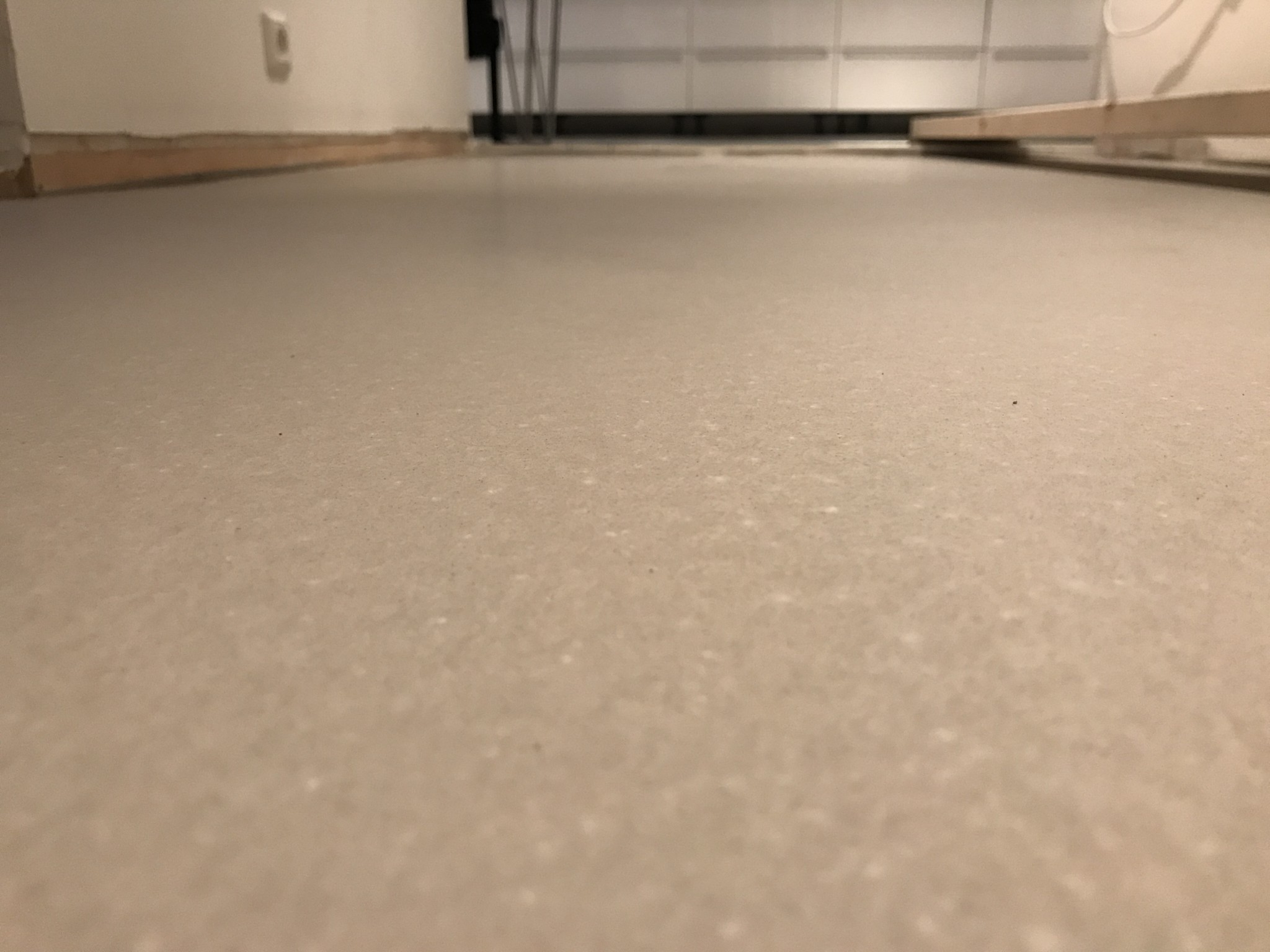
Right now, I have about 5 mm "cracks" around every brick, so a small crack is better than what it is 
If one is going to remove the brick, pour concrete, and reinforce, a completely different logistics is needed for the whole thing.
And if you start with larger measures, you end up with questions like:
If I remove the brick, shouldn't I dig down a bit as well to get standing height?
And if I do that in 3 out of 6 rooms, I might as well do it in the rest.
And if I've taken on that cost and have standing height, maybe the basement should be used for more than just storage.
Then I might need to re-drain and ....
Soon you're up to a lot of zeros
If one is going to remove the brick, pour concrete, and reinforce, a completely different logistics is needed for the whole thing.
And if you start with larger measures, you end up with questions like:
If I remove the brick, shouldn't I dig down a bit as well to get standing height?
And if I do that in 3 out of 6 rooms, I might as well do it in the rest.
And if I've taken on that cost and have standing height, maybe the basement should be used for more than just storage.
Then I might need to re-drain and ....
Soon you're up to a lot of zeros
But much more usable spaceC cwallentin said:Right now I have about 5 mm "cracks" around every brick, so some small crack is better than what it is
If you're going to remove the stone, cast and reinforce, a completely different logistics around the whole thing is needed.
And once you start with bigger efforts, you end up with questions like.
If I now remove the bricks, shouldn't I dig out a little too, so that I get standing height.
And if I do that in 3 out of 6 rooms, then I should probably do it in the others.
And if I have then taken that cost and have standing height, maybe the basement should be used for something more than just storage.
Then maybe I should drain again and .....
You'll soon end up with a lot of zeros
Click here to reply
Similar threads
-
Kan man "skala av" tunt lager betong från grundplatta?
Grund & Markarbeten -
Can you lay a thin layer of concrete on a stone floor?
Building Materials and Construction Technology -
Laying a thin layer of repair concrete on stairs?
Building Materials and Construction Technology -
Applying a new thin layer of plaster
Building Materials and Construction Technology -
Lägga Ett tunt lager flytspackel på gammalt golv?
Golv