
4,079 views ·
11 replies
4k views
11 replies
Can this apartment support 200kg/m2 (drawings included)?

Hello!
I'm wondering about the weight capacity of the floor in my apartment as I want to move in something quite heavy, about 200kg. I'll be at the point too, so it will be 300kg, but it won't be static, only when I'm there!
I recently got hold of the old blueprints and I'm wondering if someone could help identify what type of flooring it is and whether it would handle 200kg/m2. The building was constructed in 1938/1939.
Blueprints are included, one side mentions flooring and concrete etc., but I don't have the understanding to make an assessment.
I also have an image highlighted in yellow where my apartment is; it's "Hall" or "Room" where I'm planning to place this heavy object. The first choice is where the red square is marked with an x.
I'm wondering about the weight capacity of the floor in my apartment as I want to move in something quite heavy, about 200kg. I'll be at the point too, so it will be 300kg, but it won't be static, only when I'm there!
I recently got hold of the old blueprints and I'm wondering if someone could help identify what type of flooring it is and whether it would handle 200kg/m2. The building was constructed in 1938/1939.
Blueprints are included, one side mentions flooring and concrete etc., but I don't have the understanding to make an assessment.
I also have an image highlighted in yellow where my apartment is; it's "Hall" or "Room" where I'm planning to place this heavy object. The first choice is where the red square is marked with an x.
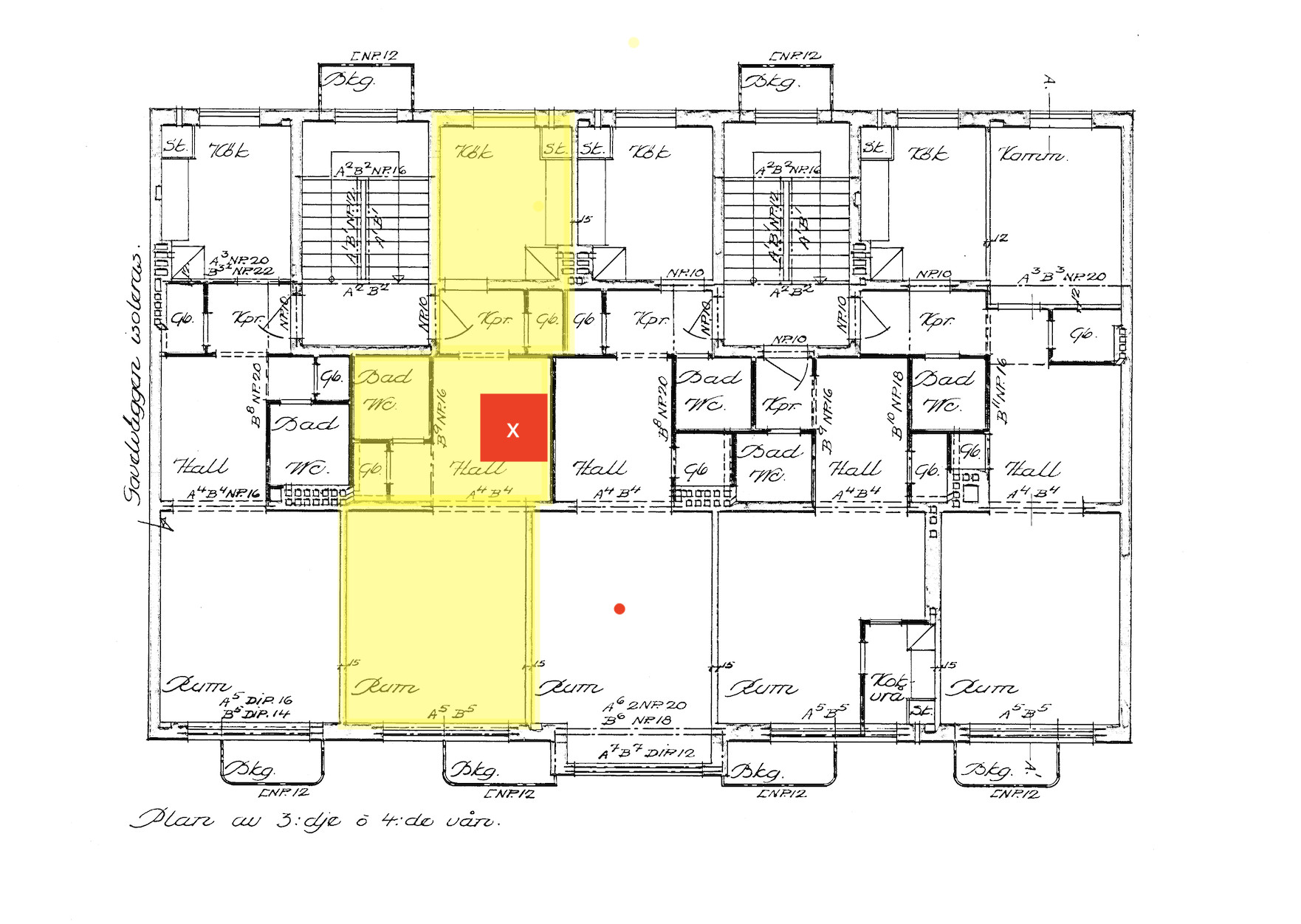
Last edited:

Glad to hear! Now, I think it will weigh around 200kg by itself, but when I stand by it, it will go up to 300kg (I should have written that in my first post, DOH!). I'm curious, how much could it handle, if you know that? And thanks for the answer!Rickard.ag said:



The house was built before the first building codes were introduced in 1946. However, the Building Statute for the Kingdom's Cities from 1874 applied, which included requirements for local building regulations. What applied in Malmö can certainly be found out. The building's floors consist of alternating concrete (staircases, bathrooms, etc.) and wood (most of the apartments). It is evident from the section that the floor joists are consistently 5x10 inches, i.e., 125x250 mm. This corresponds to 45x350 mm in modern dimensions. Quite sturdy indeed! A point load of 300 kg is not much in that context.

Electronics enthusiast
· Västra Götaland
· 671 posts
A bit OT but what are you going to set up that weighs 200kg?
I assume you've seen the section drawing somewhere else because I can only see the plan drawing above. Interesting with such robust joists, it would be even more interesting to know their spacing distance and the maximum span they were used for.J justusandersson said:The house was built before the first building codes were introduced in 1946. However, the Building Charter for the Cities of the Realm from 1874 was applicable, which included requirements for local building regulations. What applied in Malmö can certainly be found out. The building's floors are alternately concrete (staircases, bathrooms, etc.) and wood (most of the apartments). It is clear from the section that the floor joists are consistently 5x10 inches, i.e., 125x250 mm. This corresponds to 45x350 mm in modern dimensions. Sturdy stuff indeed! A point load of 300 kg is not much in this context.


Click here to reply