
22,320 views ·
18 replies
22k views
18 replies
Can I tear down this wall? Is it load-bearing? Drawing available
I reason like this, based on the information you've provided about the house. Which isn't much. It is possible that the carpenters you have had there see more of the construction and therefore draw other conclusions. However, it is not uncommon for carpenters to knock down load-bearing walls.
The walls are very thin. This suggests that they may be non-load-bearing interior walls. Normally, you build thicker if it is to support something. However, this is far from certain. How does the same wall look in the apartments below?
However, the floor plan suggests that the load-bearing structure runs along the house and that the wall across is load-bearing. That is, the brick walls constituting the continuation of the beam/column frame support the roof. This wall then supports half of the roof in your apartment. (If this is the case, there should be no load on the wall you’ve already removed, so don't draw too large conclusions from this.)
If you calculate low (with a concrete floor structure), you get: 2.4*0.1*5=1.2 tons/m just for the floor structure. To this, you then add the roof itself and snow load. But you don't know where these loads are transferred. They might go directly into the concrete frame, impossible to say.
In addition, walls also have a stabilizing function. They simply prevent the house from blowing over. It is, however, less likely that your brick walls are working this way, but it's a possibility.
Either you need nothing at all, or you need a proper beam. This can be made of wood, steel, or concrete. But if it is needed, it's not something one guesses about. Invest in a structural engineer instead of glue-laminated beams. They can be found even during vacation times.
The walls are very thin. This suggests that they may be non-load-bearing interior walls. Normally, you build thicker if it is to support something. However, this is far from certain. How does the same wall look in the apartments below?
However, the floor plan suggests that the load-bearing structure runs along the house and that the wall across is load-bearing. That is, the brick walls constituting the continuation of the beam/column frame support the roof. This wall then supports half of the roof in your apartment. (If this is the case, there should be no load on the wall you’ve already removed, so don't draw too large conclusions from this.)
If you calculate low (with a concrete floor structure), you get: 2.4*0.1*5=1.2 tons/m just for the floor structure. To this, you then add the roof itself and snow load. But you don't know where these loads are transferred. They might go directly into the concrete frame, impossible to say.
In addition, walls also have a stabilizing function. They simply prevent the house from blowing over. It is, however, less likely that your brick walls are working this way, but it's a possibility.
Either you need nothing at all, or you need a proper beam. This can be made of wood, steel, or concrete. But if it is needed, it's not something one guesses about. Invest in a structural engineer instead of glue-laminated beams. They can be found even during vacation times.
Couldn't find an engineer.Krawk said:I reason like this, based on the information you've provided about the house. Which isn't much.
It's possible that the carpenters you had there see more of the construction and therefore draw different conclusions. However, it's not uncommon for carpenters to knock down load-bearing walls.
The walls are very thin. This suggests they might be non-load-bearing interior walls. Normally, you build thicker if you're going to support something. However, this is far from certain. How does the same wall look in the underlying apartments?
The floor plan suggests that the joists support along the house and the wall across is load-bearing. That is, the brick walls that continue the beam/pillar frame support the roof.
This wall then supports half the roof in your apartment.
(If this is the case, there should not be any load on the wall you have already demolished, so don't draw too big conclusions from this.)
Calculating low (with a concrete floor) you get: 2.4*0.1*5=1.2 tons/m just from the floor. To this comes the actual roof and snow load. But it's unknown where those loads are transferred down. They might go directly into the concrete frame, impossible to say.
Additionally, walls also have a stabilizing function. They simply prevent the house from being blown over. It's less likely that your brick walls function this way, but it's a possibility.
Either you need nothing at all. Or you need a real load transfer. This can be of wood, steel, or concrete. But if it's needed, it's not something to guess at.
Spend the money on a structural engineer instead of glulam beams. It's possible to find such even during vacation times.
The floor above my apartment is concrete. Regular wooden trusses hold up the outer roof.
I went with the golden middle way. Kept parts of the walls and made a load transfer.
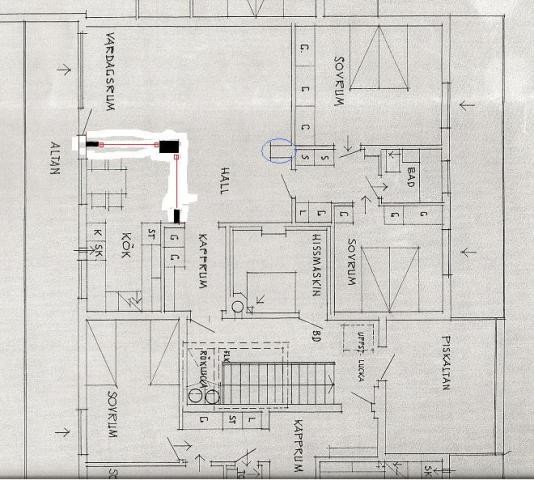
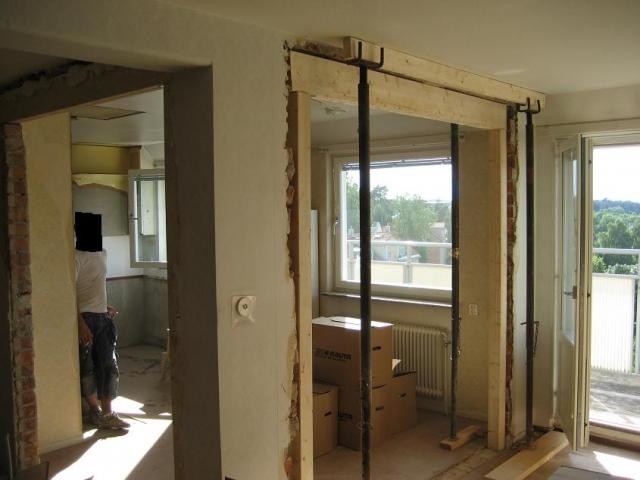
I left a part of the wall from the outer wall (40 cm). Then, of course, the concrete pillar remains opposite. It has dimensions of 50 * 30 cm. In between, there was a load transfer (width approx. 210 cm) with glulam beam/pillar (see picture). Dimension of glulam post 90*90 mm, Glulam beam 2*42*180mm = 84*180mm.
The wall towards the hall was also left 40 cm. There, I did a load transfer with glulam beam/pillar where one end rests on the wall I left. Dimension of glulam post 90*90 mm, Glulam beam 2*42*180mm = 84*180mm.
See the pictures below: (The black markings are existing wall, the red marks the glulam beam and glulam posts).
What do you think?
Last edited:
I still think there is a very small risk that these walls are load-bearing. It just feels incredibly unnecessary to put in glulam beams if they aren't needed. How much did these cost? Wouldn't it have been cheaper to bring in a structural engineer?
On the other hand, I shouldn't be sitting here writing what you should and shouldn't do
Hope it turns out for the best, so far it looks good.
On the other hand, I shouldn't be sitting here writing what you should and shouldn't do
Hope it turns out for the best, so far it looks good.
Click here to reply