We are in the process of renovating our living room and kitchen and are planning for an open floor plan, which means a load-bearing wall between the kitchen and living room must be replaced with a beam that needs to be recessed into the upper floor structure since we want to continue with tall cabinets from the kitchen into the previous dining room.
We have now run into issues with a carpenter who inspected the project before the summer and said there were no problems but that he couldn't get to it before summer. We were careful to mention that the beam should not hang lower than a maximum of 9 cm from the existing ceiling (13 mm chipboard mounted on the floor structure). We also received a quote for the work using an HEA 160 beam.
After the vacation, it was suddenly not so straightforward, and a new calculation was required, and recessing the beam into the floor structure became very difficult. Additionally, the calculation guy was on vacation for 2 weeks.
After 2 weeks of waiting, during which according to our plan we should have installed flooring and ceiling, it suddenly turned out to be impossible to recess the beam, and we were offered an I-beam 160x83 and told we had to reconsider the kitchen... sigh.
We don't want to rethink our plans, and when I started googling load-bearing walls, I found quite a few threads here where people received help with calculations, and I hope there's someone who can assist.
Our house is modular and the floor structure consists of prefabricated modules that are 2x9m, and the house has 5 such modules. Each module consists of 22mm chipboard on top (as floor for the upper floor), 48x220 beams spaced approx. 33cm apart, and 13mm chipboard underneath (as the ceiling).
The trusses are also attached to these modules, so they also take up the tensile force generated by the roof.
The exterior walls are stud walls 48x120 spaced at 60cm, and the load-bearing wall is 48x70 spaced at 30cm. However, the load-bearing wall is not in the middle; it's 3.8m in the living room and 5.2m in the kitchen area. The central wall in the crawl space foundation is in the middle of the house, meaning the load-bearing wall is not directly over it.
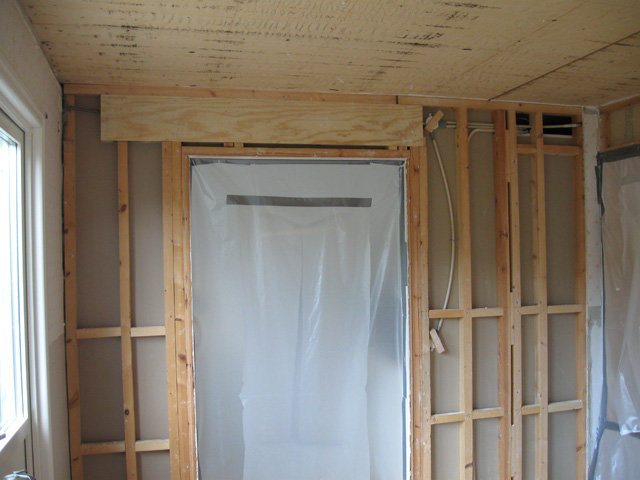
The door opening between the kitchen and living room is currently reinforced with a piece of plywood (10mm, 23cm high) on each side. See the picture.
The kitchen is 2.4m wide, which is also the width the beam needs to support. On the right in the picture, you can see the seam between the two modules. Just to the right of the seam, there are two studs closely placed together, marking the end of the kitchen.
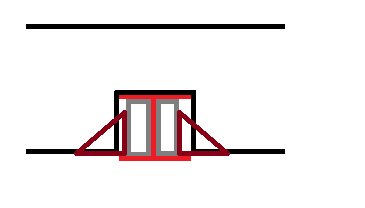
Since I assume you want to make as few interventions in the floor structure as possible, an HEB beam might be preferred (?). If you also bolt a stud on each side of the steel beam's web, you could use joist hangers to attach the beams to the floor structure. I have a sketch made in paint, but the dimensions may not be to scale...
Grateful for any help we can get.
Our new kitchen arrives in a week, and it's getting urgent, even though we thought we had plenty of time.
Not sure if I understand the description. But I interpret it as you needing a beam with about a 2.4m span? It shouldn't be a problem to integrate it into the joist.
We did an extension on a part of the house. We got an HEA 180 beam with about a 5m span in the ceiling. The joists were then inserted into that beam. We have about a 4m span in the transverse direction from the steel beam.
In practice, it became two identical steel beams since we have a staircase that comes up in the middle of everything. So, there was a steel beam on either side of the staircase.
Have you talked directly with the engineer?
One thing that's easy to forget is how the beam should be supported. It creates a very large point load at the support point. In many cases, that load must be carried by a column that, in the worst case, has to be extended down and founded below the basement floor.
No, we haven't spoken directly with the structural engineer as all communication has gone through the carpenter. We have tried to contact some structural engineers here in the GBG area but only got a response from one who was fully booked until October...
I don't think the attachment to the outer wall will be a problem since the outer wall is practically straight on a beam in the lower floor, which in turn stands on the foundation wall (rough concrete beam). The problem would lie at the other end, especially if the partition wall isn't directly under the load-bearing wall.
I've been thinking about this a lot since yesterday, and since we want different ceilings in the kitchen and living room, I've concluded that it's not a problem if the beam goes down 8cm below the floor joist, which would mean that you only need to make incisions of about 8cm in the floor joist with a HEA160 beam (which was the first suggestion).
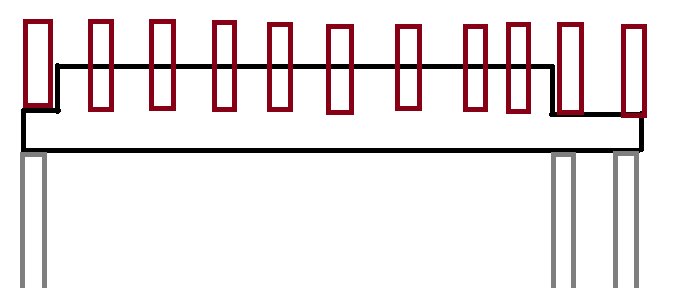
A continuation of that thought is if you take a significantly longer beam than 2.4m, maybe you could notch the beam to spread the load over a larger area on the right side, see sketch...
The black is the HEA beam.
Click here to reply
Vi vill skicka notiser för ämnen du bevakar och händelser som berör dig.