Hi, I was thinking of building a zip line at home between two sturdy trees with the option to secure it behind the second tree. The distance is about 60 meters and it should hold an adult. My question is what type of cable and what thickness is needed?
A complete wire calculation is not very easy to do. However, you can build towards safety with a higher safety factor and a conservative calculation.
I've actually just built a zip line for the kids (yes - for myself too, of course), so I'll share some of my experiences.
To begin with, besides the length, you need to know how much sag you want under different loads (or can tolerate, as it affects how high up the wire needs to be set in the trees). I calculated that I wouldn't scrape the ground myself while making sure the wire and all suspension components can also withstand trees moving up to 3-4 cm in opposite directions during strong winds. I'll share some rough calculations, but keep in mind they are only rough without accounting for stretching and dynamic forces. I'm also not an expert on wires, so there may be inaccuracies that someone knowledgeable can point out .
In my case, with a 38-meter wire and 2-meter drop height, I chose to tension the wire according to approximately the following (all sag in the middle).
Unloaded sag (self-weight total about 25 kg): 50 cm
Sag with seat+rope+tandem pulley 35 kg total: 70 cm
Sag with a child riding weighing 55 kg: 100 cm
Adult sag 125 kg total: 150 cm
For adults, this provides an approximate load of 1500 kg in the wire and 750 kg at the ends. This is just a trigonometric setup of the force components.
Starting from this, I wanted a safety factor of at least 3 for adults (it's about 5 for children). Therefore, I chose a wire from Swedol with a 10 mm diameter and 216 strands with a breaking strength of 5300 kg. You don't want to be known as the one who killed the neighbor's child with the zip line wire, right?
With the same calculation for sag with your 60-meter wire (which may have at least a 12 mm diameter = at least 45% more self-weight per meter), I get about 3400 kg load in the wire for an adult weighing 90 kg. For a typical 12 mm wire, this is a safety factor of just over 2, which might be a bit low. If you can allow a sag of 2 meters or more for adults, you're approaching a safety factor of 3 or more. These calculations should also be conservative.
I would start there, then you have to calculate what it means in terms of mounting height in the trees (it might be around 5+ meters high). I had to build a proper ramp for this, which luckily will also serve as a sledding hill.
Then you need good attachments otherwise. I've used a combination of shackles (3 at each end) and ratchet straps x 2 at each end (2-ton workplace, 4.8-ton breaking strength). To make them last over time and for the sake of the trees, I placed 5 mm rubber (Biltema) between the ratchet straps and the tree.
During installation, you'll benefit greatly from pulleys, ratchet straps, winch, etc. Hand power unfortunately doesn't get you very far . Make sure not to damage any component to be used in the suspension, as it can greatly affect the breaking strength.
Standard wire locks are also not approved for this. There are some called IronGrip. I wasn't able to get these myself unfortunately, so that's currently my weakest link.
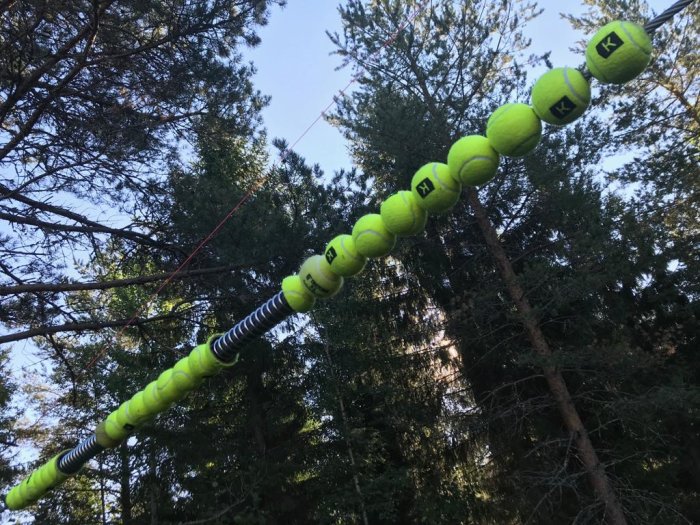
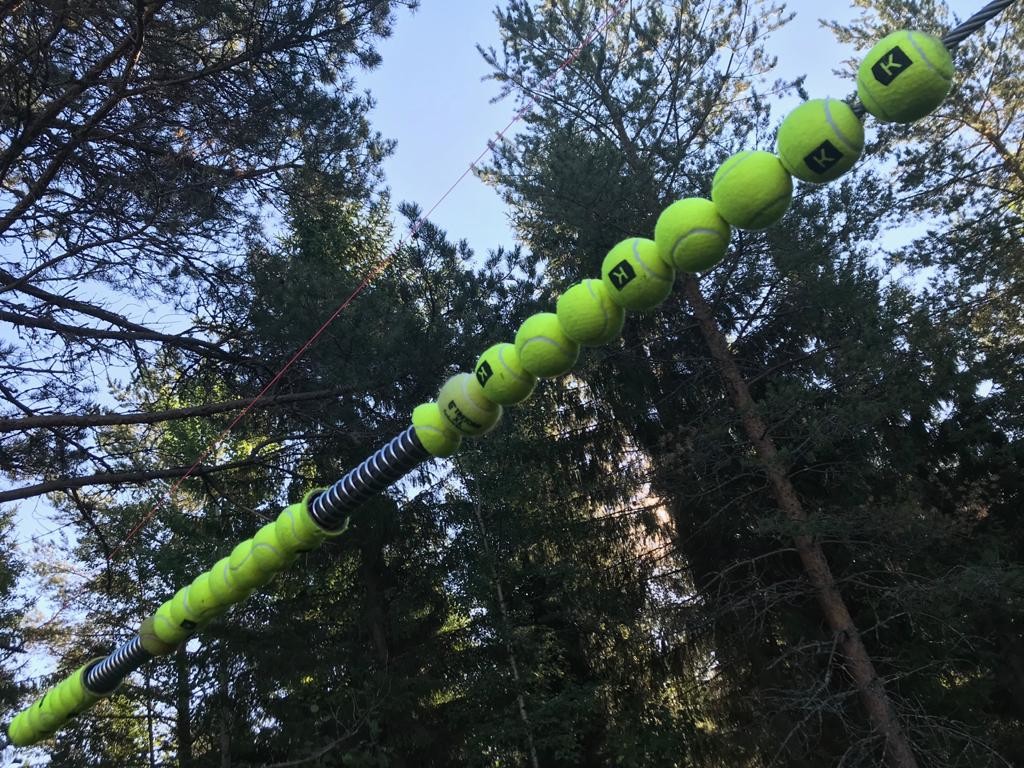
The damping was a custom solution. Could share some pictures if there's interest.
I'm interested in the damping! Bought a ready-made zipline but since there is no damping it has to go quite slowly for the children to be able to stop. Guess if it's fun when it goes slowly?
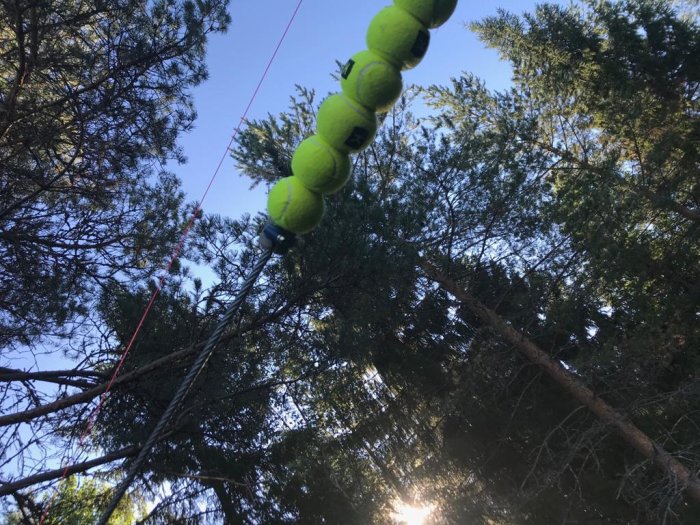
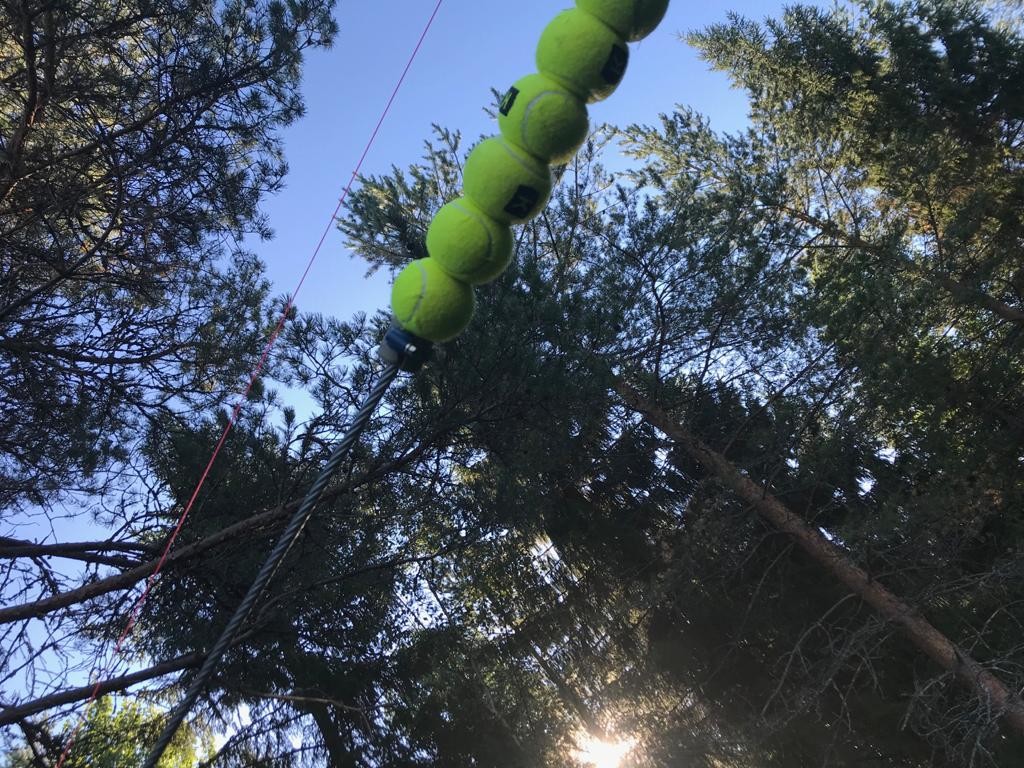
This damping is basically a typical home hack since it was nearly impossible to find ready-made damping or a long spring at a reasonable price. Components:
Tennis balls (2x12 pack Jula)
Fence spring
Pipe insulation (between spring and wire to protect the wire)
Rubber doorstop at the end
Pipe clamp (to clamp the doorstop onto the wire)
You can easily exclude the spring+pipe insulation. I took them because I had them lying around gathering dust.
It may look a bit rough but works excellently as damping !
There was a good damping. My concern is that the handle will break when it hits the damping. Our zipline is something the wife bought for a lot of money. What have you used as a "cart" or glide wheel or what should one say?
I don't know what the handle on your zipline looks like. But since the pulley hits tennis balls, I can't see anything breaking (except the tennis balls, of course). We don't have a handle; instead, you hold onto a synthetic hemp rope that is attached to the pulley. The pulley is called Petzl Tandem Speed. Works well actually!
I also looked at "expensive ready-made" ziplines first, but they fell away due to limited length and weight! (You want to ride yourself too). This turned out to be significantly more expensive anyway, but it was probably worth it.
I don't know what the handle on your zipline looks like. But since the pulley hits tennis balls, I can't see anything breaking (except the tennis balls, of course). We don't have a handle but you hold onto a synthetic hemp rope that's attached to the pulley. The pulley is called Petzl Tandem Speed. Works well, actually!
I also looked at "expensive ready-made" ziplines first, but they were ruled out due to limited length and weight! (You want to ride it yourself too). It turned out to be significantly more expensive in the end, but it was probably worth it.
Plundraren
Hi Plundraren. I've read your posts in this thread with great interest, as I have my own plans for a longer zipline. I have a small forest plot, so there's plenty of trees available, but when I read about the forces you've calculated when tensioning the wire, I become a bit concerned. My tallest trees are growing on rock, which makes me even more worried. There's both pine and spruce to choose from, if one is preferable over the other? It would indeed be interesting to hear more about how you've set up your arrangement, have you secured the forces on multiple trees, or secured in ground/rock? I think the higher up in the trees you tension the wire, the less force the trees can withstand? On the other end, I have the option to fasten to oak or beech, and I assume those trees are more stable and can withstand more forces, so I'm less worried about that.
Hi Plundraren. I have read your posts in this thread with great interest, as I have my own plans for a longer zipline. I have a small forest plot, so there is a good supply of trees, but when I read about the forces you calculated when tensioning the wire, I become a bit concerned. My tallest trees grow on stone, which makes me even more worried. There are both pine and spruce to choose from, if one might be preferred? It would certainly be interesting to hear a bit more about how you have tensioned your arrangement, have you secured the forces on several trees, alternatively secured in ground/stone? I think that the higher up the trees you tension the wire, the less force impact the trees can withstand? At the other end, I have the opportunity to attach to oak or beech, and I assume these trees are more stable and will withstand more forces, so I am not as worried there.
Cool! With all those trees, there are surely great opportunities to build a good zipline . I don't know how much moment a tree can withstand sideways, but with a zipline, you don't create forces directed from the root to the tree crown as there is somewhat with strong winds, so the limiting factor should not be uprooting the trees but rather breaking. As you say, the moment becomes larger with the attachment point higher up. For the trees to give way before the cable or anything else in the suspension gives way, you would need to make a substantial design! But of course, you should still choose a well-grown and, above all, healthy tree. My trees are pines, about 35-40 cm in diameter at the trunk at the attachment points approximately 4 meters up. I have not secured them in any other way. It is absolutely possible to do more advanced setups, anchoring in the rock etc. Regardless of what you do, don't forget that the trees move around the clock in the wind, and the suspension must be able to withstand wear and handle, for example, the attachment points moving unsynchronized with the wind. Here, there have been no problems with gusts of wind at 25m/s. That wind itself creates a greater bending moment on the tree than the zipline.
There is interest in how I've calculated this, so I’ll try to present it: I calculated the forces trigonometrically by breaking them down into force components. It's easiest to draw it on paper. I've placed the cable's own weight as a point load along with the person load in the middle of the cable, and assumed that the cable then forms the hypotenuse (h) in two mirrored triangles with the sagging* in the middle of the cable as the short leg and the horizontal distance (x) to the trees as the long leg. A vertical counterforce to the weight should then be created via the two force vectors extending along the hypotenuse (they are identical but mirrored through x). It then emerges that the magnitude of that force is g*(own weight+person weight)/sin(arctan(y/x)). This is the force in the cable. The force in the suspension is half of this, which in turn creates pressure and tensile forces in the trunk and a moment on the tree at the root that depends on the suspension height. I have not calculated these. But note that this is not a professional calculation but a very simplified model without, for instance, dynamic load, and I cannot guarantee that the calculation is generally adequate.
If you have the right conditions and can anchor a construction in rock, it's probably possible to build a good suspension of laminated timber!
*The sagging greatly affects the forces, and you can decide how much sagging you want and then size accordingly. During installation, you then need to pre-tension the cable enough to get the sagging you have in mind. Too little sagging can cause the cable to break if the zipline is hung on trees and the wind is strong. Too much sagging can wear holes in your pants at the rear.
Fun! With all those trees, there are probably great opportunities to build a good zipline . I don't know how much torque a tree can withstand sideways, but with a zipline, you don't create forces directed from the roots towards the treetop as you do with strong wind, so the limiting factor should not be uprooting the trees but rather breaking. As you said, the torque becomes greater with the anchor point higher up. If the trees were to give way before the wire or any other part of the suspension does, you'd probably need to beef up the dimensions significantly! But of course, you should still choose a well-grown and more importantly healthy tree. My trees are pines, about 35-40 cm in diameter on the trunk at the anchor points about 4 meters up. I haven't secured it in any other way. It's definitely possible to make it more advanced, like anchoring in rock or similar. No matter what you do, you mustn't forget that the trees move around the clock in the wind and that the suspension should withstand wear and handle, for example, the anchor points moving asynchronously with the wind. Here, there haven't been any problems with gusts at 25m/s. That wind itself creates a larger breaking moment on the tree than the zipline.
If there's interest in how I calculated it, I'll try to present it: I calculated the forces trigonometrically by breaking it down into force components. The easiest way is to draw it on paper. I placed the inherent weight of the wire as a point load along with the person load in the middle of the wire and assumed that the wire then forms the hypotenuse (h) in two mirror-image triangles with the sag* in the middle of the wire as the short leg and the horizontal distance (x) to the trees as the long leg. A vertical counterforce against the weight should then be created via the two force vectors extending along the hypotenuse (they are the same but mirrored through x). It then turns out that the magnitude of that force is g*(inherent weight + person weight)/sin(arctan(y/x)). This is the force in the wire. The force in the suspension is half of this, which in turn creates push and pull forces in the trunk and a moment on the tree at the root, depending on the suspension height. I haven't calculated these. But be aware that this is not a professional calculation but a very simplified model without, for example, dynamic load, and I cannot guarantee that the calculation is generally adequate.
If you have the right conditions and can anchor a construction in rock, you can probably build a good laminated wood suspension!
*Sag impacts the forces greatly, and you can decide how much sag you want and then size accordingly. During installation, you then need to pre-tension the wire enough to achieve the sag you have in mind. Too little sag can lead to wire breakage if you hang the zipline in trees and it's very windy. Too much sag will wear holes in the pants at the backside.
Followed your argument above until you set up the formula to calculate the force. Would probably need a derivation to understand it. If even that would have helped, haha! Also tried to plug in some numbers, but the calculation didn't go well


 ), so I'll share some of my experiences.