
2,623 views ·
12 replies
3k views
12 replies
C24 or Glulam in pent roof cc400 or cc600?
Here are some questions that I am sure many experienced or knowledgeable people can help me with.
I am going to build an Attefall house with a mono-pitched roof with an 8-degree slope and metal roofing. In the future, solar panels will be placed on the roof.
I am debating which dimension for the roof joists to use.
Span between the outer wall edges is 4.5m
Overhang 400mm
Total length 5.4m
The designer has specified 45x220 C24 cc400, but what do I do with insulation? It involves a lot of cutting and waste.
Cut everything lengthwise or widthwise?
Thermal bridges in the roof? Not fun to deal with two layers when gravity comes into play.
I did some calculations myself and got approved for 45x220 C24 with the following premise.
Snow load 1.5 and metal roofing 0.55kN/m2 (or sedum 0.7kN/m2 as in the example to simulate solar panels)
Used Byggbeskrivningars excellent calculator
https://www.byggbeskrivningar.se/dimensionering/pulpettaksbalkar-och-balkar/
Or change to glulam 56x225 cc600 according to similar premises
- Twice as expensive in material (timber)
- takes a bit more roof height
+ easier with insulation, cc600.
I thought I would place the air gap on the inside of the joists so as not to affect the building height/interior ceiling height.
However, I realize it will be a huge job instead of laying it flat on top of the rafters and then nailing batten on top. Or is there another handy solution?
Thanks for now!
I am going to build an Attefall house with a mono-pitched roof with an 8-degree slope and metal roofing. In the future, solar panels will be placed on the roof.
I am debating which dimension for the roof joists to use.
Span between the outer wall edges is 4.5m
Overhang 400mm
Total length 5.4m
The designer has specified 45x220 C24 cc400, but what do I do with insulation? It involves a lot of cutting and waste.
Cut everything lengthwise or widthwise?
Thermal bridges in the roof? Not fun to deal with two layers when gravity comes into play.
I did some calculations myself and got approved for 45x220 C24 with the following premise.
Snow load 1.5 and metal roofing 0.55kN/m2 (or sedum 0.7kN/m2 as in the example to simulate solar panels)
Used Byggbeskrivningars excellent calculator
https://www.byggbeskrivningar.se/dimensionering/pulpettaksbalkar-och-balkar/
Or change to glulam 56x225 cc600 according to similar premises
- Twice as expensive in material (timber)
- takes a bit more roof height
+ easier with insulation, cc600.
I thought I would place the air gap on the inside of the joists so as not to affect the building height/interior ceiling height.
However, I realize it will be a huge job instead of laying it flat on top of the rafters and then nailing batten on top. Or is there another handy solution?
Thanks for now!
A great solution if you want to avoid cutting insulation is to ask a company to spray in insulation. It often results in very well-filled gaps, c/c widths matter less technically, it goes quickly, and if you consider not having to pick up insulation/order it home, handle it/dispose of any waste, you generally avoid having to deal with the hassle at all.
Superbly subjective answer indicating that insulating is a hassle and it's worth avoiding it.
I would also consider using lightweight beams. There are several suppliers, but they are easy to handle, and the increased height does not lead to any significant additional costs but provides good stability and better insulation value in the ceiling than 220.
My 2 cents.
Superbly subjective answer indicating that insulating is a hassle and it's worth avoiding it.
I would also consider using lightweight beams. There are several suppliers, but they are easy to handle, and the increased height does not lead to any significant additional costs but provides good stability and better insulation value in the ceiling than 220.
My 2 cents.
Sprayed insulation is not a bad idea either! Thanks for the tip. I can imagine the difference between the more expensive glulam beams and the cost of spraying insulation evens out.T Tsdoesds said:A great solution if you want to avoid cutting insulation is to ask a company to spray in insulation. It often provides very well-filled spaces, c/c widths matter less insulation-wise, it goes quickly, and when you factor in not having to pick up/order insulation, handle it/dispose of any excess, and generally not having to deal with the hassle, it's worth it.
Superb subjective answer implying that insulation is a hassle and it's worth avoiding.
I would also look into using lightweight beams. There are several suppliers, but they are easy to handle, and the increased height doesn't incur any direct huge costs but provides good stability and better insulation value in the roof than 220.
My 2 cents.
I want to keep the ceiling height as high as possible since the maximum building height is 4m for a small outbuilding. The roof will be a compromise, just like with many other things when it can only be 30 sqm.
It should work with 45x220s600 and by blowing in loose fill insulation between the studs👍
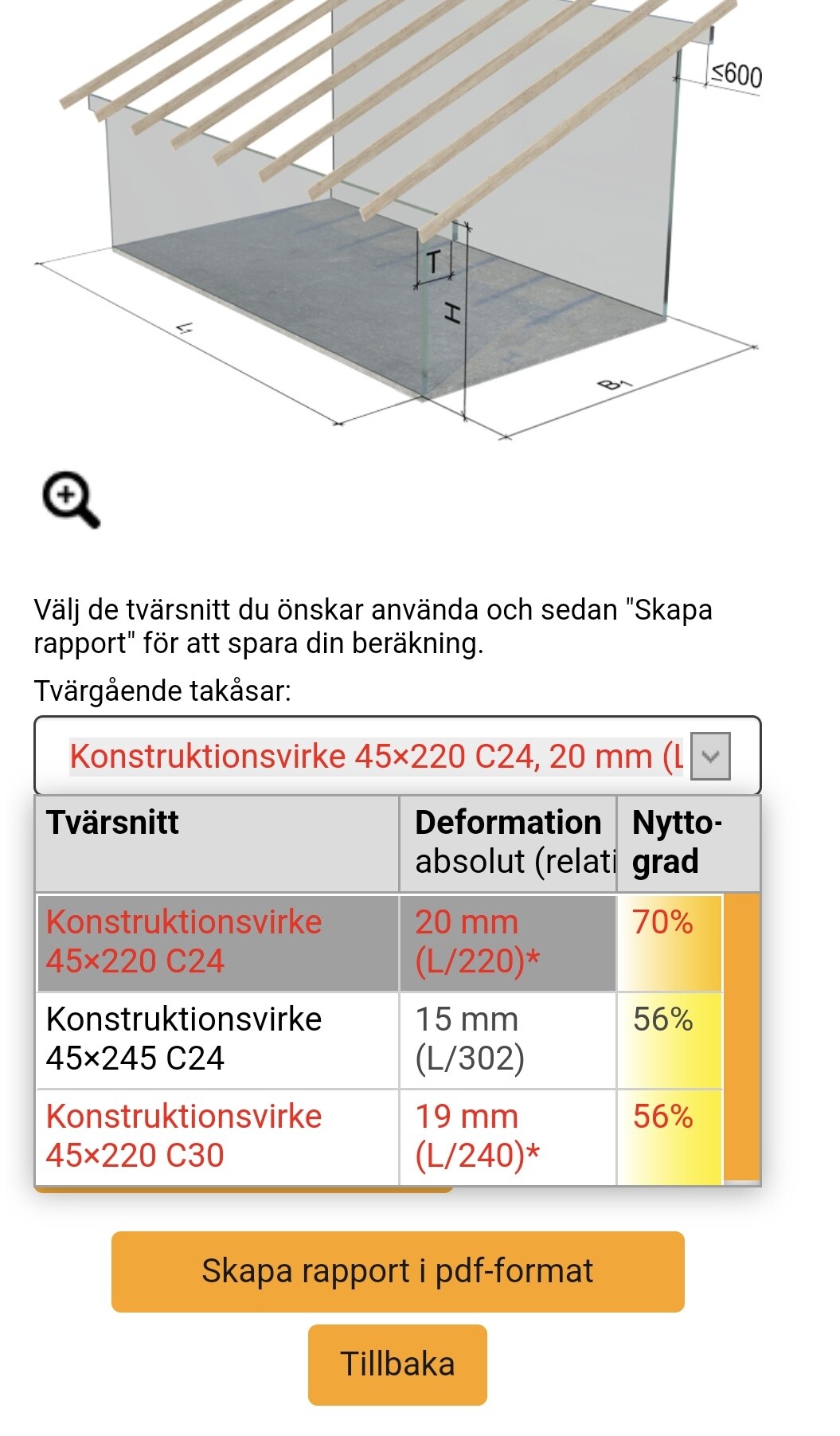
Calculating with a 4.5m span between the walls, 45x220 c24 cc600 with 1.5 in snow load zone and 0.7 kN in load, I'm finding that it's insufficient, as the deflection becomes too large?B bossespecial said:
I am attaching an image of the calculation.
Then there's the question,
Is the span considered as the outside of the frame wall or inside of the frame wall?
I place the reinforcement of the top plate on the outside.
Request a price for loose-fill insulation of the whole house and you'll see that it's not more expensive to have loose-fill insulation blown in than to do the insulation job yourself. Travel/setup costs become an unreasonably high proportion if you only have the roof insulated.
Which climate class is used in the calculation, as it has an impact on the deflection.
Yes, you're right about that. To get a decent price, it's essential to let them do the entire building.F fribygg said:
What different climate classes are there? And how do they affect the wood? That sounds exciting!B bossespecial said:
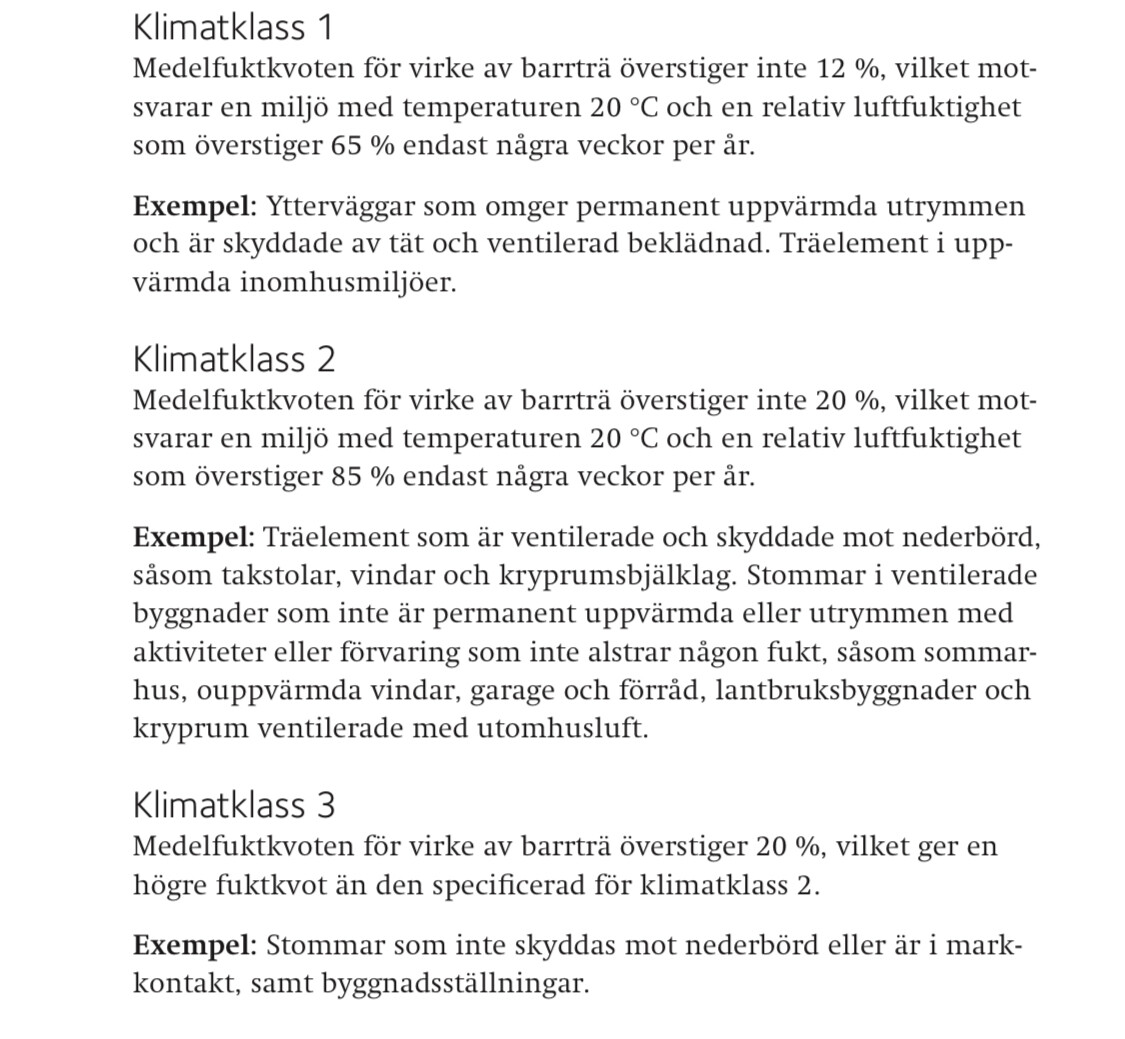
Thanks for the explanation!B bossespecial said:
It cannot be specified in the calculation, and I can't see it mentioned anywhere in the final calculation either.
The only thing that is stated is:
"Calculation standard: European Construction Standard - EKS12 (BFS 2022:4)"
Click here to reply