
22,563 views ·
26 replies
23k views
26 replies
Byggmax floor chipboard

I saw that Byggmax sells 2 different types of flooring chipboard. One is 240cm long, the other 180.
Does anyone know if there is any other difference in quality, other than the size?
Does anyone know if there is any other difference in quality, other than the size?
I believe that ByggMax carries the brands Puhos or Kronospan, quality P6; according to Puhos, these can't be joined between joists like those from Byggelit/Contifloor with their patented tongue and groove. Byggelit has a classification called V20 & V313, which I understand is actually a glue used in the manufacturing; V312 should be a moisture-resistant board, so that glue is probably better in damp areas.
Evaluating adherence is a jungle since V20 has been tested by Sitac and passed a so-called "Flooring grade," but in fact, it corresponds to P4 according to the European standard, and P5 corresponds to V313.
P6 seems to be somewhat stiffer according to the classification, but to really compare, one needs to look at, for example, Puhos specifications for their product and compare against the Swedish Board of Housing, Building and Planning's norms "Boverkets konstruktionsregler, BKR building regulations and building ordinance" where they specify how many mm a board can bend over a certain radius to qualify as an approved floorboard. I believe it’s also called NKB classification.
I have never quite grasped this, but if someone knowledgeable in the forum could shed some light on this, I would be immensely grateful.
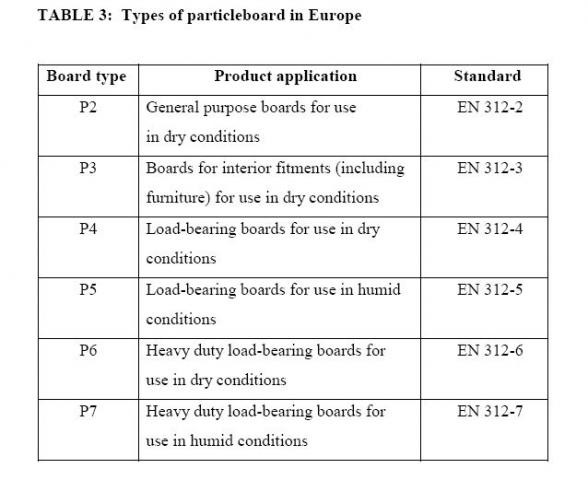
Attached is a table of P-classifications.
Evaluating adherence is a jungle since V20 has been tested by Sitac and passed a so-called "Flooring grade," but in fact, it corresponds to P4 according to the European standard, and P5 corresponds to V313.
P6 seems to be somewhat stiffer according to the classification, but to really compare, one needs to look at, for example, Puhos specifications for their product and compare against the Swedish Board of Housing, Building and Planning's norms "Boverkets konstruktionsregler, BKR building regulations and building ordinance" where they specify how many mm a board can bend over a certain radius to qualify as an approved floorboard. I believe it’s also called NKB classification.
I have never quite grasped this, but if someone knowledgeable in the forum could shed some light on this, I would be immensely grateful.
Attached is a table of P-classifications.

Question:jon_h said:
If you then use chipboard as a base for, say, 15 mm "parquet".
Shouldn't the subfloor + the parquet handle even the joins between joists?
I naturally realize that it becomes different if you're laying linoleum/vinyl
on top of the chipboard.
//KnockOnWood

byggmax flooring chipboard is almost as expensive as "real" chipboard (byggelit), with a difference of only 6-8:-, and considering that it can only be joined on battens, there can be a lot of waste, making it expensive to buy cheap at byggmax...

if you start counting the screw you make wrong, then you probably shouldn't renovate at all. the same goes for the glue string you take and apply. agree with you on the price difference, but we are only talking about byggmax in this thread.
best regards
snickar estwing
best regards
snickar estwing
if you want to get extra work, then ok, you can go ahead and splice with planks. on the bygg-max page, they do not inform that it cannot be spliced between the studs, nor do they have any link to the manufacturer or any product information.