
3,468 views ·
11 replies
3k views
11 replies
Built new retaining wall for basement stairs, moisture-proofing questions
Hello!
I have built a new retaining wall for our basement stairs to the house with leca blocks. I have also plastered the wall with the same mortar we used for masonry (weber base 222). Then I plan to use platon on the outside of the wall. Now to my actual question: It states that a membrane should be used at the bottom to further secure the wall, how important is that?
The leca wall is built on the old slab for the stairs and there is limited access outside the wall to reach lower than the top edge of the slab. I have tried to create a slope away from the wall at the bottom with mortar, but it's a bit difficult to access properly. How well will such a membrane work under these conditions? Do leca blocks need this type of moisture-proofing membrane or is the platon sheet sufficient?
I have built a new retaining wall for our basement stairs to the house with leca blocks. I have also plastered the wall with the same mortar we used for masonry (weber base 222). Then I plan to use platon on the outside of the wall. Now to my actual question: It states that a membrane should be used at the bottom to further secure the wall, how important is that?
The leca wall is built on the old slab for the stairs and there is limited access outside the wall to reach lower than the top edge of the slab. I have tried to create a slope away from the wall at the bottom with mortar, but it's a bit difficult to access properly. How well will such a membrane work under these conditions? Do leca blocks need this type of moisture-proofing membrane or is the platon sheet sufficient?
Ok, is it fine with just cold asphalt or is that moisture membrane better? I'm attaching a picture of how it looks. I'll get down to the end of the wall and there I've also built a slope out from the wall. However, I'll never get the Platon or anything else lower than the "slope" at the bottom..R rävlyan said:
The slab will be under the slope then, so to speak, it's basically what I've built the slope on. But on the other hand, the bottom slab has been unprotected for almost 70 years now, so for that, there will be no direct difference.
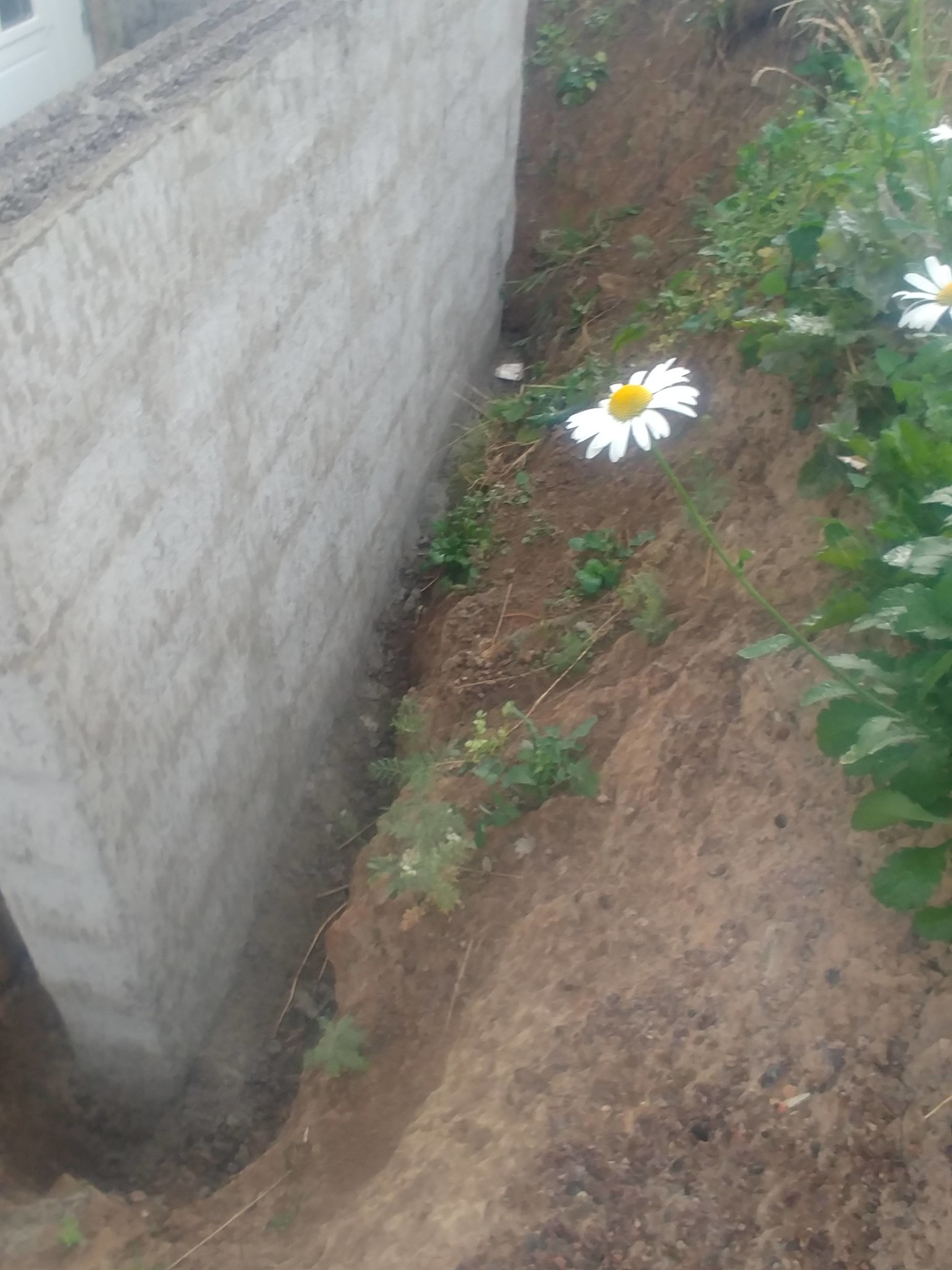
Try to apply a layer of kallasfallt (don't be stingy) as far down as possible and about 20 cm up, then the platon comes on the outside so it should manage quite well, the asphalt is to seal between the slab and your masonry. It has been like this for a long time with the wall as you say, it's just a little extra protection that might be needed.
I have now been to Byggmax and bought platon membrane, which you stick onto the wall. However, I'm starting to wonder how good it is to apply this. Both sides of the wall are outdoors, so if water comes in from the inside (the side of the retaining wall facing the basement stairs), you'd want it to go out somewhere, and by putting this membrane on the outside of the retaining wall, you effectively keep the moisture in the wall? But on the other hand, it's probably good since most moisture would come from the outside of the wall where there's soil and clay...
I guess I should put the membrane on and then put up platon and backfill. I have plastered the wall on both sides with Weber's base 222, so it should be possible to attach the membrane directly to the plaster layer, I guess, or shouldn't I have plastered where I'm placing the membrane?
I guess I should put the membrane on and then put up platon and backfill. I have plastered the wall on both sides with Weber's base 222, so it should be possible to attach the membrane directly to the plaster layer, I guess, or shouldn't I have plastered where I'm placing the membrane?
It's fine to apply oil to the wall on the outside of the plaster, about 20-30 cm up, then place plataton there and shovel back, as moisture or wetness is then stopped from the ground side. Should anything unexpectedly get into the wall, it evaporates straight through, as it's open there.
Ok, the lecan stands on a concrete slab so the water probably evaporates down to that... then the water goes some direction... Hopefully, the plaster doesn't crack. I bought a membrane that you stick on instead of painting it on, I assume it should be just as good or better? Or is it better to brush on kallasfast than to put this membrane?R rävlyan said:
( https://www.byggmax.se/gjutning-och...ring/fuktisolering-av-husgrund/membran-p21222 )

Click here to reply
Similar threads
-
Staket på ny stödmur av betongblock
Trädgård allmänt -
Måla med silikatfärg på nygjuten stödmur, hur länge vänta?
Färg, Måla & Tapetsera -
Byta ut ruttna slipers i stödmur mot nya
Trädgård allmänt -
Bygga stödmur på prickad mark - chans att inkomma med nya handlingar?
Juridik -
Riva stödmur inför ny grund
Grund & Markarbeten