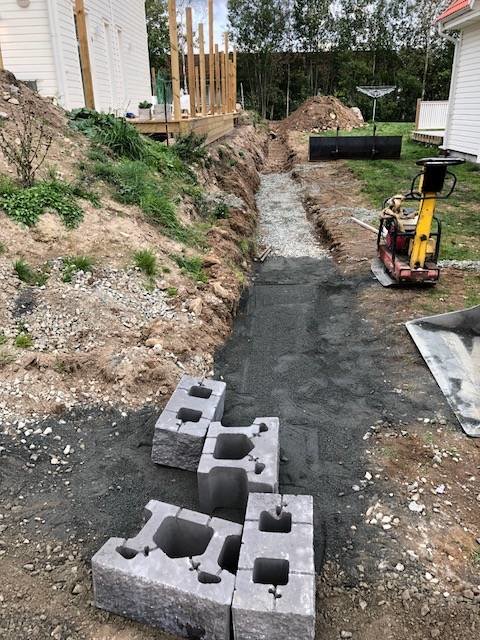
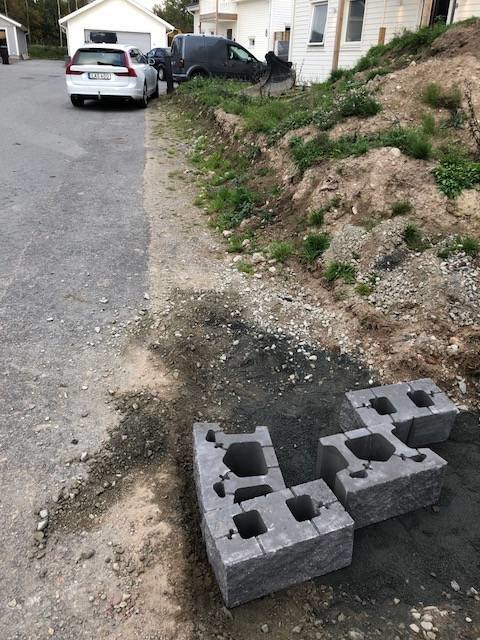
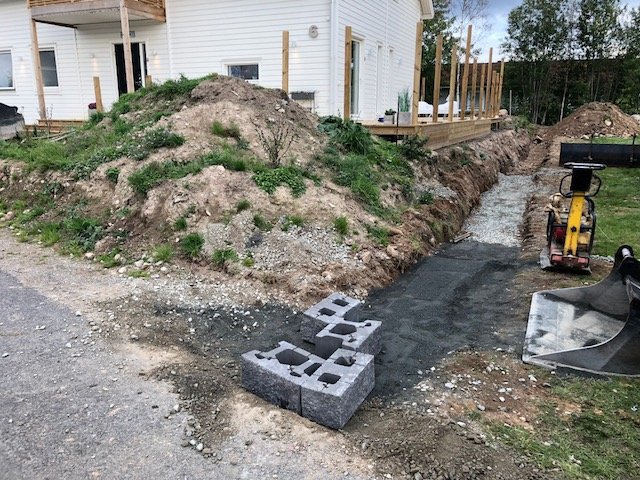
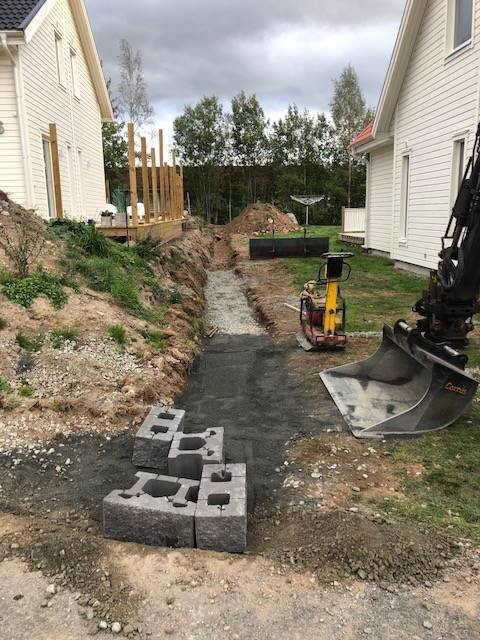
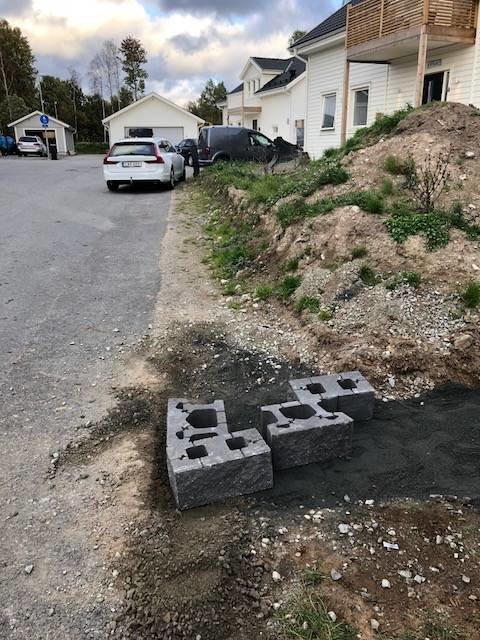
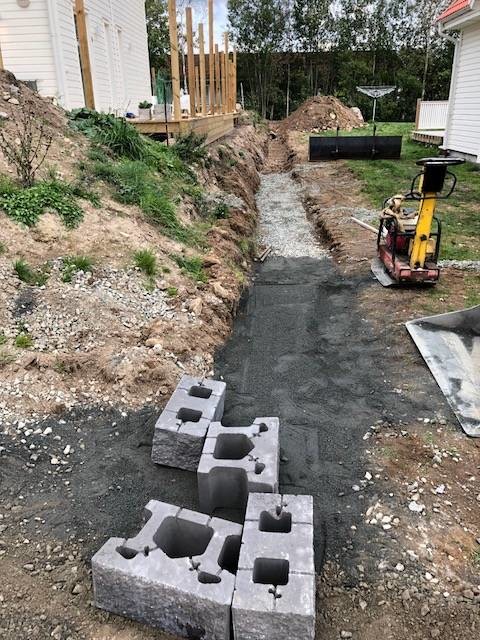
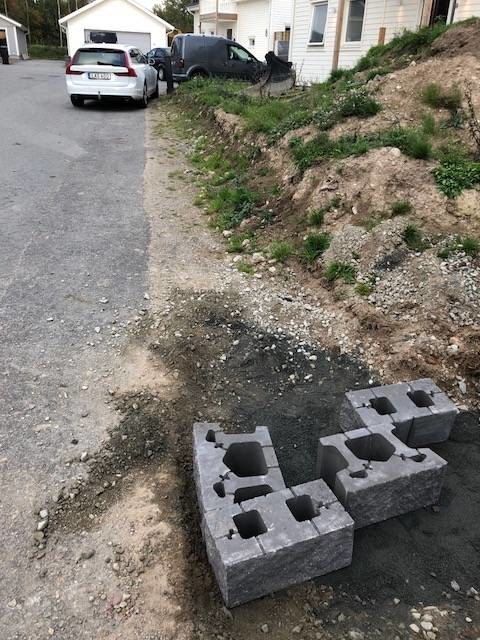
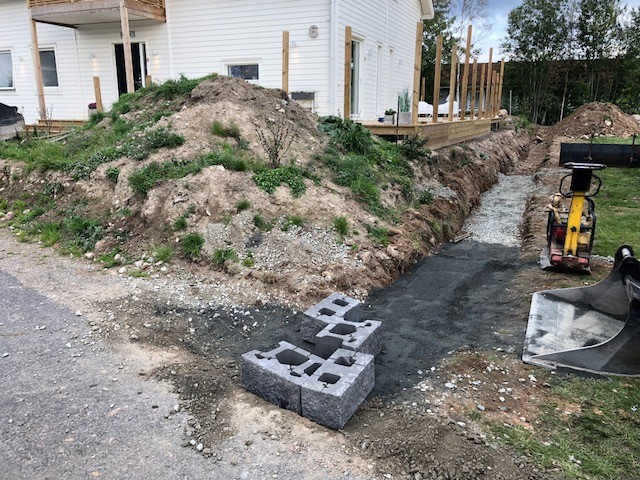
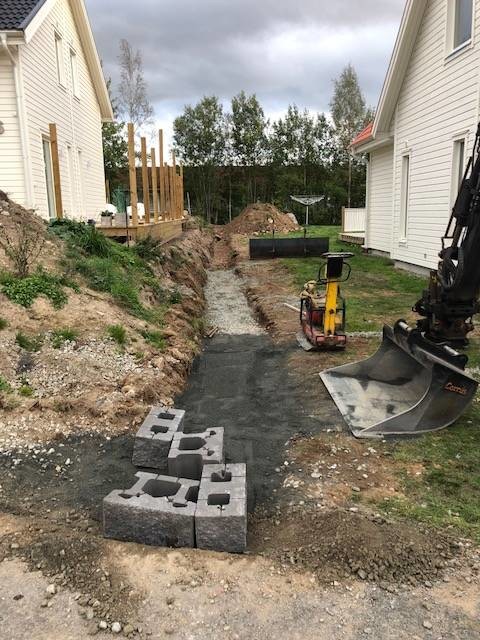
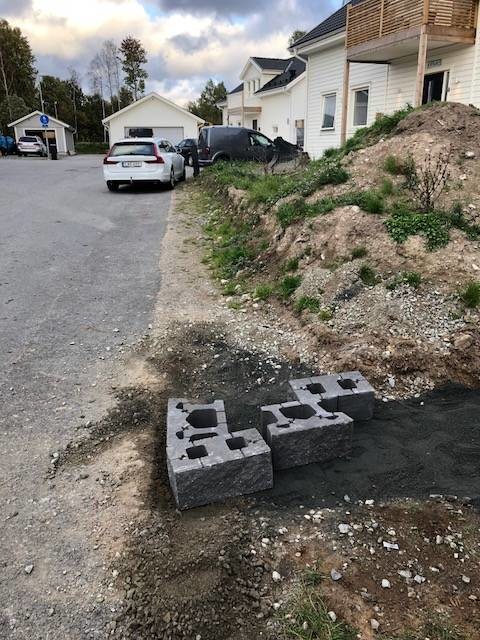
This weekend I will start digging for a wall that will be placed at the property boundary. The wall will form an L shape, 33 meters in one direction and 19 meters in the other.
I have purchased the stones.
Heda's compact, including edge blocks.
But now it occurred to me that I didn't really consider that the corner of the L is not 90 degrees.
It's probably more like 80 degrees.
How do I create a nice-looking corner?
The edge blocks have the same texture as the rest of the wall, which means I wouldn't want to cut them to get the correct angle.
But how should I do this to make it look nice?
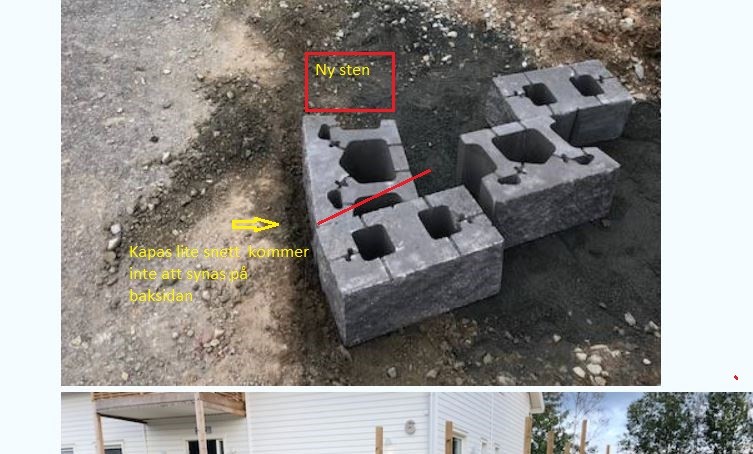
Not much to do, either cut or place tex bruk between in the corner. You say 80 degrees, then cut on the back side of one corner, so it doesn't show on the front side.
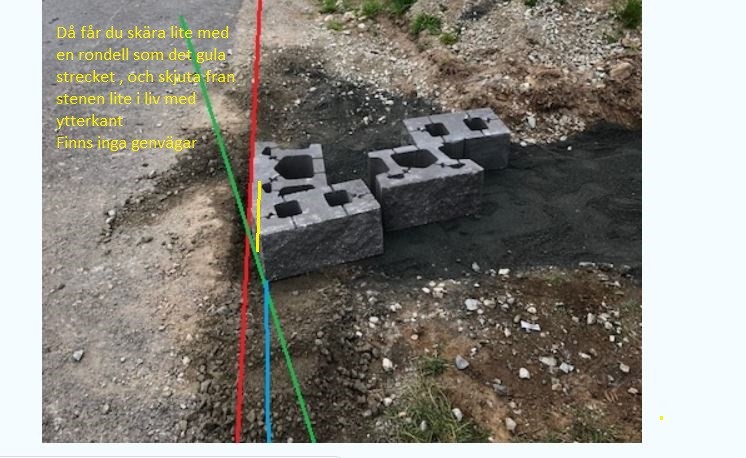
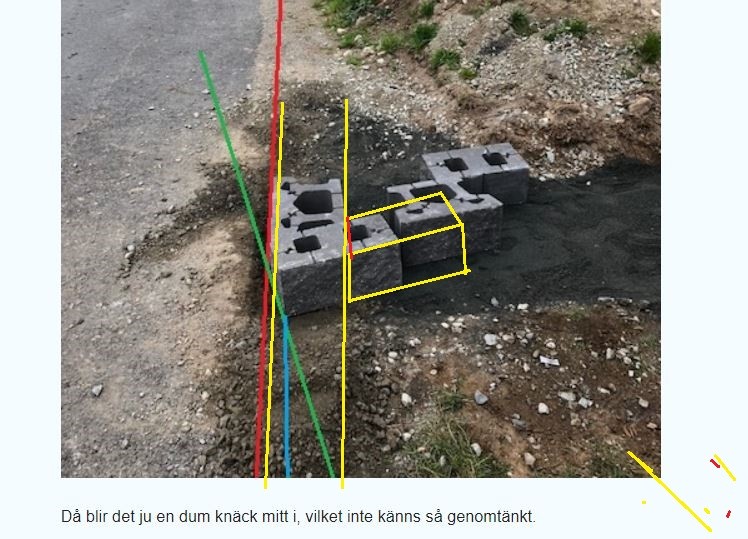
Attaching some pictures to make it easier to understand.
The idea is for the wall to form a "T"
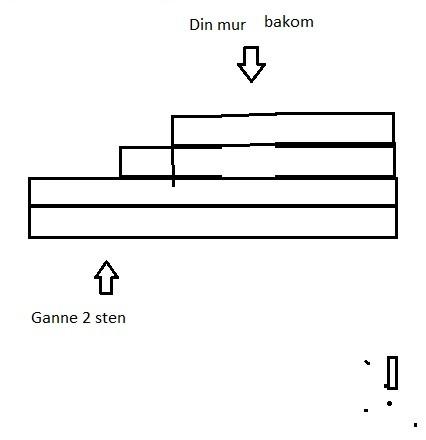
High wall on my front side and between the properties.
And then the neighbor only wants something like 2 stones high on their side.
This means I have to start from the road.
But then the 33-meter stretch ends up at an angle less than 90 degrees.
I don't understand what you mean by cutting at the back?
If I place the stone at an angle, one corner of the stone will always be outside the opposing stone. So it will always look odd.
See sketch, you can choose which way the wall should go, less than 90 degrees means cutting, greater than 90 degrees means filling in a bit on the backside in the angle.
Alright, then I'm with you.
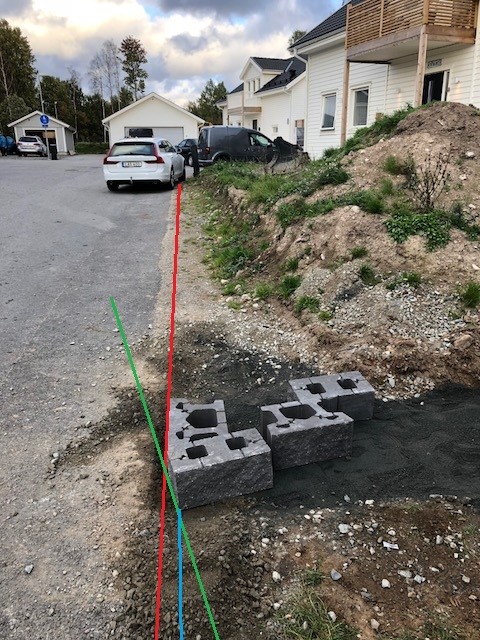
But then the stone that must travel the long distance ends up skewed in relation to the front.
Which means that the neighbor's stone ends up way off from the street's line.
Or you could just ignore it completely, and he can solve it however he wants.
But it feels best to solve this properly now.
So you simply mean to cut the entire front side so it's angled with the street then?
But how do you handle the surface texture?
It's not particularly nice with a cut surface outwardly seen
Lay out the entire yellow road, then you can cut a bit on the part that goes into your plot to get the angle. To make it stable in the corner, you can place some iron between each shift to hold it in place so it doesn't fall. It looks best if the neighbor agrees to a small step from your wall up to his in the corner just with some stone.
The stones should be offset 50%, then you'll need to calculate what to start with on the first row, a half or whole.
Yes, exactly. It will probably look the best to do it that way.
I was thinking of putting geoduk on two levels to hold back the masses.
So maybe that will keep the corner together.
I will talk to the neighbor tomorrow.
That will be the best solution.
If you place geoduk in the corner and under his stone, it should hold, but I would probably have some iron at the top between the shifts, nothing to skimp on, and you can sleep peacefully when it's done.
Common reinforcing steel 10 mm, approximately 0.5 - 0.6 meters long, (one length is 6 meters which is enough for 10 pieces), are you going to fill concrete in the cavities? Either carve out a little in the stones so they fit between them (the stones seem to be for block assembly) and concrete is filled in the holes, then the iron also adheres, which can also be good for the T to become strong. It's possible to drill with, but it's a bit more complicated and more work.
Okay, I'm with you.
The cavities are really just meant to be filled with macadam.
But of course, one could fill the stones that are in the corner with concrete.
Vi vill skicka notiser för ämnen du bevakar och händelser som berör dig.