
3,281 views ·
11 replies
3k views
11 replies
Building a new interior wall in the boiler room
Good evening.
I am in the middle of a heating system replacement and in connection with that, planning to fix the boiler room in the basement properly. I am considering tearing down a partition wall which is currently a blue concrete wall that is considered the "worst" type from a radon perspective, but I would like to proceed with my project with your expert help!
# 1: Steel/metal studs are to be used for both the floor/ceiling and all the studs in between, I assume?
# 2: No organic materials are recommended, but what type of drywall should be used? The other side of the wall is a guest room, so I want to be able to fill/joint the seams.
# 3: Insulating a partition wall is a big no, I guess? Because one of the studs would be attached to an exterior wall.
Thank you in advance!
I am in the middle of a heating system replacement and in connection with that, planning to fix the boiler room in the basement properly. I am considering tearing down a partition wall which is currently a blue concrete wall that is considered the "worst" type from a radon perspective, but I would like to proceed with my project with your expert help!
# 1: Steel/metal studs are to be used for both the floor/ceiling and all the studs in between, I assume?
# 2: No organic materials are recommended, but what type of drywall should be used? The other side of the wall is a guest room, so I want to be able to fill/joint the seams.
# 3: Insulating a partition wall is a big no, I guess? Because one of the studs would be attached to an exterior wall.
Thank you in advance!


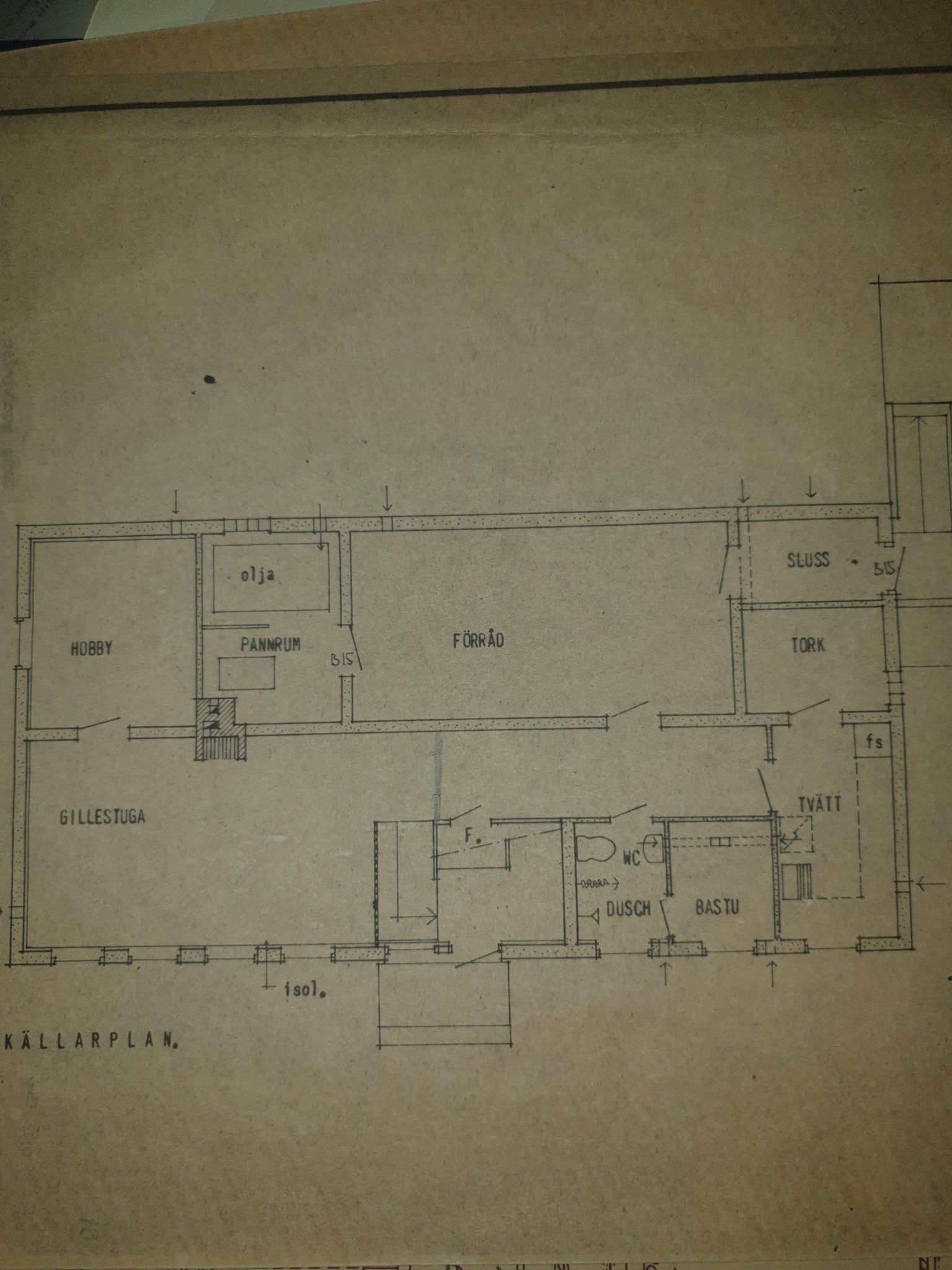
A floor plan as well as some general information about the house, year built, building type, etc., I think can stimulate responses. Otherwise, it easily becomes very general.
J justusandersson said:
It is the wall between Hobby and Pannrum that is 75 mm thick. Year built 1971 Concrete hollow block in the outer wall and hjärtevägg.J justusandersson said:
Unfortunately, being able to brick is not something one is born with. It's all about trial and error. A lecabrick wall is the absolute best material choice in this context (except for lightweight concrete, of course). You have to be meticulous. Make sure the wall is level and plumb. Use wide lecablocks and a mortar board. It can also be done with metal studs and plasterboard. Insulate the metal studs against the floor and walls with base paper or regular underlay paper. You can have insulation in the wall but no vapor-tight layers. Only the paper in the plasterboard is organic. There are completely inorganic alternatives as well.
I'm a bit pressed for time as an oil tank has to be cut out, tiles laid, and a new heating system installed at the same time. I think I'll go with steel studs for that part since I know how to do that. However, I've never done it in a basement, so should the wall base paper be closest to the floor and the outer wall?J justusandersson said:Unfortunately, being able to do masonry is not something one is born with. It's all about trial and error. A wall built with leca blocks is the absolute best material choice in this context (except for lightweight concrete, of course). One must be meticulous. Ensure that the wall is level and plumb. Use wide leca blocks and a mortar box. You can use steel studs and gypsum as well. Insulate the steel studs against the floor and walls with wall base paper or regular underlay paper. You can have insulation in the wall but no vapor-tight layers. Only the paper in the gypsum board is organic. There are completely inorganic alternatives as well.
And what kind of insulation is suitable for the wall?
And lastly, what are the organic alternatives to the board?
The paper should moisture-insulate the steel rule, so it should be closest to the concrete/concrete hollow block. I would use mineral wool, but most materials work. A completely inorganic alternative to gypsum is wet room board.
If you are going to build a plasterboard wall, make sure to lift the panels from the floor and outer wall at least 10mm so they cannot absorb moisture and deteriorate. Regular cardboard-clad plasterboard is a big no-no in basements as the paper will mold.
Under no circumstances should the insulation be regular glass wool as it smells when it becomes damp.
Keep in mind that if you are going to have a boiler or similar, there might be fire safety requirements for your new wall.
Framed constructions with panels in basements are always a risk construction.
Under no circumstances should the insulation be regular glass wool as it smells when it becomes damp.
Keep in mind that if you are going to have a boiler or similar, there might be fire safety requirements for your new wall.
Framed constructions with panels in basements are always a risk construction.
There will be an indoor unit of an air/water system, so no boiler and heat like an old wood boiler.Matti_75 said:
If you are going to build a drywall, make sure to lift the panels from the floor and outer wall at least 10mm so that they do not absorb moisture and deteriorate. Regular cardboard-covered gypsum is big no no in basements as the paper will mold.
The insulation must under no circumstances be regular glass wool as it smells when it gets damp.
Keep in mind that if you are going to have a boiler of some kind, there may be fire regulations for your new wall.
Framed constructions with panels in basements are always a risk construction.
Is it possible to spackle and tape wet room boards as usual? Maybe with fiberglass tape and wet room spackle?J justusandersson said:
Click here to reply