Your pictures don't show any direct oddities with your so-called "worn" concrete block but rather a reasonably good renovation object.
The water around the house needs to be removed regardless of what you're planning to do on site, and moisture in the walls that have been underwater can be dried out.
The walls don't seem exceptionally bad but are completely renovatable; it all depends on what you envision for the house in the future. Residential house, summer house, hobby space, etc........
My assessment is that the cost and effort for the operation you're asking about aren't in proportion to what it costs to tear down and build something new on the site. Even if you dismantle reusable parts like raw planks, roof trusses, floorboards, ceiling panels, and floor beams, it’s likely still cheaper than undertaking the operation of jacking up the construction to then elevate it and build new underneath.
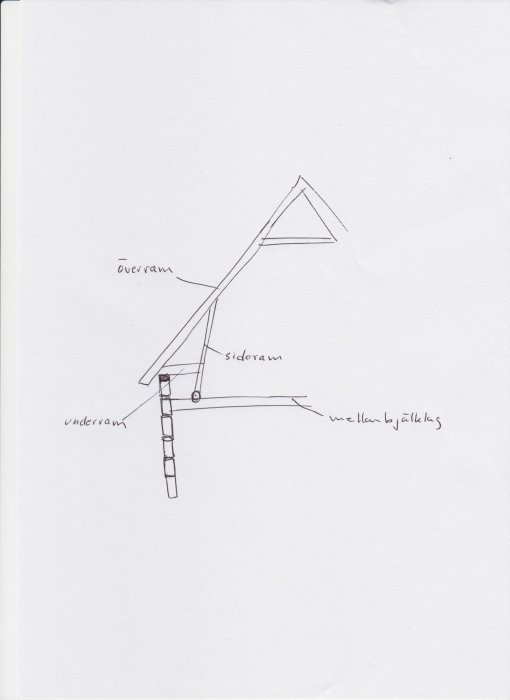
You have a classic old Swedish roof truss, which means you must support all the floor beams in the intermediate floor as they act as support for the side frame of the roof truss, and the floor beam is not an actual part of the roof truss.
You also need to ensure that there's support for the lower frame since it currently stands on the wall and is a direct part of the roof truss.
So, the workplace becomes full of supports where you need to demolish, excavate, and pour a new foundation for your walls, and then finally excavate the floor. All this work will be prolonged and made more expensive compared to just salvaging certain loose parts, efficiently demolishing, and building up from scratch, possibly reusing your saved parts.
A quick sketch for you to understand what I mean with my explanations about supporting the roof trusses.
So, the point is, why not renovate the existing walls of the house instead, as it can turn out really well!
Stamping is really when you place a vertical support leg under something that needs to be temporarily supported, if I haven't misunderstood.
What I actually mean is that you should build a truss construction with wooden studs that stand on the concrete slab and support the intermediate floor. So, a whole bunch of triangles, simply put. Triangles are incredibly sturdy, so it takes a lot before such a construction gives way. Then you do the same thing on the upper floor and support the roof. If possible, make some openings in the intermediate floor and connect the upper and lower parts with a few braces as well.
Here's a simple sketch of the principle. Proportions obviously don't match and the sketch only shows from one direction. A few such supports connected with braces in between and you're good to go.
Edit:
"Losing" the internet for quite a while and in the meantime, a lot of replies came in...
Of course, this can be done, I've done it myself.
The cost of this project versus demolition/rebuilding is obviously up to you. I myself got an old deck floor for free that was used for the truss construction. A few purchased studs and garage jacks for a couple of thousand plus a lot of my own labor and providing lunch and drinks to a bunch of friends for the lifting occasion cost me.
Since you're neither demolishing nor building new, you avoid demolition/permit costs and administration.
Basically, you can say this; if you find such projects fun, go for it. If you want to preserve the feel of the old house, go for it. On the other hand, if you just want it done, regardless of cost, then demolish and build new. Demolition/building permits are entirely up to you.
Are the walls that bad? I don't think it looks that way in the pictures. Drain so you get rid of the moisture and patch up the walls. Replacing with wood when it's already wet is doomed to fail.
After having carried out similar projects on a much smaller scale, I would have immediately advised against the plans to tear down the walls to build new ones. It always involves more than you think and it also risks causing settlements and more. The gables must also be completely removed, all the way up to the ridge, as they also rest on the existing walls. However, the gables should be easier since they don't support any roof trusses, so it should just be a matter of tearing them down after minor reinforcements in the attic, I guess.
You can also take down the entire roof and save the trusses, demolish the rest, and build a new frame. Then put the trusses back up again.
No, I would probably rather tear everything down and start anew. It would probably go much faster, and I wouldn't be surprised if it ends up being cheaper in the long run, considering the increase in value, etc.
But first and foremost, I would have tried to save and patch up the existing walls
I have concrete hollow blocks in my basement built in 1943. I agree that it's very porous when trying to attach something to it. I would also love to remove it but would never undertake such a job. The walls are unlikely to collapse, so I'll just plaster them on the inside and be a bit thoughtful when hanging heavier items on the walls.
My basement floor also resembles yours, and I definitely want to break it up to insulate and pour a new one with underfloor heating. It will be a matter of supporting the walls in a smart way then.
There may be different types of concrete block. I have an outbuilding from the 1930s, presumably, which is built with such blocks. There they have pretty much managed to fill all the cavities with concrete, so it is more or less solid. I made a hole for the chickens. That block was so damn hard it was like nothing else.
Thanks for all the opinions and tips. I will take this with me. Was there this weekend and scrubbed the green floor. The sump pump removed all the water, thank goodness. It feels much better now... and yes... I will probably try to repair the concrete instead of tearing it down. Need to consider the floor as well. Can you lay something like a Platon mat on it and then maybe a wooden floor on top? It probably needs to be non-tongue-and-groove so it doesn't become too tight.
Thank you for your long reply here, and the sketch. Yes, right now it feels like I'm worrying unnecessarily... I probably need to hold back on my crazy plans and look at it more realistically. Yes, the concrete floor should be able to be removed... it is a maximum of 4 cm thick, less in some places. Inside the house, that is. Under the walls, it looks like the concrete is thicker. I think the walls were built first and then they just "poured" concrete in the middle to create a floor. It's not a solid concrete slab under the house, if you know what I mean... Well, it's goodnight now... I'll try to take some close-up photos of the construction next time I'm there.
A Platon mat requires a smooth floor. If you instead choose a Nivell/Granab floor, it works with an uneven and poor floor. Nivell typically ventilates better than Platon.
I decided to chisel away the concrete floor... the continuation is in a new thread "chiseling away the concrete floor" not really sure how this works here with the threads... I thought it would continue here. but maybe someone here in this thread wanted to know the continuation so now you know where to find it! /Evalouise