1. I'm installing beadboard from floor to ceiling.
2. I want a chair rail at a height of 120 cm to separate the lower panel from the rest of the wall so that I can paint the panel below the chair rail a different color than above... Gray and white for example.
3. The upper edge of the chair rail will then have gaps where the tongue-and-groove goes under the rail. That could look bad. Or?
4. Maybe this rail on a solid tongue-and-groove panel doesn't work so well? Haven't seen it.
5. Traditionally, it was most common to have a smooth wall above the chair rail, but I want to avoid wallpapering and sanding, etc. And it's low to the ceiling, so a full-height panel on the wall could make it look taller.
6. Ideas and solutions?
It's a house from 1859 that was renovated... in the 60s... so everything is smooth now... the idea is to restore the old style. Real moldings, casings, and panels, etc.
The alternative if you want to align with how it was done in the past is either to paint all the beadboard in one color or to paint as you intended but instead of a trim, paint a narrow simple stencil or a simple line in a darker color that separates the upper part from the lower. It would probably look odd to add a trim as you mentioned.
Or to install horizontal paneling first and then beadboard at the bottom and chair rail. I've gotten a little fixated on having paneling on the entire wall unfortunately. The traditional way is a wallpapered wall. How do you build a completely smooth panel wall without sheets?
With tongue and groove, there will be a beveled gap. But beadboard at the bottom and a proper chair rail is necessary for it to look right.
It depends on what you mean by right. The traditional approach is exactly what I describe, that if you have paneling from floor to ceiling, it is either painted in one color or you have it two-toned with a thin line or narrow stencil in a darker color over the seam between the two colors. Alternatively, you place the stencil just above where the lower and darker color ends, in the same color as the lower darker one.
If you really want to be precise, you wouldn't have beadboard in such an old house; it became common only later. If you had beadboard, it was both wider and thicker than what is sold today. I haven't seen examples of the combination of horizontal/vertical paneling, and I've never seen examples of doing as you write with a chair rail in the middle, and I've seen many older houses.
It depends on what you mean by right. The traditional way is exactly what I describe, that if you have paneling from floor to ceiling, it is either painted in one color or you have it two-toned and make a thin line or a narrow stencil in a darker color over the seam between the two colors. Alternatively, you make the stencil just above where the lower darker color ends and in the same color as the lower darker one.
If you want to be really precise, you wouldn't have pärlspont in such an old house; it became common later. If you had pärlspont, it was both wider and thicker than what is sold today. I haven't seen examples of the combination of horizontal/vertical paneling, and I've never seen examples of doing as you write with a bröstlist in the middle, and I've seen many older houses.
Unfortunately, I can't quite agree with you because pärlspont came in the mid-1800s and was common in the latter half of the 1800s, disappearing in the 1920s.
Bröstning was probably most common, but fully paneled walls did occur, so it's likely a toss-up, but you are absolutely right that they were often painted in two colors. I'm more unsure about stencils and wonder if this isn't a modern invention.
But I also write that there was beadboard, but it was wider and thicker than what is sold today. Gradually, it became narrower and narrower, and there was even beadboard with a fake bead in the middle to make it look really narrow. I still maintain that it wasn't that common. It depends on what type of house it is.
I know for certain that stencils were used, as I have seen many examples of this.
It is quite possible that it was not beaded paneling to chest height. It might have been a coarser panel. Moldings, casings, etc. were, as I remember, rough, at least 100 mm wide. It was my grandmother's house, and she and grandpa had owned the house since 1920 or so. I don't think it had been renovated since the original build. The house was only about 60 years old when grandpa bought it from a very old lady. There was a wood-burning stove and tiled stoves, of course. Built with 3 chambers plus kitchen downstairs and an unfinished attic. Until dad renovated it in the 60s, all the old stuff was removed. Two of the chambers were merged and have exposed ceiling beams throughout, so it can be turned into a fine room. A couple of fine doors still exist, and there's probably some paneling left on a wall, so you can get the correct panel profile. If I undertake this, I'll plane everything to the original profile for sure. As I recall, it was similar to what is called a traditional profile when looking at the available plane blades. But you can bring out special blades. So we're still in the planning and feasibility phase!
As for the walls, it will likely be panel and moldings plus wallpaper, that's what I remember. But full bead paneling with painted stencil sounds grand but maybe a bit too fancy and refined... not so common in Bohuslän? But bead paneling has probably been around for a long time? Yet perhaps in a more robust style than the more delicate turn-of-the-century style?
But the idea is not to go back to 1859. This is no damn museum. A living house should reflect ALL its history, including the present. Although all the plastic from the 60s will be banned!!
I can chime in that I'm in the process of tearing down a room in my "house" built either around the turn of the century or as late as '29, and there's beadboard everywhere, everywhere!, (under 2 layers of fiberglass wallpaper, 2 different layers of masonite, and a tree fiberboard layer and the cardboard layer of course), it goes from floor to ceiling. It might even have gone all the way up through to the second floor... it was probably the cheapest option for this build.
(as a side note, I can say that I don't even have sawdust between the "asphalt paper" and the inner paper, just air)...
In order for ts to get what ts wants in the first post, you should install the panel in two stages, first at the bottom, finish with the breast trim, then install the panel standing on the breast trim, this way you won't have any gaps.
Well, I did think about that, but that won't be a hidden transition either.
But what about the tongue and groove and skirting board?
The same problem arises there with gaps between the board and tongue and groove.
That gap is not something you think about, at least not between the floor trim and the paneling. That's just how it was done. The alternative is to place the beadboard on the floor trim, but personally, I think it looks strange.
We have beadboard that is 12 cm wide in our kitchen along with floor trim that is about 15 cm high. The profiles are replicas of the originals in the house.
I can't stop thinking about full wall paneling. But beadboard might be too stripy from floor to ceiling. It's a low ceiling, so horizontal paneling doesn't work well and seems so trendy.
But what if one used a 10 cm wide beadboard below the chair rail and a standing smooth panel, a very wide one, above the chair rail and a substantial 10 cm chair rail and a 15 cm baseboard, do you think that could work?
I want the smooth surface above the chair rail but without having to mess with spackling and wallpapering. And the massive feel of wood paneling. Now I'm a bit crazy, but I'm thinking 40 cm wide smooth paneling. Yes, it would be laminated board then.
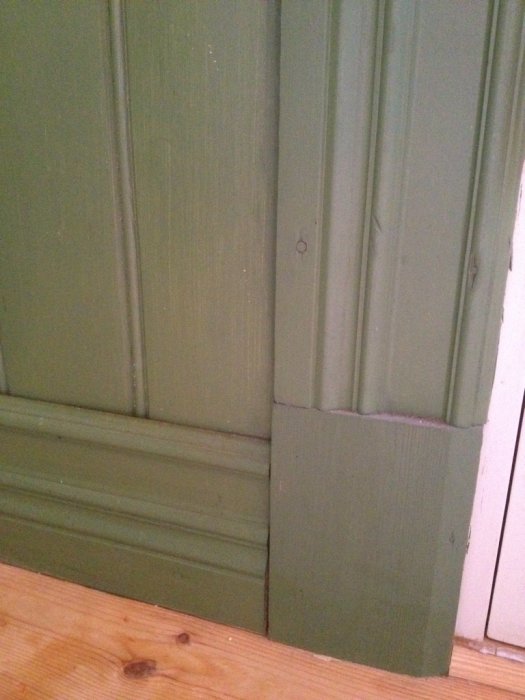
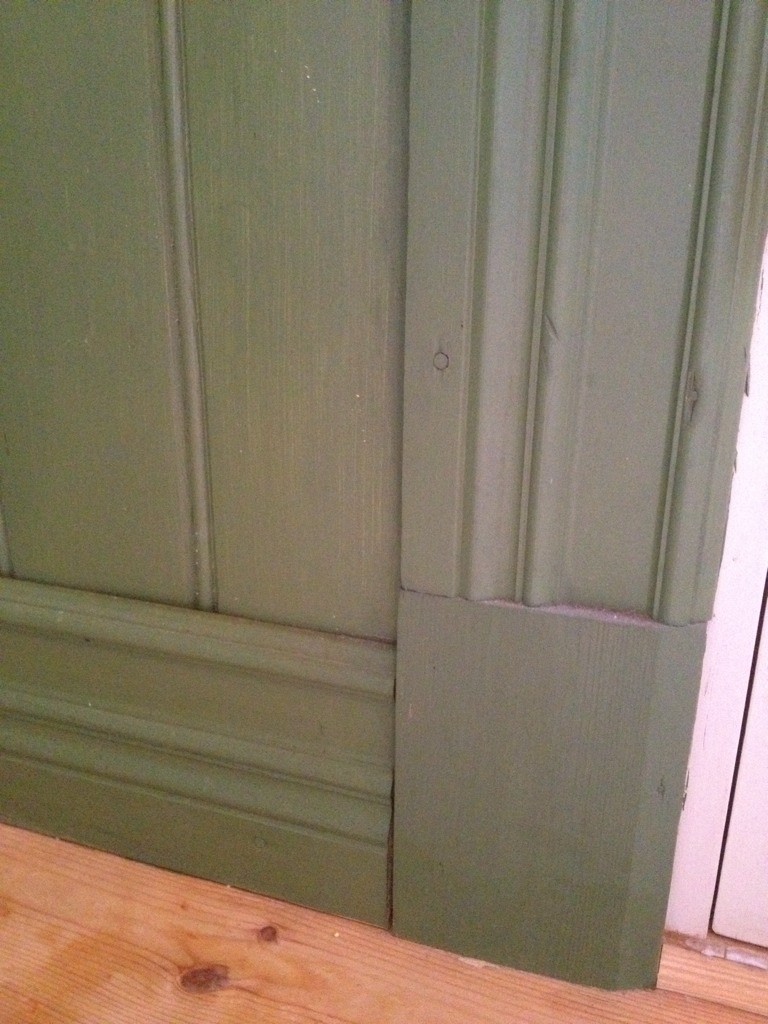
Hi Sophie! I'm wondering if you remember how thick the beadboard is that's shown in the picture? I'm considering these exact things and pondering how to achieve these junctions between plinth, beadboard, and molding. I don't want a beadboard that's too thick so it's level with the molding and plinth.
I think that usually the beadboard is installed first, followed by the trim and then the baseboard. That way, the thickness of the beadboard doesn't have much impact on the final result.
Vi vill skicka notiser för ämnen du bevakar och händelser som berör dig.


 The traditional approach is exactly what I describe, that if you have paneling from floor to ceiling, it is either painted in one color or you have it two-toned with a thin line or narrow stencil in a darker color over the seam between the two colors. Alternatively, you place the stencil just above where the lower and darker color ends, in the same color as the lower darker one.