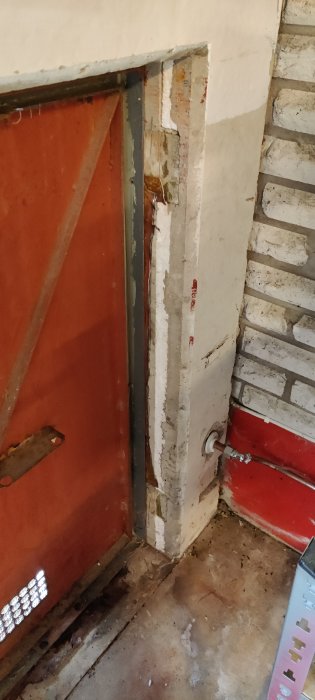
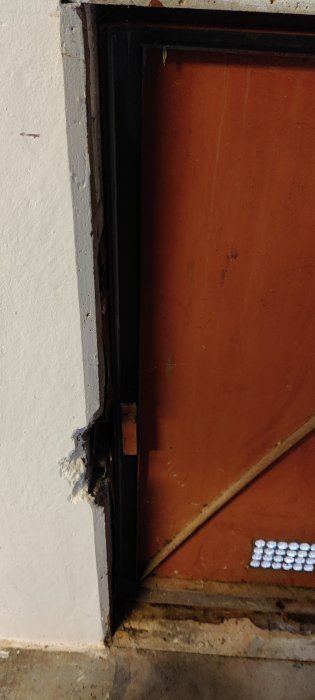
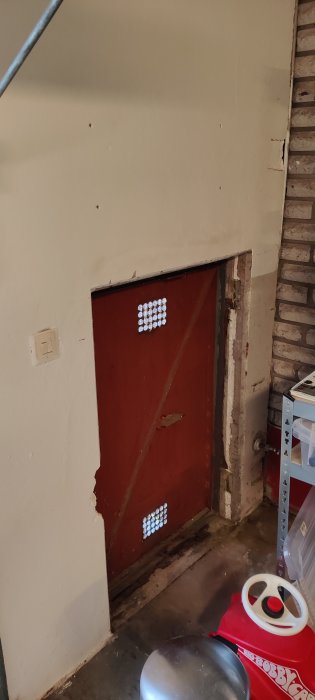
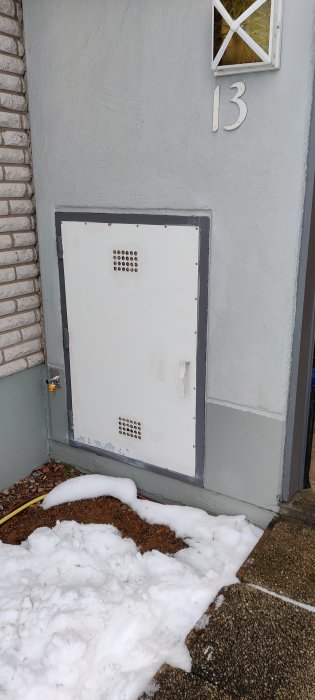
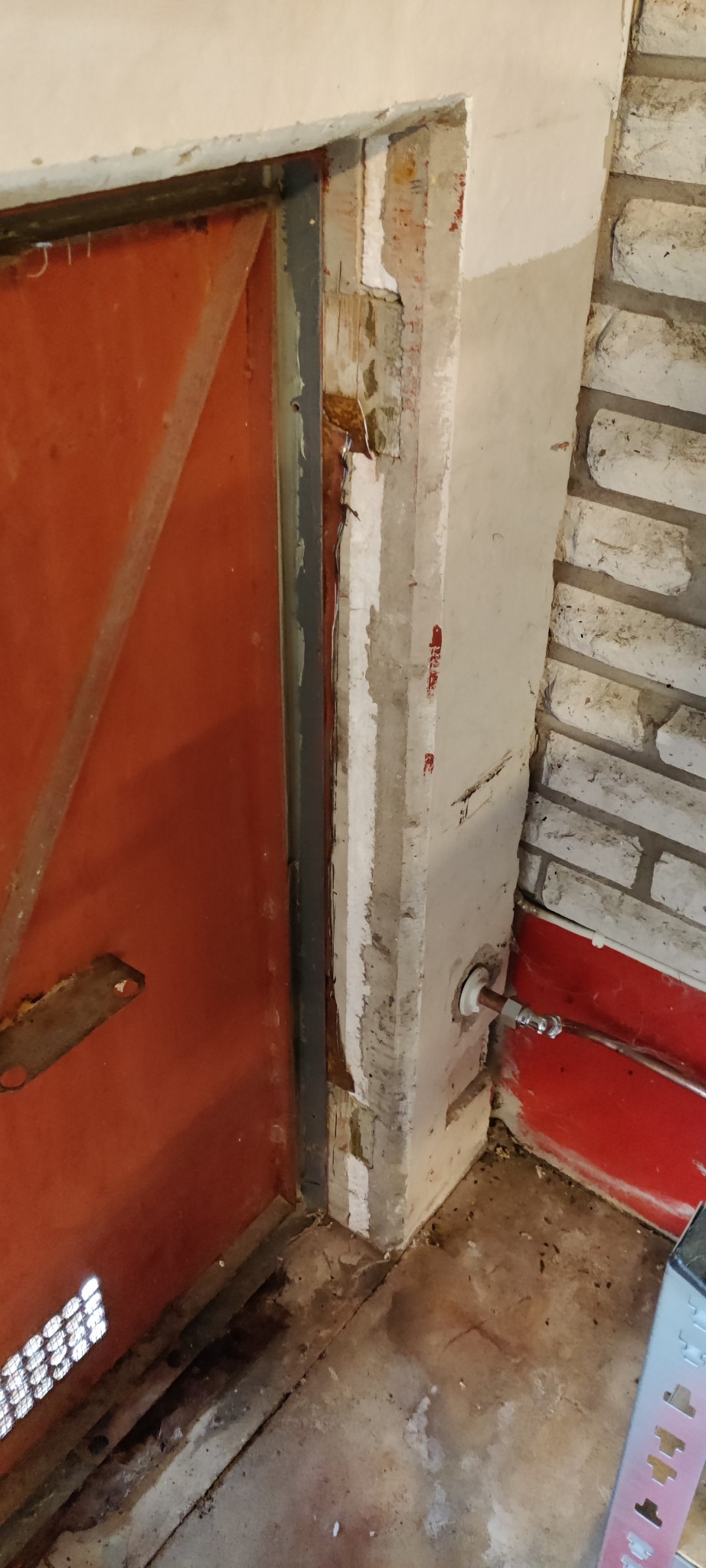
I have a trash cabinet in the garage wall that is no longer used and I have sawed off the inner part. But what remains is the hole in the wall where the cabinet was. How do I best close up this hole?
As seen in the top picture, the wall seems to be made up of two layers of concrete with insulation in between.
My idea is to close the hole with lecablocks and mortar B, I live near a Byggmax so I prefer shopping there. Then finish by plastering the surface smooth on the inside and outside so it levels with the existing walls.
So to my questions/thoughts:
Does it work to brick up with lecablocks or do I need to cast something equivalent to how it looks now?
Is additional insulation needed or are the lecablocks sufficient?
Do I need to drill some reinforcement bars into the surrounding hole and anchor them, then brick them into the lecablocks? Or does the mortar bond well enough to existing walls/floor/ceiling?
I have never bricked or plastered anything so all input on how I should proceed is greatly appreciated!
No problem. Blocks seem to be available between 150 and 350 mm, so choose something that is appropriately thick for the wall. Drill in reinforcement every second or third course. The last course will be a bit tricky; how you solve it depends on how the height of the hole matches the height of the stone. When you are ready to plaster, you will use the existing wall as a guide.
That seems to be unproblematic, just seal it with leca and then plaster it. To prevent cracks, attach rebar to the existing masonry.
Purely aesthetically, a good portion of the plaster on the foundation needs to be knocked down if you don't want to see that there was a sealed-off door there. That's a matter of taste.
So leca should provide roughly the same insulation as the current wall? Or is the hole too small to worry too much about it?
Is mesh needed for the plaster to adhere to the lecablocks?
You mean on the outside, I should knock off some plaster around the hole so it won't be an obvious "door hole" after I paint?
So leca should provide roughly the same insulation as the current wall? Or is the hole too small to worry too much about it?
It depends on which leca you choose, there are variants with foam plastic in them. Or you can ignore it, it probably won't be worse than the heat leakage you had through the door anyway.
Mikael Wallin said:
Is mesh needed for the plaster to stick to the lecablocks?
Leca is a very good plaster carrier so mesh is usually not needed. But using mesh is more common these days and it doesn't hurt, so why not? It reduces the risk of cracks in transitions.
Mikael Wallin said:
You mean on the outside I should chip away some plaster around the hole so it doesn't become a clear "door hole" after I paint?
It's really up to you how you want to do it. Either you emphasize the old door hole when plastering with the logic that a poor attempt to hide it is uglier than acknowledging the house's original layout, or you need to chip away enough plaster so you can plaster a larger area homogeneously. For example, draw a horizontal line along the top of the door hole and replaster everything below this. Then mesh might be a good idea, it would be unfortunate if it cracked at the edge of the old door hole, defeats the purpose of the effort so to speak.
It depends on which leca you choose, there are variants with foam plastic in them. Or you can ignore it, it probably won't be worse than the heat leakage you had through the door anyway.
Leca is a very good plaster carrier so a mesh is usually not needed. But mesh is used more than ever these days and it doesn't hurt, so why not? It reduces the risk of cracks in transitions.
It's optional how you want to do it. Either you make the old door hole accentuated when you plaster with the logic that a poor attempt to hide it is uglier than acknowledging the house's original layout, or you'll have to knock down a significant amount of plaster so that you can plaster a larger area consistently. For example, draw a horizontal line along the top of the door hole and replaster everything below it. Then a mesh is probably a good idea, it would be unfortunate if it cracks at the edge of the old door hole, defeats the purpose of the effort so to speak.
Thanks for the detailed answers! I feel significantly better equipped to move forward now.
A project thread might come later this spring when I actually do the work, a bit too cold to be outside and building now.
Outside, I expect some of the plaster to come off when I remove the steel frame for the door, so I'll take it from there and decide how much to plaster. There have also been discussions at home that plaster is ugly and that the entire garage should get new cladding, like fiber cement boards or similar.
Click here to reply
Vi vill skicka notiser för ämnen du bevakar och händelser som berör dig.




Claes Sörmland said:
That seems to be unproblematic, just seal it with leca and then plaster it. To prevent cracks, attach rebar to the existing masonry.Mikael Wallin said: