
7,040 views ·
7 replies
7k views
7 replies
Brick up basement window - slanted wall opening
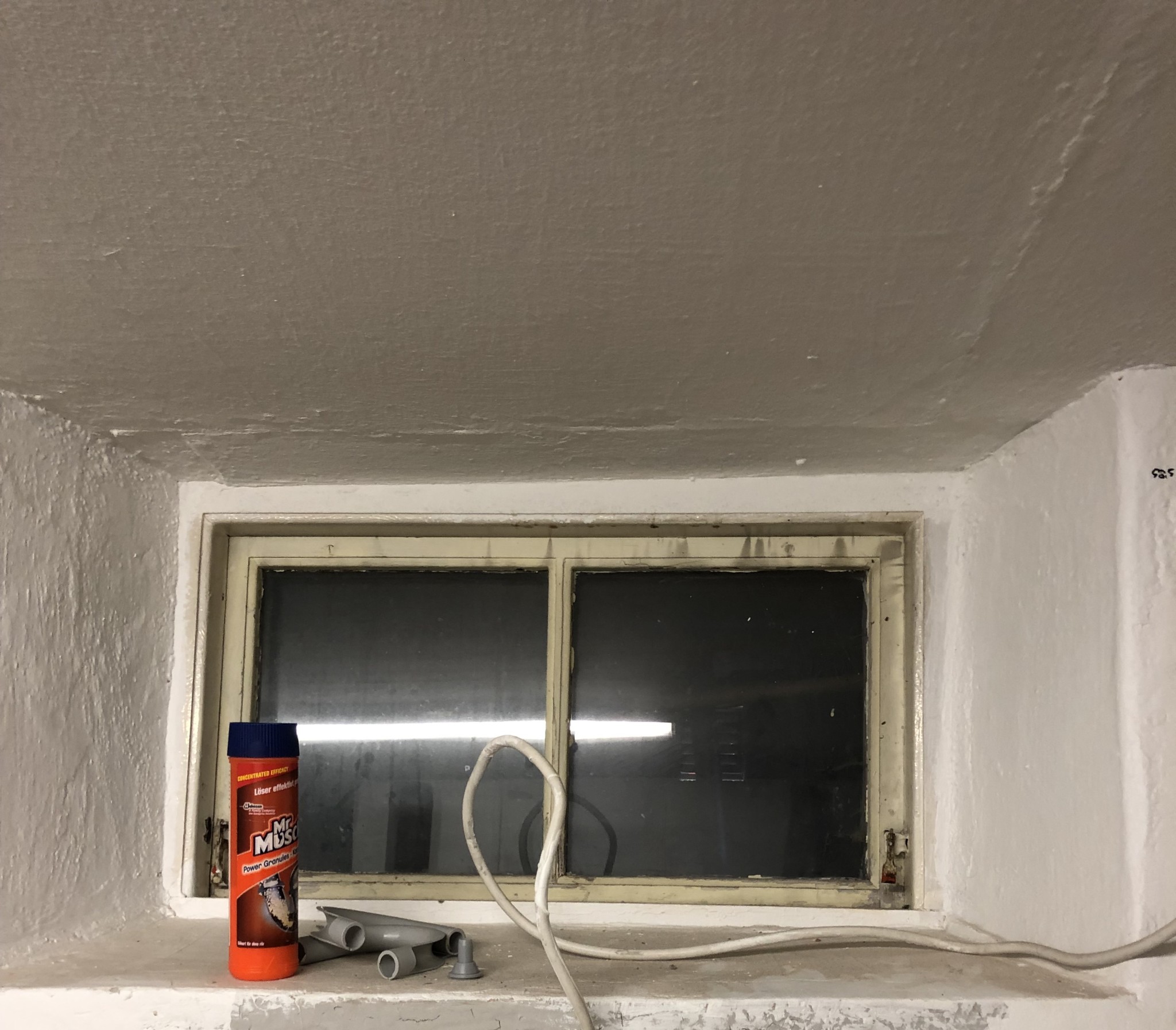
Hello! I'm going to brick up our basement window with concrete blocks and mortar B (if I can't get it 100% tight, foam sealant will be a backup solution). Outside the window, there's an extension crawlspace. On the inside, we'll be installing cabinets on the walls - so it doesn't need to be completely smooth and perfect.
I have two short questions regarding the wall being slanted/angled:
1. The bottom part is not flat. It's not just a matter of placing a concrete block at the bottom. How is this usually solved? How do I keep the concrete block plumb/level? Follow-up question: how much mortar should I have between my two concrete blocks and between the concrete block and the basement wall?
2. The same applies to the sides. If I cut the concrete blocks so they go edge to edge deep inside at the window (outer wall) - then closest to the picture (inner wall) I'll have about 10 cm on both the left and right sides that need to be filled. What's the easiest way to solve this? As mentioned, it just needs to be tight - cabinets will be in front anyway, so it doesn't need to be 100% perfect and smooth. But a lot of mortar probably won't stick by itself.
I'm also wondering if anyone can estimate how many 25 kg bags I should buy. It's my first time trying to do some masonry
I have two short questions regarding the wall being slanted/angled:
1. The bottom part is not flat. It's not just a matter of placing a concrete block at the bottom. How is this usually solved? How do I keep the concrete block plumb/level? Follow-up question: how much mortar should I have between my two concrete blocks and between the concrete block and the basement wall?
2. The same applies to the sides. If I cut the concrete blocks so they go edge to edge deep inside at the window (outer wall) - then closest to the picture (inner wall) I'll have about 10 cm on both the left and right sides that need to be filled. What's the easiest way to solve this? As mentioned, it just needs to be tight - cabinets will be in front anyway, so it doesn't need to be 100% perfect and smooth. But a lot of mortar probably won't stick by itself.
I'm also wondering if anyone can estimate how many 25 kg bags I should buy. It's my first time trying to do some masonry
I had the same problem. At the bottom, I solved it by leveling with concrete. I attached a board on the inside and filled with the right amount of concrete to even out the slope. Once it had set, it was just a matter of building on top. I didn't have any side slope, but there I would probably have tried to bevel the lecablocks. No finesse is needed since you fill out with mortar.
I would personally have chosen to custom-build storage in that space and not cover it up. The window can also serve as an entrance to the crawl space for inspection and work.
When it comes to leveling it before laying bricks, you can cast a level base by leveling a piece of board and screwing it to the wall, then casting up to it. It should also work to use a slightly thicker mortar and lay the first rows out to the edge, letting them harden before continuing. If it settles a bit, you should be able to adjust it during the ongoing bricklaying.
If you cast, you have the advantage of building up a level that may reduce cutting, maybe casting so you only have one or a couple of rows to lay lecan.
Why do you want to remove the window?
When it comes to leveling it before laying bricks, you can cast a level base by leveling a piece of board and screwing it to the wall, then casting up to it. It should also work to use a slightly thicker mortar and lay the first rows out to the edge, letting them harden before continuing. If it settles a bit, you should be able to adjust it during the ongoing bricklaying.
If you cast, you have the advantage of building up a level that may reduce cutting, maybe casting so you only have one or a couple of rows to lay lecan.
Why do you want to remove the window?
The window looks directly into the crawlspace of the extension, so it's pitch black there all year round. I have a door to the crawlspace from the outside, so that's already resolved.T tobiast said:I would personally choose to custom-build storage in that space and not seal it off. The window can also serve as an entrance to the crawlspace for inspection and work.
When it comes to leveling before masonry, you could cast a level base by leveling a plank and screwing it to the wall, then casting up. It should also work to use a slightly thicker mortar and level the first layers out to the edge, letting them cure before continuing. If it settles a bit, you should be able to adjust it during further masonry work.
By casting, you have the advantage of leveling at a height that might reduce the need for cutting, maybe casting so you only have one or a few layers of leca blocks to lay.
Why do you want to remove the window?
I'm going to build a laundry room with overhead cabinets along the entire wall - so I don't want custom-built storage in the middle. Also, a drain pipe will go through this hole before the wall is bricked up. 😊
Thanks for the quick response!janwide said:
I had the same problem. At the bottom, I solved it by leveling with concrete. I attached a board on the inside and filled it with the right amount of concrete to even out the slope. Once it had cured, it was just a matter of building on top. I didn't have a slope sideways, but there I would probably have tried to angle cut the leca blocks. There's no need for finesse since it gets filled in with mortar.
Two short follow-up questions:
Is it okay to brick in a board? (Considering it's wood/living material).
Approximately how long can I expect it to take for the "leveling" to cure before I can build again completely? Let's say it becomes 3-4 cm high.
The board should not be bricked in. It is only used as support for the concrete while it cures, similar to a mold for concrete.J jeric.cire said:
You screw the board to the inner wall by the red bottle. You do this with a concrete drill and plug.
The top edge of the board should then be at a height so you can fill inside to a completely flat surface.
Once it has set, you remove the board, fill the drill holes, and can continue casting the rest.
It may be good to remove the paint to give the concrete a better grip and to drill in some pieces of rebar at the bottom and sides to strengthen the construction.
The top edge of the board should then be at a height so you can fill inside to a completely flat surface.
Once it has set, you remove the board, fill the drill holes, and can continue casting the rest.
It may be good to remove the paint to give the concrete a better grip and to drill in some pieces of rebar at the bottom and sides to strengthen the construction.
The concrete has cured enough in a few hours. If you pour in the evening, it's completely fine to mortar the next morning. I wouldn't bother scraping off paint or drilling into rebar. The concrete will hold anyway. If you want to be on the safe side, you can chip a few splinters from the underside so that the surface becomes rougher and easier for the concrete to adhere to. Mix the concrete with quite a little water so that it is firm and not runny. Then you hardly need to have any board at the front. You can cover it with a little plastic so that it doesn't dry out, as it won't cure if it does.J jeric.cire said:
Click here to reply