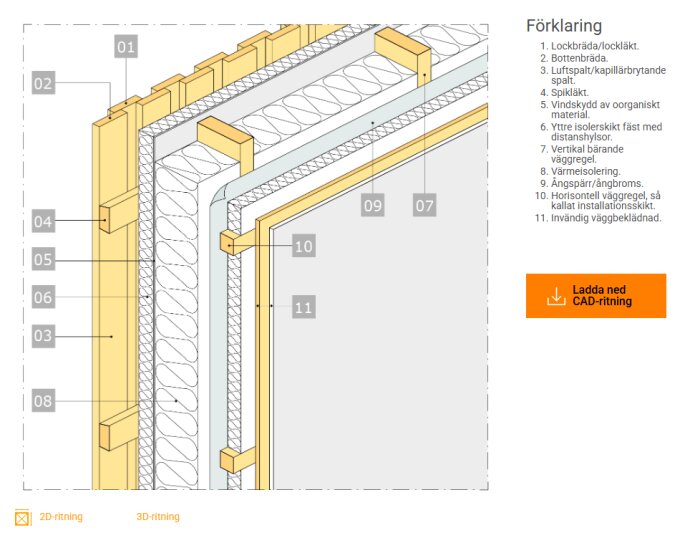
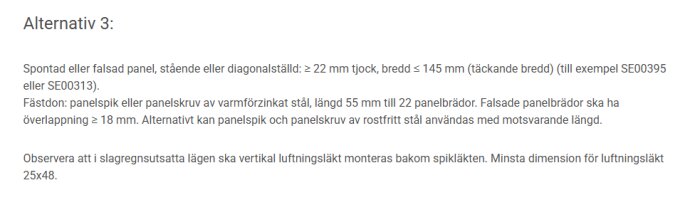
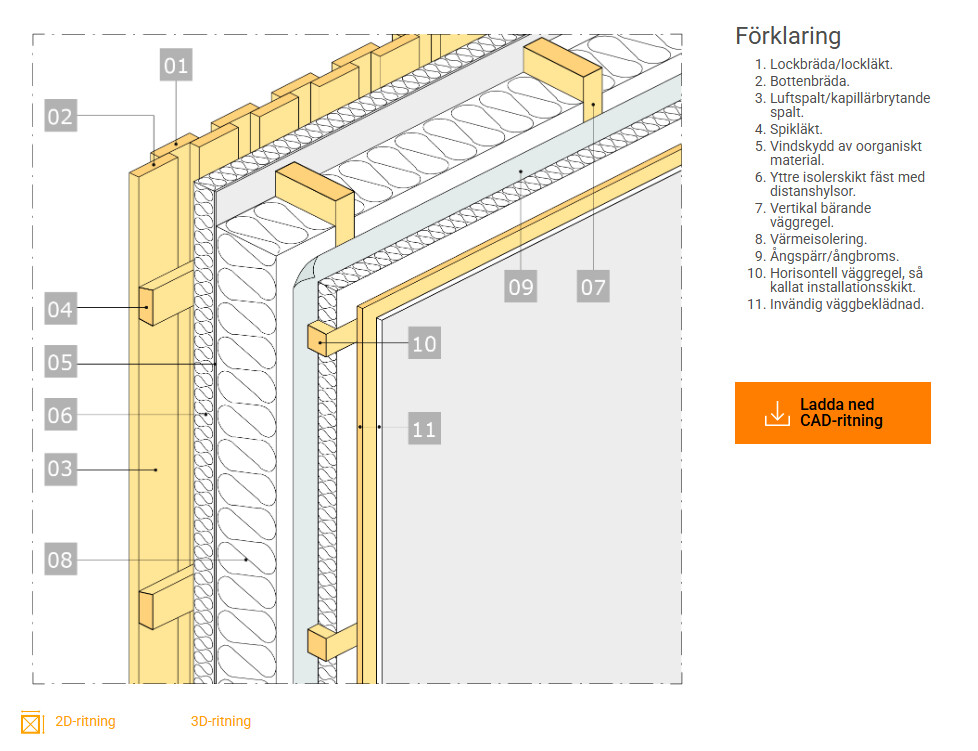
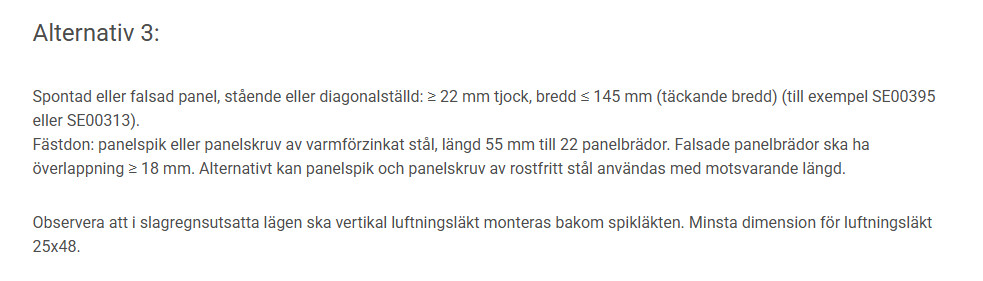
Hello, I am planning to build a house and use Västkustskiva and a standing seamed groove panel. Träguiden shows this method for installation.
With descriptive text if you are to use a seamed panel
Does this mean I only need a horizontal nail strip if there's "normal" weather and not a vertical air strip under the nail strip?
Looking at Paroc's installation instructions, they show a vertical air strip (though they don't consider which panel to use). Looking at Isover's installation instructions, they only show a horizontal nail strip. Looking at Rockwool, they show a vertical air strip.
So what exactly applies? Does it vary depending on the supplier, or are they just showing "best practice" given that Träguiden doesn't show a vertical air strip and it was updated in 2021?
I'm trying to get a grasp on the installation here as I, like many others, don't want it to protrude too much. I've also thought about going a middle way and installing a 12mm vertical, so I can get a bit of an air gap.
A horizontal nail batten is sufficient, the west coast panel is not too moisture-sensitive, so that's enough..
Only sides exposed to driving rain are recommended with a vertical ventilation gap..
But we have built for many decades without vertical battens, so it works under normal circumstances..
A horizontal nailing batten is sufficient, the västkustskivan is not so moisture-sensitive, so that's enough. Only sides exposed to driving rain are recommended with a vertical air gap. But we have been building for many decades without vertical air battens, so it works under normal circumstances.
Okay, but is there any kind of ventilation behind it if it only has vertical nailing battens? In other words, does air get in somewhere anyway?
How do you finish at the bottom of the slab with västkustskivan/nailing battens, do you set a nailing batten at the bottom, or do you set a beam that the västkustskivan stands on and attach the panel to the beam??
Okay, but is there any kind of ventilation behind if it's only vertical battens? I.e., does air get in somewhere anyway?
A panel is never airtight so air blows in, and usually, the panel has grooves on the backside to prevent it from cracking and warping.
NNygge72 said:
How do you finish at the bottom with the west coast board/battens, do you put a batten at the bottom or do you put a beam like the west coast board stands on and attach the panel to the beam??
It depends on whether the west coast board is covered by the foundation at the bottom or not?
If it is covered by the foundation, you don't need to do anything, but if it is outside the construction, I would have placed it on a beam or used some kind of start strip in metal or plastic.
A panel is never airtight, so air will blow through, and often the panel has grooves on the back to prevent it from cracking and warping.
It depends on whether the west coast board is covered by the foundation at the bottom or not.
If it is covered by the foundation, you don't need to do anything, but if it is outside the construction, I would place it on a bracket or have some kind of starter strip in metal or plastic.
Okay, so if you put a type of drip edge at the bottom, it could rest on that, or alternatively on a bracket. I think a bracket would be a good protection against mice
If it "rests" on the slab, should the sill insulation cover this as well, or is it just the sill that you cover?
Okay, so if you put a kind of drip edge at the bottom, it could rest on that, or alternatively on a beam. I think a beam would also be good for mouse protection
If it "rests" on the slab, should the sill insulation cover this too, or is it just the sill it covers?
The sill insulation rarely extends beyond the width of the beam externally..
What does your construction look like? What do you have inside the west coast board?
I used "västkustskiva" on my garage and then set a rule for the board to stand on. Then I still used a mouse band to cover the air gap. In my case, the rule was not larger than the "västkustskiva," so it wouldn't have been sufficient as the only mouse protection.
I have horizontal paneling, so I only have vertical battens. But if I had vertical paneling, I assume I would only have horizontal battens.
The foundation insulation rarely extends beyond the width of the framing externally..
What does your construction look like? What do you have inside the Västkustskiva?
As I planned, it will be Panel-Batten-Västkustskiva-Studs/insulation (170)-Vapor barrier-installation layer (45-OSB-Drywall
As I thought, it will be Panel-Batten-Västkustskiva-Stud/Insulation (170)-Vapor barrier-Installation layer (45-Osb-Plasterboard
You should have a wind barrier inside the västkustskiva, either a windbreaker or some form of board. If you have a windbreaker, you can let it fold out on the foundation so that the västkustskiva can stand on the fabric and thus be protected from moisture absorption.
You should have a wind barrier inside the west coast board, either wind paper or some form of board..
If you have wind paper, you can let it fold out on the foundation so that the west coast board can stand on the paper and thus be protected from moisture absorption..
Okay, I saw that they said wind paper was only needed if the building had 3 floors or more, but I had planned to check that as well.
"In places exposed to wind and from the third floor and upwards in tall buildings, a complete windproof layer is always required, and outer corners must be protected, for example with Vindskydd WALKI Wall Breath 65 (XMW 065), Wind barrier, which is installed inside the Climate Board."
But it's such a small cost, so it probably doesn't hurt to add it even if it's lower.
I have also interpreted that a windbreak shouldn't be necessary and don't have one on my garage. But a garage is also a bit less critical than a house, so maybe it's worth it with both belt and braces there.
My garage is otherwise of full villa standard with horizontal paneling, battens, västkustskiva, 195 mm studs and insulation, then 45 mm inner insulation, 12 mm plywood and finally drywall.
My recommendation is to mount a vertical 12 mm ventilation batten to allow air circulation behind the panel, especially if you paint the panel with modern paint.
Okay, I saw that they said a wind barrier was only needed if the building had 3 floors or more, but I was going to check it too.
"In areas exposed to wind and from the third floor and up in tall buildings, a comprehensive windproof layer is required, and outer corners must always be protected with e.g. Wind Protection WALKI Wall Breath 65 (XMW 065), Wind protection, installed inside the Climate Board."
But it's such a small cost that it wouldn't hurt to put it up even if it's lower.
Yes, I think a wind barrier is a requirement because you get many horizontal seams with the west coast board, and these will not be windproof—I know this from experience.
Additionally, it's not wrong to protect the frame from moisture that the west coast board can handle, but if it's against the frame without anything in between, there's a risk that moisture will migrate into the frame if you don't have something in between.
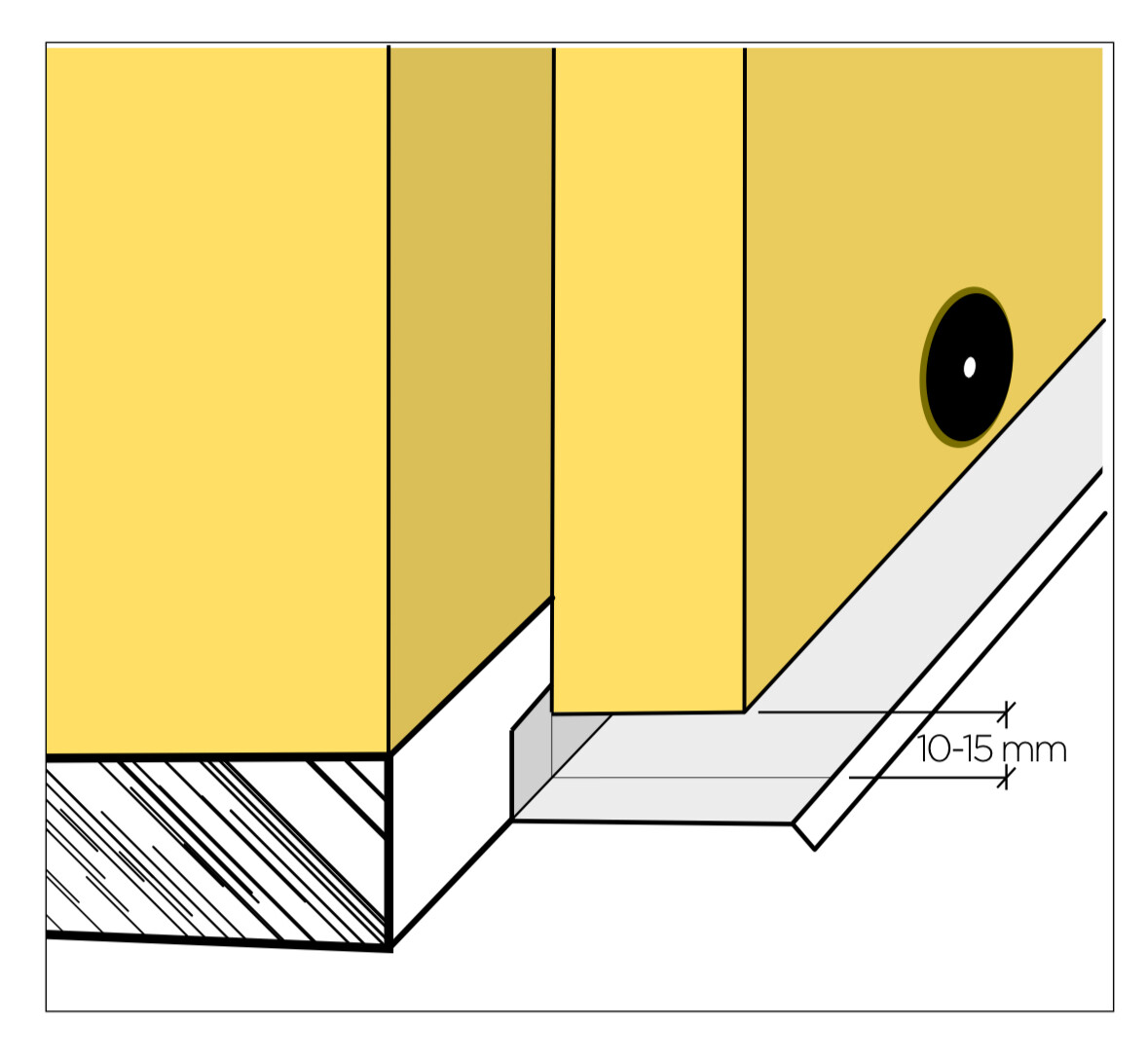
I would have built so that the outside of the west coast board aligns with the foundation so that you don't need a stud at the bottom.
Alternatively, a water diverter like this picture.
I have also interpreted that wind protection should not be necessary and do not have it on my garage. But a garage is also a bit less critical than a house, so maybe it's worth having both belt and braces there.
Yes, that's true. It's too small of a cost to be stingy about. You can be stingy with things you can replace afterwards. But with things that are permanent, you shouldn't be stingy.
Vi vill skicka notiser för ämnen du bevakar och händelser som berör dig.



Hemingway said: