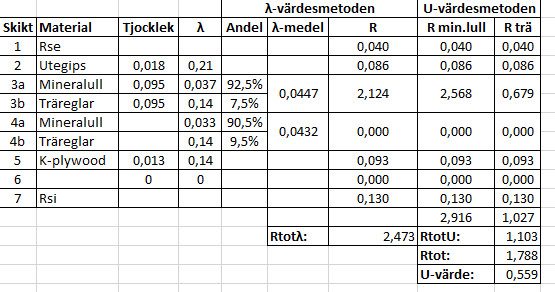
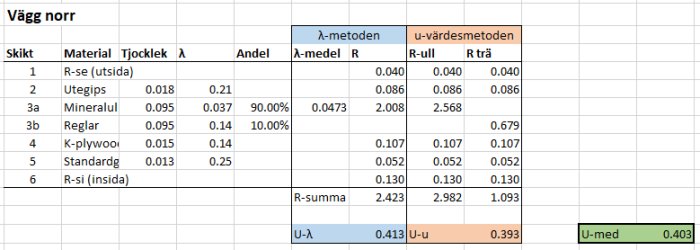
I have now read more and learned that calculations are usually done using BOTH the U-value method and the lambda method, and then an average of these is used. However, I can't make sense of your example huggan, are you 100% sure it's correct? Spontaneously, I also think 0.559 sounds a bit high.
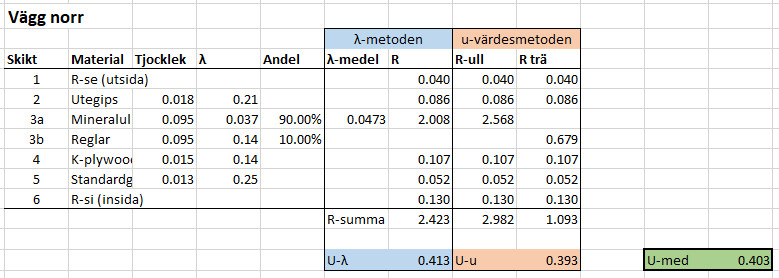
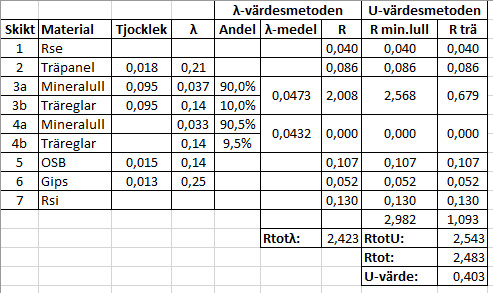
Here's a new attempt I've done with both lambda and U-value combined:
If you have Excel templates to share, I'm interested
For those who might find this post in the future, I can add a bit of what I've learned today, taken from a book:
lambda method or U-value method?
An exact calculation must be done with multi-dimensional models on a computer. With manual calculation methods, average values can be calculated in two different ways, which give the extremes. One method, the lambda-value method, gives too high a U-value. The other method, the U-value method, gives too low a U-value. For practical calculations, you should calculate the U-value with both methods and then form an average of the corresponding thermal resistance.
U-value method
In the U-value method, it is assumed that all heat flow occurs perpendicular to the wall. The heat flow in the two materials occurs independently of each other and no heat transport occurs laterally. The wall's U-value then becomes a weighted average of the U-values of the different parts.
lambda-value method
In the lambda-value method, instead, it is assumed that the different materials have "infinite" thermal conductivity transversely. The flow through the wall will then be the same everywhere. In this case, a weighted average of the lambda-values of the different parts is first formed computationally.
Your calculation is completely correct now, except that you haven't considered any thermal bridges.
I found an error in my formula which I corrected, thanks for pointing that out.
[image]
Hello huggan.
I usually don't calculate U-values but need to submit a U-value calculation to the municipality. I've gotten as far as obtaining Rtot-Lambda but I'm interested in how you derive the figures for RtotU and Rtot?
What does the formula look like in each cell? It would help a lot
Hi, I also need to calculate the U-value of building components before the start notice/building permit. Could I also have access to the Excel sheet you used for your calculation example? thanks in advance!
Thank you for sharing the Excel file.
I'm trying to understand how all the formulas are made, and have a thought now.
If you want to use 4a+4b as well, it feels like the % share isn't included in "RtotU:"
during "trace precedents"
That's correct because I removed the connection once when I made a västkustskivafasad that doesn't have studs in it. Do you know how to solve the formula?
Det stämmer för jag tog bort kopplingen en gång när jag gjorde en västkustskivafasad som inte har reglar i sig. Vet du hur du ska lösa formeln?
Jag har inte koll på hur jag skall skapa den formeln. Tacksam om du kan ge mig den?
Det går inte att fortsätta på samma rad även för U-värdesmetoden? Istället för att lägga in procentsatsen i summeringen RtotU: Det känns som procentsatsen påverkar alla rader då?
Can't see the attachment, but if you just copy the formula under the λ-medel column for 3a 3b, you'll get it right. You don't need to change the other cells. If that doesn't work, I'll upload it again.
Vi vill skicka notiser för ämnen du bevakar och händelser som berör dig.