
2,229 views ·
10 replies
2k views
10 replies
Before buying a house - is this moisture damage?
Hello everyone,
I'm looking for a house and my partner has taken a liking to a rather nice 1.5-story house from around 2000.
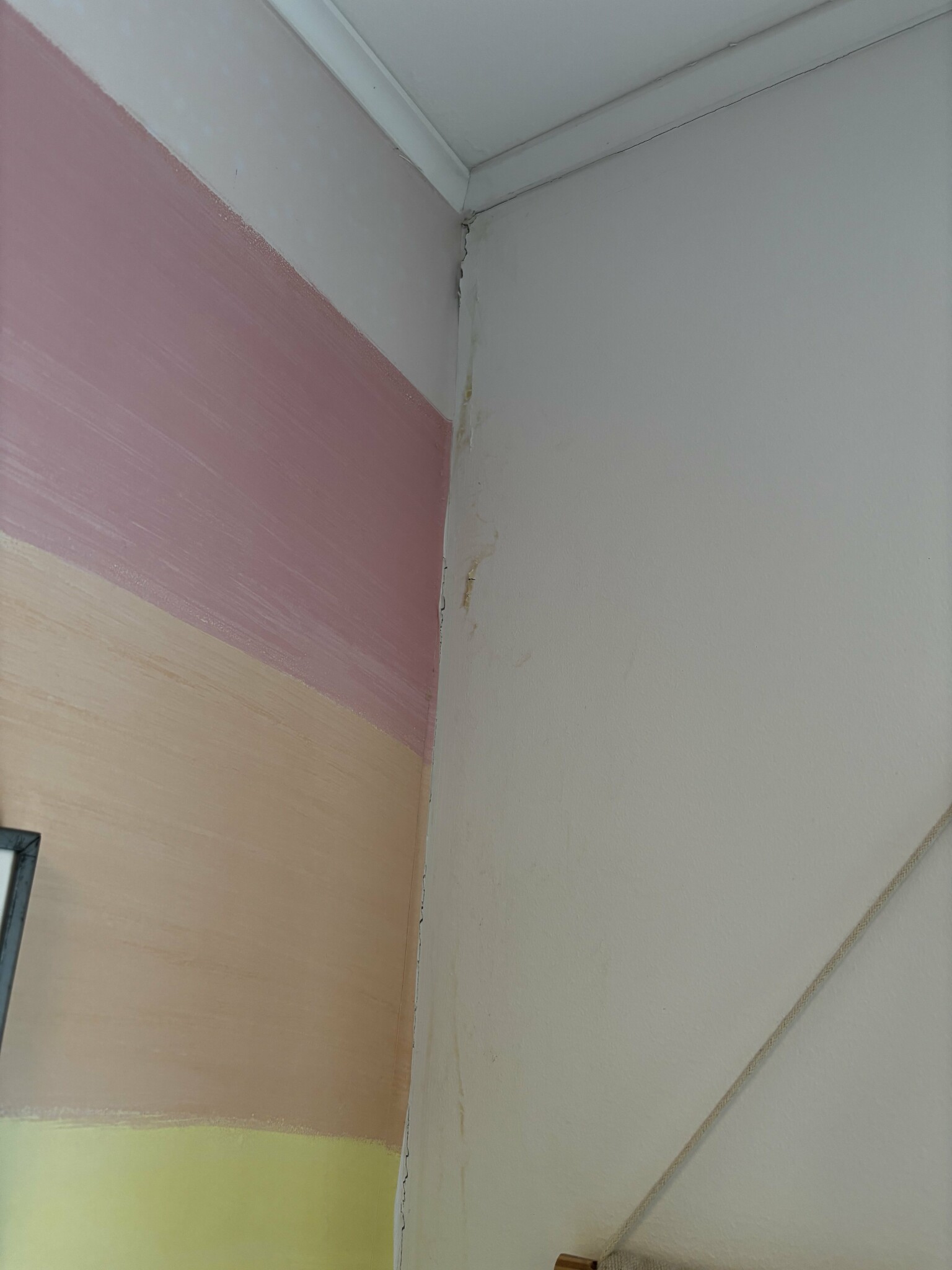
During the viewing, I noticed stains that, according to the seller, are a combination of settlement and wallpaper paste (the yellow stuff). I buy the settlement explanation, but not the yellow, especially where it's bubbled up and cracked.
The stains are high up in the corner on the interior wall against the facade. Above is the attic without inspection hatches, which the inspector noted should be established.
I've been in contact with the inspector, and he couldn't remember these stains but said he could measure moisture.
My concern is that it may occur under certain specific weather conditions, such as strong wind and rain combined. This happened to a friend of mine; the moisture was measured and seemed OK, but it turned out everything behind had rotted when he opened up after the first heavy rain when water dripped from the wall.
What do you think, is it enough with a moisture measurement due to these stains, or should it be examined more thoroughly? How would one best do that in such cases?
The realtor hasn't been particularly helpful in making us feel confident. Quite the opposite, questioning rather aggressively why these stains are stopping us if we like the house otherwise.
I'm looking for a house and my partner has taken a liking to a rather nice 1.5-story house from around 2000.
During the viewing, I noticed stains that, according to the seller, are a combination of settlement and wallpaper paste (the yellow stuff). I buy the settlement explanation, but not the yellow, especially where it's bubbled up and cracked.
The stains are high up in the corner on the interior wall against the facade. Above is the attic without inspection hatches, which the inspector noted should be established.
I've been in contact with the inspector, and he couldn't remember these stains but said he could measure moisture.
My concern is that it may occur under certain specific weather conditions, such as strong wind and rain combined. This happened to a friend of mine; the moisture was measured and seemed OK, but it turned out everything behind had rotted when he opened up after the first heavy rain when water dripped from the wall.
What do you think, is it enough with a moisture measurement due to these stains, or should it be examined more thoroughly? How would one best do that in such cases?
The realtor hasn't been particularly helpful in making us feel confident. Quite the opposite, questioning rather aggressively why these stains are stopping us if we like the house otherwise.
So it's not possible to access the attic? Not from the outside either?

Considering how extremely poorly the wallpaper is cut, it is likely the old wallpaper paste. You can easily scrape a little on it, right? If it's just on the surface, it's the glue.
That it has come loose and bubbled, that's usually how setting issues look.
That it has come loose and bubbled, that's usually how setting issues look.

Self-builder
· Stockholm
· 8 781 posts
A bit silly that it can't be inspected, perhaps you can have the seller create an opening for a hatch, or cover the cost yourself (shouldn't cost that much), as part of the inspection clause.S Settis009 said:Hi everyone,
I'm on the hunt for a house and my partner has taken a liking to a rather nice 1.5 story house from around 2000.
During the viewing, I discovered stains which, according to the seller, are a combination of settlement and wallpaper paste (the yellow stuff). I accept the settlement explanation, but not the yellow, especially where it's bubbled up and cracked.
The stains are high up in the corner of the interior wall facing the facade. Above is an attic without inspection hatches, which the inspector noted, suggesting one should be established.
I have been in contact with the inspector and he couldn't remember these stains but said he could do a moisture measurement.
My concern is that it might occur under certain specific weather conditions, for instance, strong wind and rain combined. This happened to a friend of mine; they took moisture measurements, and everything seemed OK, but it turned out that everything behind had rotted when he opened up after the first heavy rain when water dripped from the wall.
What do you think, should one be satisfied with just a moisture measurement because of these stains, or should it be examined more thoroughly? How would you best do that in such cases?
The realtor has not been particularly helpful in ensuring we feel secure. Quite the opposite, questioning rather aggressively why these stains stop us if we like the house overall.
Or you can account for it and place a slightly lower bid, though that might depend on whether there are other bidders too?
Is there a seller's inspection with other remarks on the house indicating poor building quality/wear and tear, or is this the only issue?
No, unfortunately not, neither outside nor inside. The side attic is supposed to have an inspection hatch, but it hadn't been opened because it was wallpapered over. However, it doesn't help in this case where the stains are against the ceiling.Hammarskallen said:
Not from today, but from the outside, it looks OK.Jonatan79 said:
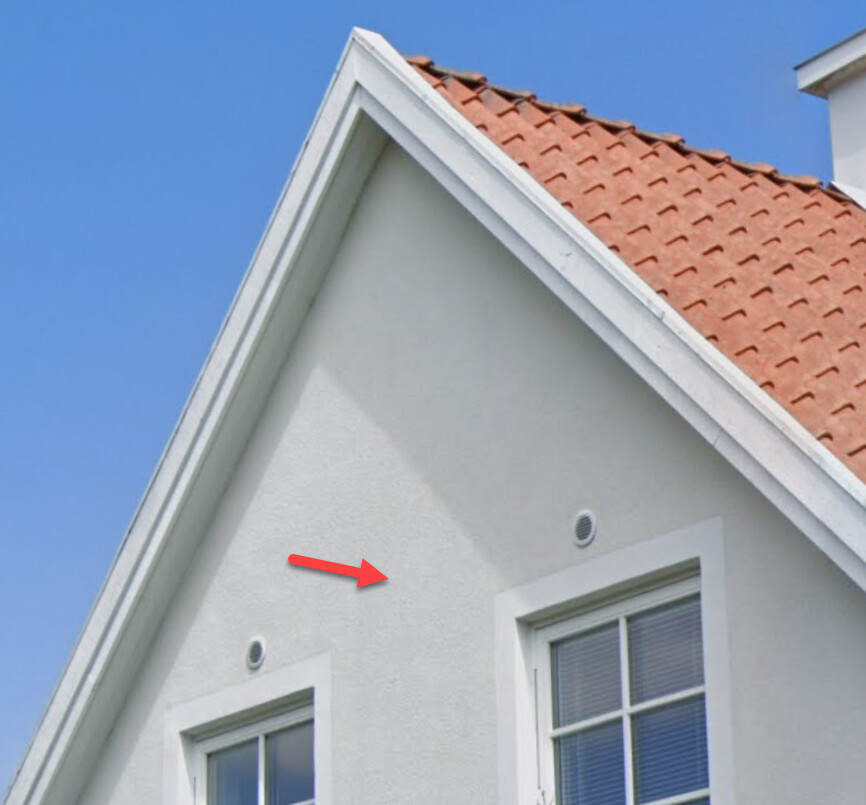
Here's a picture from Streetview, the arrow shows approximately where the damage is visible from the inside.
Thanks for the tip, we never went there for another viewing, but if we decide to proceed, I'll ask for a new viewing and do this.L Lechuza said:
So an inspection hatch is the secure way to investigate the damage, and one shouldn't just settle for a moisture survey?A bit silly that it can't be inspected, maybe you can get the seller to open up a hatch, or cover the cost yourself (shouldn't cost too much), as part of the inspection clause.
Or you could account for it and make a slightly lower offer, although that probably depends on if there are other bidders, right?
Is there any seller inspection with other remarks on the house indicating poor construction quality/wear, or is this the only one?
There are currently no other bidders, as far as we know. There was one who made an offer about 5% below the asking price, but this offer was withdrawn. The agent called us a few days later and asked if we were interested in making an offer in the same region, as the seller might consider it now.
A seller inspection has been carried out, and no major issues were detected, mostly cosmetic and wear. The house is, after all, from the early 2000s, with kitchen and bathroom renovations done in 2014-2017, and the facade with double-coat plaster in 2014. Otherwise, it's original, so some wear. In fact, we know the family that lived there before the current owners, they sold the house in 2022. They had no other problems with the house and didn't recognize these stains on the wall.
It sounds very strange that you can't go up to the attic and check. You definitely want to be able to do that to see the status there regardless of the stains.
It's not uncommon to have inadequate ventilation in the attic, and it's the easiest place to detect problems with roofing, errors in the vapor barrier, etc.
It's not uncommon to have inadequate ventilation in the attic, and it's the easiest place to detect problems with roofing, errors in the vapor barrier, etc.
Isn't this a house with the notorious single-stage sealed facade? Even small cracks in the facade from, for example, a ladder can be enough to allow moisture to be absorbed, which then has difficulty drying out. My advice is to demand a more thorough investigation.
https://www.boverket.se/sv/byggande.../fasadmaterial-ytskikt/risker-enstegstatning/
It could also be the effect of poor ventilation that has condensed against the outer wall. What type of ventilation is in the house? Exhaust air heat pump? Are the intake vents visible in the picture open?
https://www.boverket.se/sv/byggande.../fasadmaterial-ytskikt/risker-enstegstatning/
It could also be the effect of poor ventilation that has condensed against the outer wall. What type of ventilation is in the house? Exhaust air heat pump? Are the intake vents visible in the picture open?
There were no furniture during the viewing and not during the photography of the house either, and nothing the seller has pointed out when we've questioned the stains.
Here's what the inspector writes, maybe you should press on this and get the seller to solve such an issue?G g.kraft said:It seems very strange that you can't go up to the attic and check. You definitely want to be able to do that to see the condition there regardless of the stains.
It's not uncommon to have inadequate ventilation in the attic, and that's where you can most easily detect problems with roof covering, faults in vapor barriers, etc.
Observations
Attic spaces are not accessible for inspection due to lack of hatches. No damage signals or signs indicating ongoing leakage were noted in the ceiling or walls. For a better assessment of the execution and condition, inspection hatches need to be created. The hatch to the side attic was painted shut.
The house was built with a single-stage sealed facade but was later (2013-2014) modified to a two-stage.ylven said:
Isn't this a house with the notoriously problematic single-stage sealed facade? Even small cracks in the facade from something like a ladder can allow moisture to be absorbed, which then has a hard time drying out. Demand to examine it more thoroughly, that's my advice.
[link]
It could also be due to poor ventilation resulting in condensation against the outer wall. What kind of ventilation is in the house? Exhaust air heat pump? Are the intake vents seen in the picture open?
Exhaust air heat pump is correct (original from 2002, we have budgeted for a replacement if we proceed), and a small air-to-air unit in the living room.
That's a good question about the intake vents. I'm somewhat skeptical of the house's energy declaration. It claims a primary energy score of 60kWh/m2/year and has an energy class B, something I don't understand how with an EHP and ventilation according to the regulations. Maybe the vents have been closed, don't know how much that affects.
If they have renovated the facade, there shouldn't be ongoing moisture damage from the old facade at least. Is there documentation on how they did the job?
Another thing that strikes me with the first image is that it looks kind of dirty around the cornice and such. Either a lot of air pollution or mold due to humid indoor air as a result of potentially blocked air intake vents.
Another thing that strikes me with the first image is that it looks kind of dirty around the cornice and such. Either a lot of air pollution or mold due to humid indoor air as a result of potentially blocked air intake vents.
Click here to reply
Similar threads
-
Förhöjt fuktvärde i källaren inför husköp - hur ska vi tänka?
Köpa & Sälja hus -
Orimlig energideklaration inför husköp - för låg uppvärmning trot luft/luft-vp
Elavtal, elpriser & elförbrukning -
Before buying a house: how to inspect the sill on an 80s house?
Building Materials and Construction Technology