
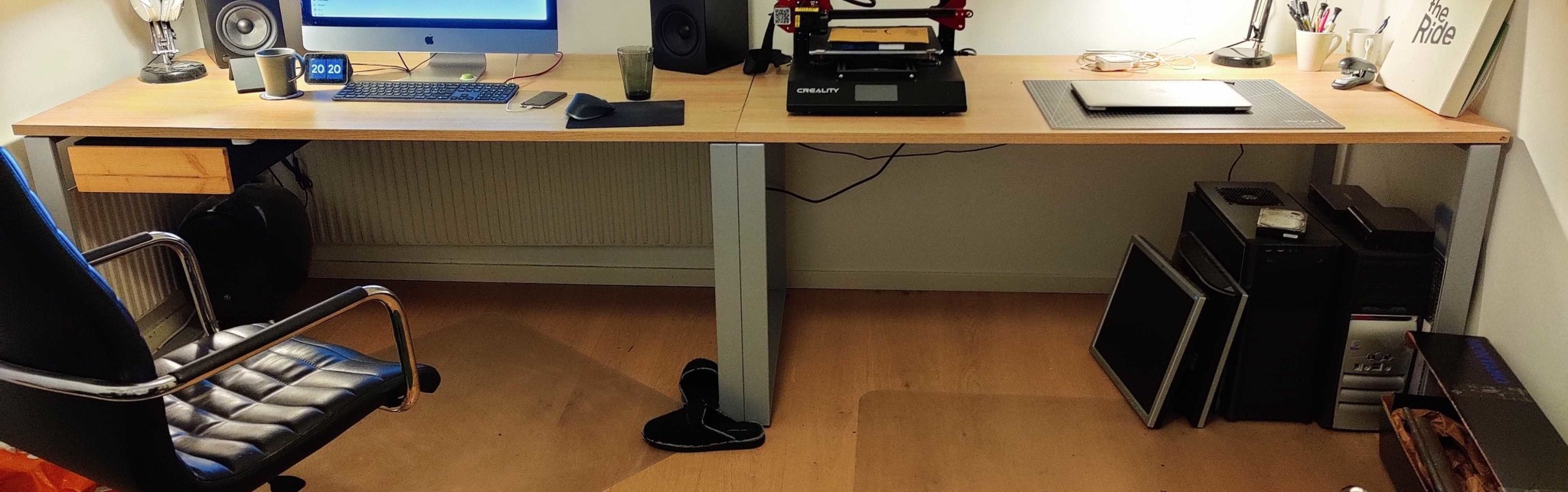
I have a dream to completely remove the legs from this desk made up of 2 boards measuring 80x160cm each. Does anyone know what dimension and material would be needed for the beam? The desk does not go all the way up to the back wall because there's a radiator and some cabling there, so the challenge is in a construction that only supports on the end walls. I feel that a beam height of 7cm could suffice without knees/legs noticing it, and 50cm in, I could increase the dimension further as that's the extent my knees reach. Since it's two boards, they probably can't help the construction.
Normally, there's not much load on it, but I suspect one would want to feel secure leaning heavily on it and possibly placing something a bit heavier, so it should perhaps carry at least 50-60kg, ideally up to 80-100kg?! Is this a utopia?
Note that cross braces to the back wall are disqualified. Only support on the ends.
Normally, there's not much load on it, but I suspect one would want to feel secure leaning heavily on it and possibly placing something a bit heavier, so it should perhaps carry at least 50-60kg, ideally up to 80-100kg?! Is this a utopia?
Note that cross braces to the back wall are disqualified. Only support on the ends.

The assumption about the load is crucial for the result you get. If it were a floor, you would calculate with 200 kg/sqm. Perhaps 100 kg/sqm is reasonable? With two beams, one inner and one outer, this would mean 40 kg/m for each beam. Steel is the simplest option. With two so-called VKR tubes (square tubes) 70x40x4 (HxBxT), the deflection in the middle at maximum load would be about 5 mm, which can be considered OK. An alternative is two glulam beams laid on their narrow edge. With 66x315 mm, the deflection would be about 7 mm. The glulam beams are cheaper.

A point load of 100 kg in the middle of the joint seam causes an additional deflection of about 3 mm beyond the 7 mm that the evenly distributed load causes. Example with glued laminated timber on edge.

richardtenggren
Ingen-gör
· Norrlandet
· 6 615 posts
richardtenggren
Ingen-gör
- Norrlandet
- 6,615 posts
If you throw everything out, maybe you can make the disc itself self-supporting by using three 66x270 joined together? (Assumption based on justus's response) 
If you skip the disc, you can go up to 90 x X as well.
If you skip the disc, you can go up to 90 x X as well.
78x270 is enough if you're not going to use it as a dance floor too... I think it could look pretty cool.
richardtenggren
Ingen-gör
· Norrlandet
· 6 615 posts
richardtenggren
Ingen-gör
- Norrlandet
- 6,615 posts
There is nothing wrong with 90 mm. Liggande limträ is an excellent stair material. They can be made from significantly thinner dimensions. 42 mm thick is probably sufficient for normally wide stairs.
Have you considered hanging it from the ceiling? I've hung a shelf from the ceiling with threaded rods. Cables also work. The cable might land not at the front edge but in the middle halfway across the board.
We have a cantilevered desk made from leftover trappämne from the stairs. 660x42x2700. It's not quite as deep as yours, but shows no signs of sagging yet.
It is mounted with a longitudinal batten 45x45 along the wall, attached to studs centering at 60 which provides much of the rigidity.
It is mounted with a longitudinal batten 45x45 along the wall, attached to studs centering at 60 which provides much of the rigidity.
Click here to reply