Hello,
The house in question is a 1.5-story from 1968.
Can any skilled expert help me and others understand what a barracuda roof specifically is, and answer the questions below?
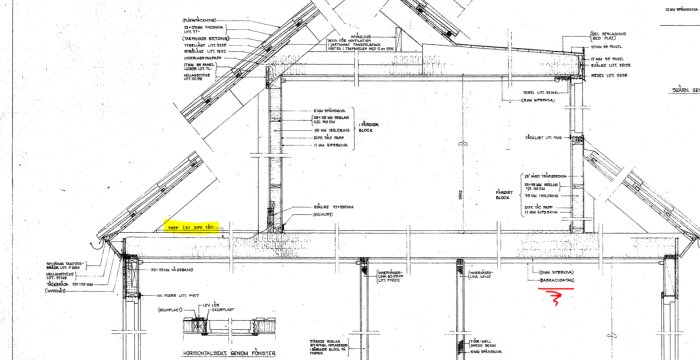
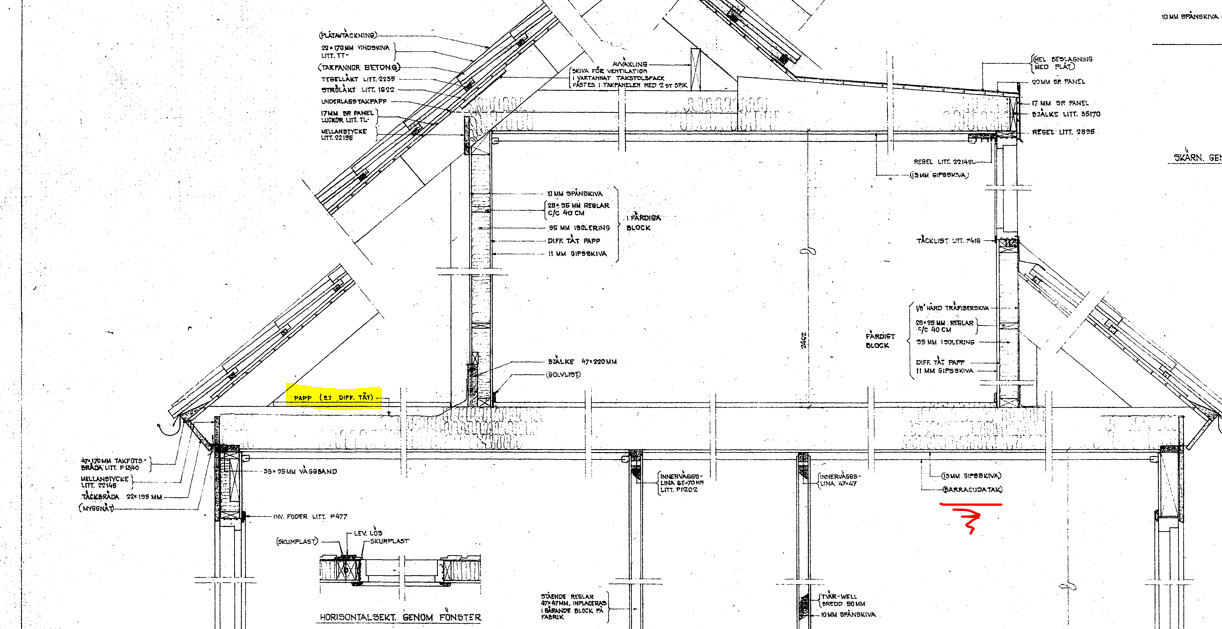
According to the drawing, the roof is a plastic roof (barracuda roof). See image.
This thread will help more people, I have searched and cannot find direct answers to the questions elsewhere.
If you have materials, feel free to link them.
1- How does a barracuda roof work and what is its function? (Preferably with pictures and description)
2- Does it have any load-bearing function or can it just be removed without affecting the house?
3- There is something called "väv-tak," is it the same as barracuda roof? (If not, can you briefly explain what vävtak is?)
4- What replaces a barracuda roof and what should be considered (vapor barrier?).
Baracuda ceiling is (I think) a term for a stretched plastic ceiling, meaning a plastic film stretched across the ceiling. It was popular in the 60s and 70s.
A disaster from a fire safety perspective. In the event of a fire, when it gets warm in the room, the film melts, detaches from the ceiling, and "vacuum seals" any people trying to flee the fire. The plastic then burns nicely. A nightmare from a fire safety perspective.
The ceiling has no load-bearing function. There are variants with small holes, resembling polka-dotted car interiors, which were found in WW in the 60s and 70s.
I think these have a ventilation function; if you tear one open, you need to check that detail.
Woven ceilings are another older form of stretched ceilings, consisting of a textile weave (I think it was burlap) stretched across the ceiling. It is wallpapered with thin paper. And painted over. These ceilings aren't great from a fire safety perspective either, as they burn. But they won't fall down and trap people who are in the room.
How difficult it is to fix a new surface in the ceiling depends on what is under the old ceiling. If there's gypsum there, it might not be the best option because you can't screw into it (the screws have to be fastened to what the gypsum is attached to, i.e., the joists). I would think that you have to install furring strips and then a new ceiling, like gypsum or those ceiling panels.
We will have a modern stretch ceiling installed in our new building, it sounds like you could easily tear down the old ceiling and upgrade to it. Fireproof, water-resistant, about half the cost compared to gypsum ceiling, you get a perfect surface, etc. Available in different designs and material choices.
Once upon a time, I lived in a house with barracuda ceilings. The entire area was built in '71 - '72. All rooms had just such ceilings. As an extra "fancy" touch, they also used plastic door frames. One house burned down and it was just a plastic heap after that.
After that, many people replaced their ceilings.
Including us.
Under this plastic film, which of course was attached with plastic ceiling moldings, the electrical wires were directly clamped to a chipboard. Meaning there was no smooth surface underneath. It was the plastic film that made the ceiling smooth.
There wasn't much to attach to, so we first installed battens at two levels and then a ceiling. The first rooms we did (bedrooms) got some type of non-combustible fiber boards. Later rooms got plasterboard...
So just get rid of it. When it hasn't been removed over all these years, you start to wonder about other things...
Load-bearing ceilings, I don't think exist. The floor structure is another thing.
Ventilation? Nah... it was just a fast way to make it smooth. Vapor barrier? Not at all. It leaks at the ceiling/wall.
If there hasn't been a vapor barrier before, you probably shouldn't install one. It requires proper ventilation, etc. If you wrap something without getting everything right, you'll run into problems.
Have this in two bathrooms. Fits perfectly. If a fire starts in there for some reason, I think you simply walk out of the room.
The other rooms had tensioned fabric ceilings.
Of course, it depends on the circumstances. You need to ask much more specific and detailed questions. Or perhaps even better, get help from a skilled carpenter and you'll have an amazing ceiling.
We are going to have a modern stretch ceiling installed in our new build, it sounds like you could easily tear down the old ceiling and upgrade to it. Fireproof, water-resistant, about half the cost compared to gypsum ceilings, you get a perfect surface, etc. Available in different designs and material choices.
We are using these:
Brilliance Ceiling
We are against the clock and have an existing carpenter who is going to do a lot. Can you install a stretch ceiling easily yourself?
What did it cost you in material and time for x sqm?
Thank you for all the answers. Let's assume it's uneven behind the plastic ceiling.
Some have recommended gles.
Does anyone here know how difficult it is and how long it takes to install gles and some nice click flooring or plasterboard afterwards?
If you have plasterboard, is it so that you have to paint it afterwards? Or are there nice boards available?
Once lived in a house with barracuda ceiling. The whole area was built in '71 - '72. All rooms had such ceilings. As an extra "nice" touch, they also put plastic door frames..
One house burned down and there was just a pile of plastic afterward.
After that, many replaced their ceilings.
Including us.
Under this plastic film, which was of course attached to plastic ceiling moldings, the electrical pipes were directly fastened to a chipboard. So there was no smooth surface underneath. It was the plastic film that made the ceiling smooth.
Then there wasn't much to attach to, so we first set up sparse beams at two levels and then an interior ceiling. The first rooms we did (bedrooms) got some type of non-flammable fiberboard. Later rooms got gypsum..
So just get rid of it. When it hasn't been removed all these years, you might wonder about other things...
I don't think there are any load-bearing interior ceilings. The floor structure is another matter.
Ventilation? No.. it was just a quick way to make it smooth. Vapor barrier? No, not at all. It leaks at the ceiling/wall
If there wasn't a vapor barrier before, you shouldn't install one. It requires proper ventilation etc. If you enclose something without getting everything right, you'll end up with problems.
The carpenter quickly installs the framework, then you can install, for example, pre-painted wood paneling, ceiling panels, or drywall that is spackled and painted. It depends on the style you want in the house.
Vi vill skicka notiser för ämnen du bevakar och händelser som berör dig.





MrJay said:
We are going to have a modern stretch ceiling installed in our new build, it sounds like you could easily tear down the old ceiling and upgrade to it. Fireproof, water-resistant, about half the cost compared to gypsum ceilings, you get a perfect surface, etc. Available in different designs and material choices.