
25,038 views ·
38 replies
25k views
38 replies
Load-bearing wall?
Hello
Yet another issue with a load-bearing wall.
I am going to redo the kitchen and open it up towards the living room.
I have checked quite a bit and just want to confirm one last time before the reciprocating saw gets to work.
The house is a Gullringshus built in 1968.
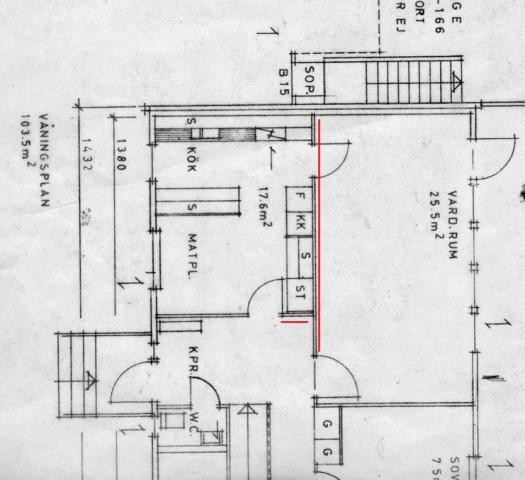
I want to remove walls along the red line (see image_1).
The roof trusses are of type W, and the lower and upper arms are made with 145x45.
Span of 7.5 m between outer walls with a roof slope of 27 degrees.
Located on the border between snow zone 2 and 2.5.
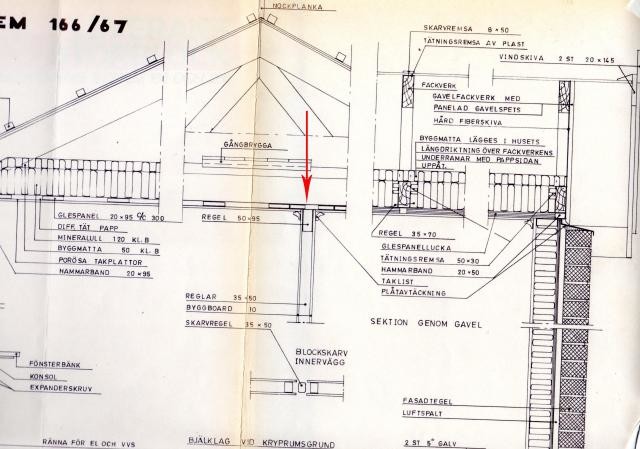
The marked interior wall is built according to image2.
My perception is that this wall is not load-bearing, but of course, one wants to be on the safe side.
/Roy
Yet another issue with a load-bearing wall.
I am going to redo the kitchen and open it up towards the living room.
I have checked quite a bit and just want to confirm one last time before the reciprocating saw gets to work.
The house is a Gullringshus built in 1968.
I want to remove walls along the red line (see image_1).
The roof trusses are of type W, and the lower and upper arms are made with 145x45.
Span of 7.5 m between outer walls with a roof slope of 27 degrees.
Located on the border between snow zone 2 and 2.5.
The marked interior wall is built according to image2.
My perception is that this wall is not load-bearing, but of course, one wants to be on the safe side.
/Roy
According to the table in the Takstolshandboken, 45x145 in the top and bottom chord timber quality T2, K24, or C24 in snow zone 2.5 can handle a span of 5.6 meters. Have a structural engineer calculate it; a beam is probably required. A building notification is also required, so you must be able to show your plan. If you just take down the wall, you risk significant deflection./MLj
Hi
Thanks for the quick response,
I had to go up to the attic and double-check.
The timber in the roof trusses is not 145x45 but 145x50. (the marking on the wood says E L, G T, if it gives any clue.
I also checked the underframe and there are 2 nailed-on battens, one on each side, that are 30x70.
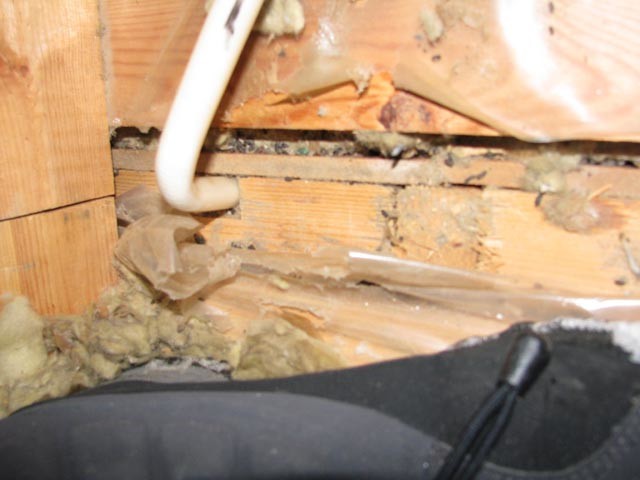
I pulled up the insulation where the interior wall goes, you can see the interior wall and it's not against the roof truss, I can get my fingers in between.
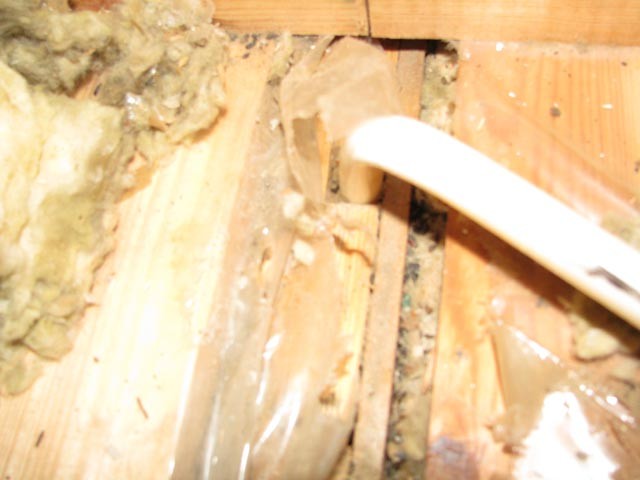
What I could see more was that there is no continuous longitudinal batten at the top of the wall, only noggings (50x95 in picture 2), I can see the end-grain of the 35x50 battens (see picture2), these seem to be just skew-nailed up towards the sparse paneling.
I think the wall seems quite weak to be load-bearing, and it's not against the roof trusses.
Could the extra 35x70 and the fact that it's 50mm instead of 45mm help achieve the correct load-bearing capacity?
/Roy
Thanks for the quick response,
I had to go up to the attic and double-check.
The timber in the roof trusses is not 145x45 but 145x50. (the marking on the wood says E L, G T, if it gives any clue.
I also checked the underframe and there are 2 nailed-on battens, one on each side, that are 30x70.
I pulled up the insulation where the interior wall goes, you can see the interior wall and it's not against the roof truss, I can get my fingers in between.
What I could see more was that there is no continuous longitudinal batten at the top of the wall, only noggings (50x95 in picture 2), I can see the end-grain of the 35x50 battens (see picture2), these seem to be just skew-nailed up towards the sparse paneling.
I think the wall seems quite weak to be load-bearing, and it's not against the roof trusses.
Could the extra 35x70 and the fact that it's 50mm instead of 45mm help achieve the correct load-bearing capacity?
/Roy
Last edited:
Hello
The timber is therefore 50 mm thick, probably 150mm wide and unplaned?
There are no numbers indicated?
Check if the knots on the edge are less than 25mm and knots on the flat side are less than 1/4 of the width; if that is fulfilled and there are no other defects, the timber can be classified as T2.
If the house is located in snow zone 2 and the top chord is 45x170 T2, it can handle a span of 7.7 meters.
Do the trusses have press plates? If so, you can reinforce the top chord with nailed-on, for example,
22x145 one on each side, nailed with 4-inch nails, 2 from each side c300mm.
Check with an expert on-site before you start cutting as it would look bad if the roof sags./MLj
The timber is therefore 50 mm thick, probably 150mm wide and unplaned?
There are no numbers indicated?
Check if the knots on the edge are less than 25mm and knots on the flat side are less than 1/4 of the width; if that is fulfilled and there are no other defects, the timber can be classified as T2.
If the house is located in snow zone 2 and the top chord is 45x170 T2, it can handle a span of 7.7 meters.
Do the trusses have press plates? If so, you can reinforce the top chord with nailed-on, for example,
22x145 one on each side, nailed with 4-inch nails, 2 from each side c300mm.
Check with an expert on-site before you start cutting as it would look bad if the roof sags./MLj
Is every other stud aligned directly under a roof truss?
Normally, you wouldn't have nogging in a load-bearing wall, but rather a recessed plank vertically, but if the studs are directly under the roof truss, it will still work.
If you have a basement or crawl space, then you likely have a load-bearing wall there, directly under the wall you want to remove.
Normally, you wouldn't have nogging in a load-bearing wall, but rather a recessed plank vertically, but if the studs are directly under the roof truss, it will still work.
If you have a basement or crawl space, then you likely have a load-bearing wall there, directly under the wall you want to remove.
Was up and checked again.
Didn't find a number but it says E.I and G.T inside a big D.
Not many branches at all.
But the thickness of the upper frame doesn't really matter for how much the lower frame will sag or have I got it all wrong?
If the upper frame is too weak, it has always been too weak for this snow zone, with or without a supporting wall.
Furthermore, all joints have press plates, and you can see in picture2 the two reinforcements of the lower frame with 35x70 mm studs.
/Roy
Didn't find a number but it says E.I and G.T inside a big D.
Not many branches at all.
But the thickness of the upper frame doesn't really matter for how much the lower frame will sag or have I got it all wrong?
If the upper frame is too weak, it has always been too weak for this snow zone, with or without a supporting wall.
Furthermore, all joints have press plates, and you can see in picture2 the two reinforcements of the lower frame with 35x70 mm studs.
/Roy
Last edited:
Hi JOW
Yes, there's a basement underneath, and that wall is load-bearing.
And no, every other post does not stand under the roof truss, as I mentioned, I can get my fingers between the roof truss and the wall.
If you look closely, it stands pretty much like in image 2, hitting half of the sparse panel.
/Roy
Yes, there's a basement underneath, and that wall is load-bearing.
And no, every other post does not stand under the roof truss, as I mentioned, I can get my fingers between the roof truss and the wall.
If you look closely, it stands pretty much like in image 2, hitting half of the sparse panel.
/Roy
Okay, but then the inner wall can still be under pressure on half of the sparse panel.
In my amateur eyes, I don't think the wall is load-bearing, but it might prevent visible sagging. In that case, it would reduce the size of a potential beam.
But I can't say anything other than Mats Lj, let someone calculate it.
In my amateur eyes, I don't think the wall is load-bearing, but it might prevent visible sagging. In that case, it would reduce the size of a potential beam.
But I can't say anything other than Mats Lj, let someone calculate it.
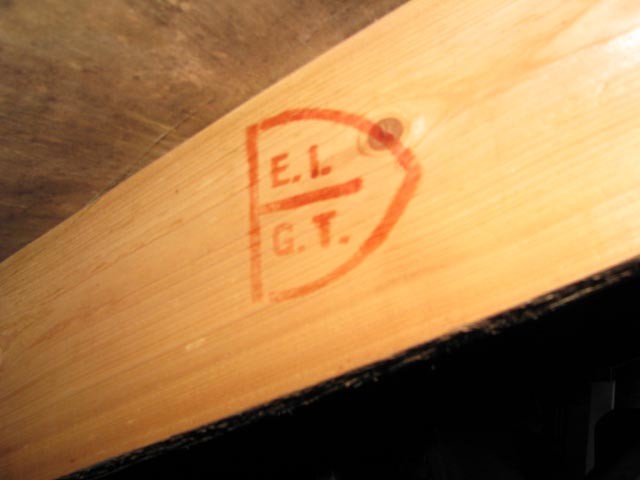
The stamp says it is sorted by a Mr. Einarsson, GT could mean Gullringshus. Looks very finkvistigt.
The upper and lower frames work together in a truss, the brace closest to the outer wall transfers a compressive force from the upper frame to the lower frame. The brace from the ridge absorbs a tensile force.
When you see the batten spacing, you wonder if the outer roof consists of eternit? or some other lighter material.
Gullringshus was a large manufacturer so they calculated precisely on dimensions and didn't take too much in excess, the Truss Handbook's table might calculate with lower deflection.
The builder, i.e., you, are always ultimately responsible during construction, so the decision is yours/MLj
The upper and lower frames work together in a truss, the brace closest to the outer wall transfers a compressive force from the upper frame to the lower frame. The brace from the ridge absorbs a tensile force.
When you see the batten spacing, you wonder if the outer roof consists of eternit? or some other lighter material.
Gullringshus was a large manufacturer so they calculated precisely on dimensions and didn't take too much in excess, the Truss Handbook's table might calculate with lower deflection.
The builder, i.e., you, are always ultimately responsible during construction, so the decision is yours/MLj
No, they are concrete tiles.
If I may speculate freely before I have all the info on the load-bearing capacity, I think the extra 35x70 nailed to the subframe is the key to it not being a load-bearing wall.
I need to consider how much extra load capacity these add to the construction, I haven't seen this before but it should contribute somewhat to the load-bearing capacity.
If you look further along the middle wall, the partition wall ends without support for several wardrobes (the back is just a panel), sure it's only a 2m gap but still.
I'll ask someone to calculate it before I go at it with the saw.
If I may speculate freely before I have all the info on the load-bearing capacity, I think the extra 35x70 nailed to the subframe is the key to it not being a load-bearing wall.
I need to consider how much extra load capacity these add to the construction, I haven't seen this before but it should contribute somewhat to the load-bearing capacity.
If you look further along the middle wall, the partition wall ends without support for several wardrobes (the back is just a panel), sure it's only a 2m gap but still.
I'll ask someone to calculate it before I go at it with the saw.
Get in touch with the municipal building inspector, they had more information. In the technical documents about the house, it stated that only the outer walls are load-bearing, and he also commented that the 35x50 studs in the wall are too weak to be load-bearing.
So now it's time to let the reciprocating saw do the work.
/Roy
So now it's time to let the reciprocating saw do the work.
/Roy
Member
· västernorrland
· 12 posts
I'm having precisely the same thoughts with a similar house.
How has it gone for you?
Sent a PM as well.
How has it gone for you?
Sent a PM as well.
