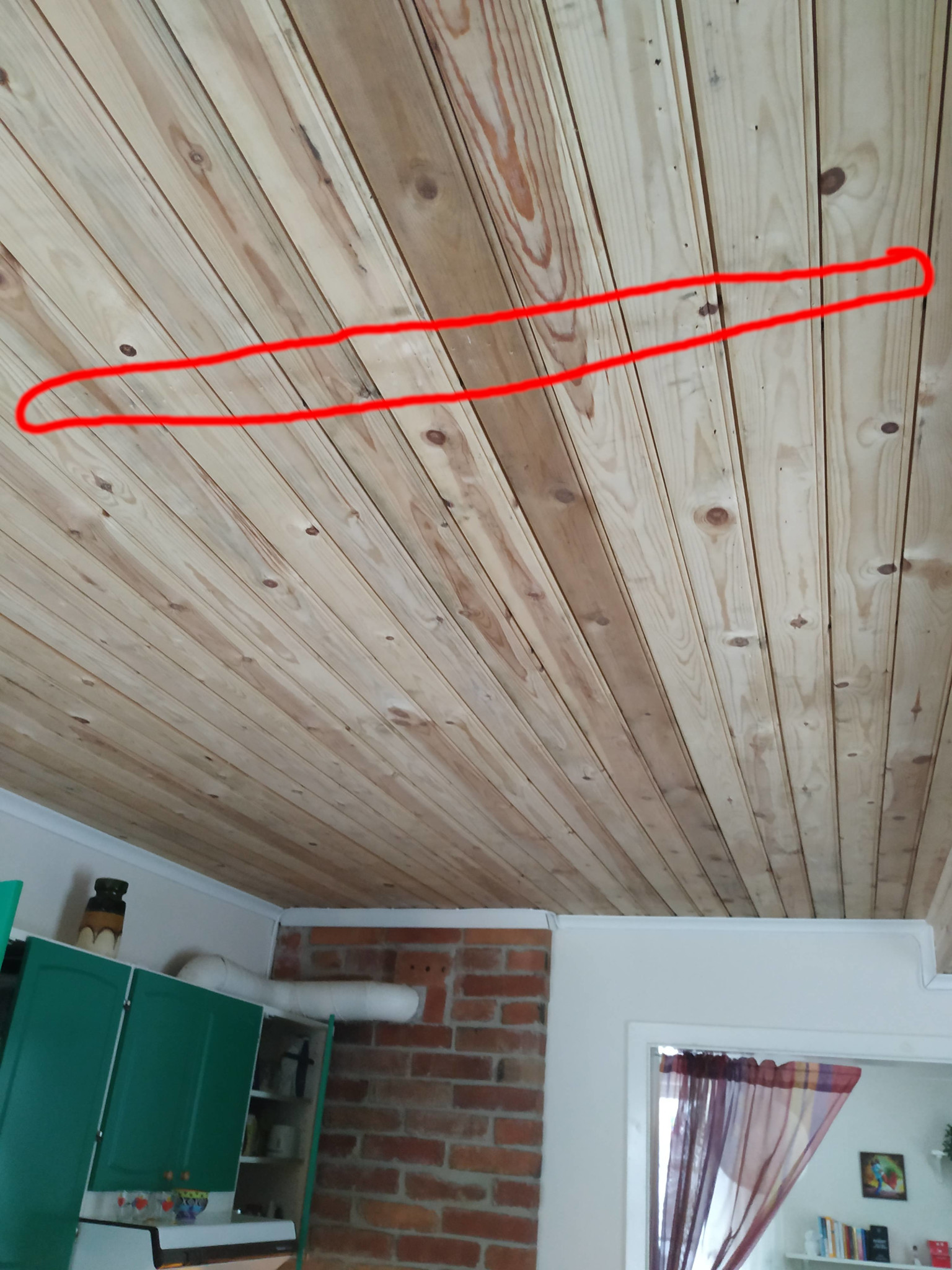
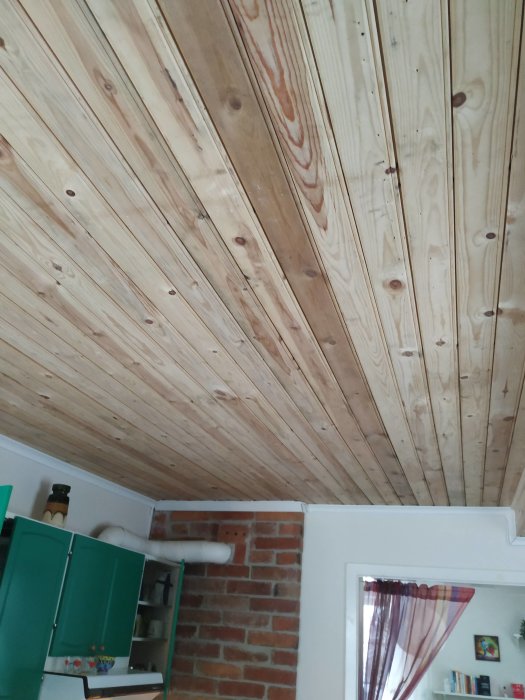
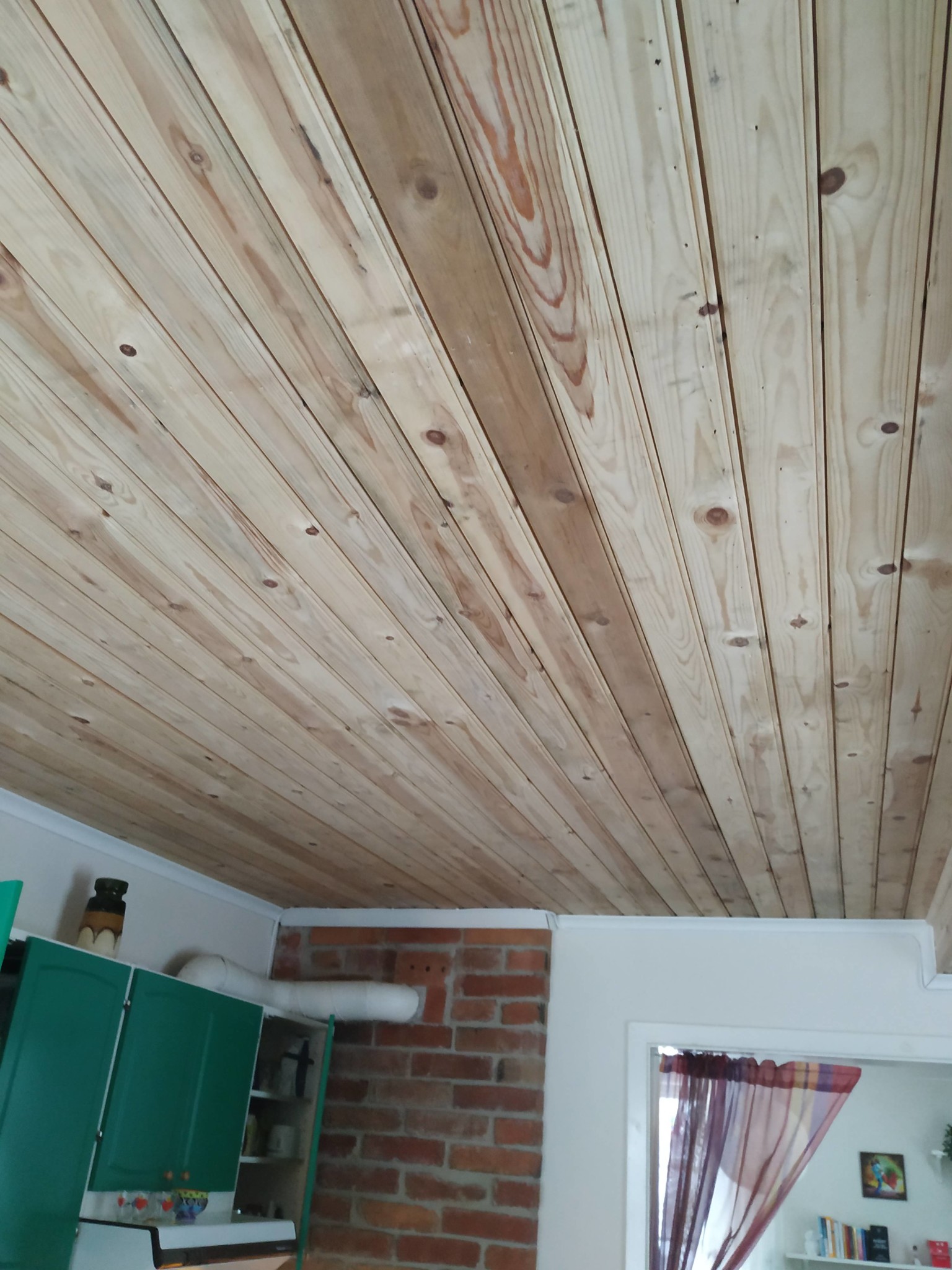
I am wondering how to go about attaching two gymnastic rings to the ceiling. Do I need to find some studs behind the beadboard or is the beadboard usually attached to some solid boards that might be sufficient as a mount? An adult should be able to hang from the rings. The beadboard is nailed with 66cm spacing that can be seen in the gap between the boards. Could it be attached to a stud?
Wooden house from the early 1900s. This is taken on the ground floor with a bedroom directly above.
You should definitely attach to the joists, i.e., not to the tongue and groove or any other boards that might be nailed under the joists.
That's unfortunate! Are there any standards for stud spacing to go by? Does such a stud detector work through the tongue and groove and possibly boards underneath it?
Currently, the most common distance for joists is 600mm, but in such an old house, there is unfortunately no standard practice. It could be that the flooring above shows where the joists are, as old subfloors are often nailed from above. I have limited and doubtful experience with stud finders, unfortunately, I suggest you call a rental company and explain the scenario.
The beadboard is nailed to the studs, (which are apparently spaced 66 cm apart). You can check by drilling a small hole next to a nail head; if it meets resistance all the way in, there's a stud there. If it's inconvenient to screw the rings right where the studs are, you should add an extra board to the ceiling for the hooks that transfers the weight from the rings to the nearby studs.
The beadboard is nailed to the studs (which are apparently spaced at 66 cm apart). You can check by drilling a small hole next to a nail head; if it encounters resistance all the way in, there's a stud there. If it doesn't work well to screw the rings exactly where there are studs, you'll need to put an extra board in the ceiling for the hooks to transfer the weight from the rings to nearby studs.
So it could be, or there might be one or more layers of plank/masonite between the beadboard and the joists - i.e., the beadboard could be nailed anywhere.
You can feel it with the drill. First, it resists for a centimeter in the tongue and groove, then the drill jumps a bit when it goes into the next layer. If the second layer resists for more than three-four centimeters, it's probably a stud. If there's another jump after two centimeters, it's more likely rough sheathing than a stud.
You can feel it with the drill. First, it resists for a centimeter in the beadboard, then the drill jumps a little when it goes into the next layer. If the second layer resists for more than three to four centimeters, it's probably a stud.
If there's another jump after two centimeters, it's more likely to be a rough board than a stud.
Good tip with the drill. I'll try it in the coming days.
... Are there any standards for stud spacing to start from? Does such a stud detector work through paneling and possibly boards underneath it?
You can see nail rows made a bit carelessly in the middle of the paneling, behind which there should be a stud. At least one row can be seen without a detector.
I would, however, like to know how sturdy the studs are; there are higher strength requirements when someone is going to hang from something with their head downwards than when hanging up a lamp. I would test hanging at least 6 times the user's weight on each ring before they can be used.
You can see nail lines made a bit carelessly in the middle of the beadboard, behind which a stud should be located. There should be at least one line that can be seen without a detector.
[image]
However, I would like to know how sturdy the studs are, there are higher strength requirements when a person hangs in something with the head down than when hanging a lamp. At least 6 times the user's weight I would test hanging in each ring before they can be used.
Nah, those are probably nail holes left from some paper that covered the ceiling before. There was some paper and Masonite on the beadboard that I uncovered this summer. I'll wait until the wood dries properly this winter and then I'll paint it. There's almost always something nice behind something ugly in old houses...
Click here to reply
Vi vill skicka notiser för ämnen du bevakar och händelser som berör dig.

ÅkeSun said:
The beadboard is nailed to the studs (which are apparently spaced at 66 cm apart). You can check by drilling a small hole next to a nail head; if it encounters resistance all the way in, there's a stud there. If it doesn't work well to screw the rings exactly where there are studs, you'll need to put an extra board in the ceiling for the hooks to transfer the weight from the rings to nearby studs.