No, the nockbalk must rest on two regel ends to achieve a sufficiently large bearing surface. You might be able to use some form of distansläkt below the cantilever so that the reglar stand a bit away from the facade.
So then I should be able to use a 45x120 as a spacer. Then take two of those and assemble them as a beam for the main structure. I could perhaps miter screw the two together with the third one that I've attached to the façade to hold it in place. The upper part I can then attach the beams that come up also to the façade. Then they rest partly on the ground and are screwed to the façade.
Does that sound like a good solution?
Hello.
I'm borrowing the thread a bit as I have the same questions.
My patio is 3.7m deep and 5m wide.
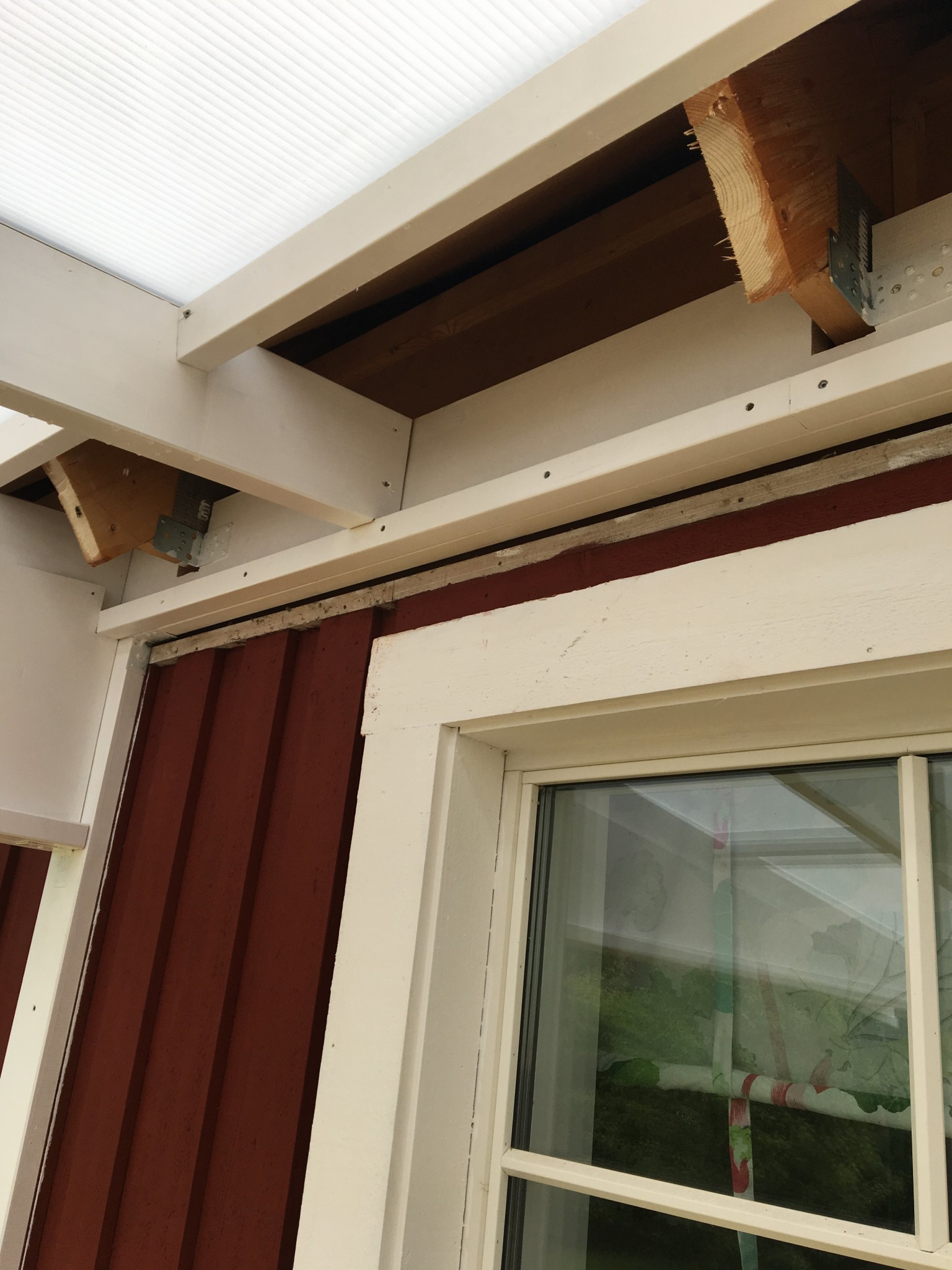
I've done it like this with angle irons that I will then enclose with a small roof where I'll place spotlights (so I can hide the existing roof trusses of the house).
The question is whether I should put a 42*120 beam in the middle as well? Or does this work?
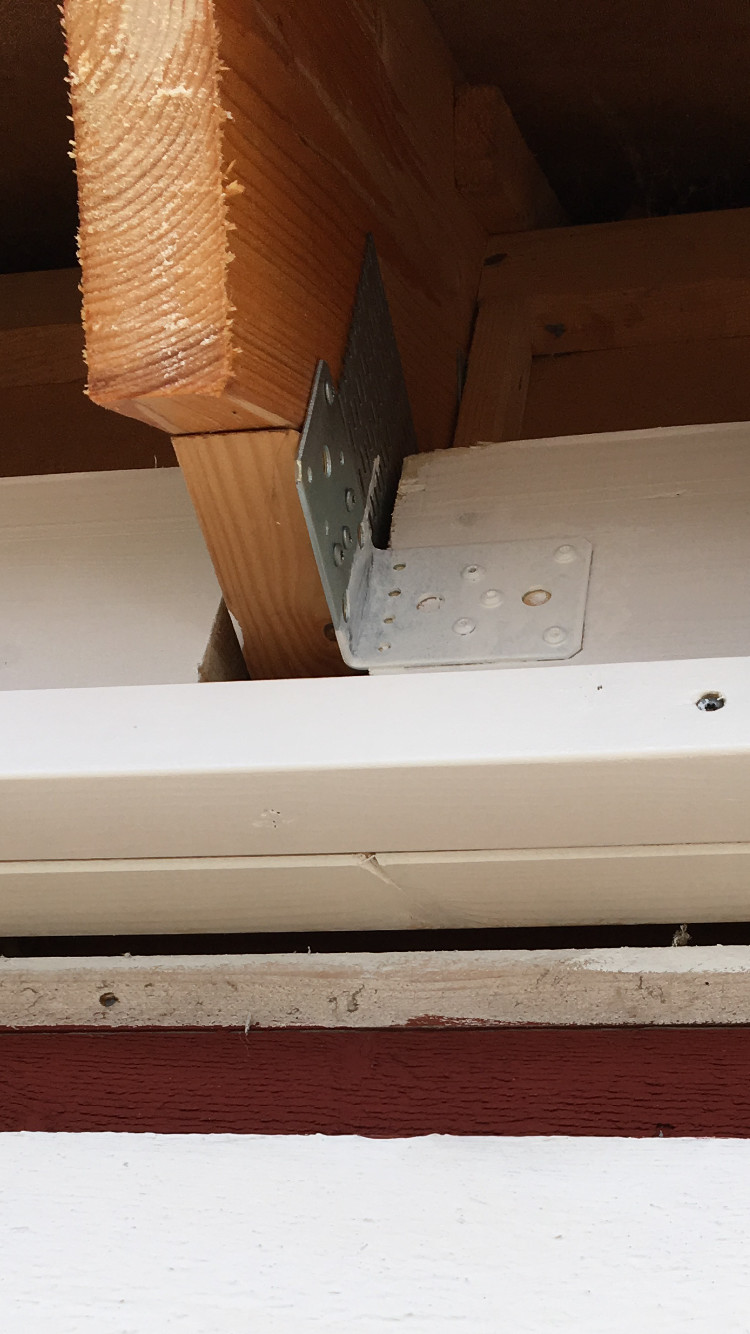
As far as I understand, you have a sloped roof extending from the house. The roof is supported by glulam beams approximately 42x180 on c/c 1200? If these assumptions are correct, the load at the ends of the beams is at most around 5 kN per beam, i.e., just over 500 kg. This is therefore a significantly smaller load than what emde has from their ridge beam. Whether your chosen solution holds depends mainly on whether you have enough sturdy screws with sufficient anchorage to handle a load of 500 kg from each beam end. This I cannot determine from the picture. Is it an outwardly stepped glulam beam on the inside, only hanging from the house's rafters with the help of angle brackets?
Yes, it is 1200cc on the roof's glulam beams.
It is a urkackad glulam beam that stands on each 42*120 stud at each end, then suspended/fixed with angle irons on the house's glulam beams.
The distance between the 42*120 studs is just over 4 meters. Should an additional stud be placed in the middle of them?
Or is there a better solution?
If you want a glulam beam that is free-standing over just over 4 meters with the current loads from the roof beams, a dimension of 42x270 without notches is required! I think it's a better strategy to ensure that what you have already installed is sufficiently anchored in the house.
The very best would be if you can screw the notched beam directly into the wall. There must be a wall plate that the house's roof trusses rest on right behind the beam.
Now I am very bad at the construction of houses etc.
But the roof trusses seem to rest on beams that run in the same direction as the roof trusses (see image). Behind "my" glulam beam, I have small beams and insulation.
My original plan was to attach the beam to the wall.
But when I started tearing down and raising the deck, the material was already ordered.
You would need to have a support for your ridge beam that is 90 mm wide and at least 70 mm deep.
How did you arrive at the support length? I think it sounds long.
Byggbeskrivningar.se says 19mm
I get 45 mm when I calculate.
so it should at least be enough with a 45x145 if it is braced in the weak direction.
Reply to larsbj: The stress on the beam should preferably not exceed 3 MPa according to new findings.
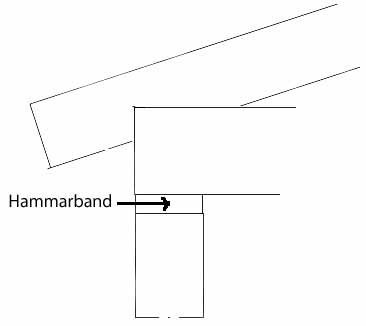
Reply to Köttisar: What you see under the truss is the bottom chord of the truss (the name depends a bit on how the truss is constructed, but it doesn't matter here). This, in turn, rests on a wall plate, which is a beam that lies on top of the wall's vertical studs. See attached sketch.
No, I don't think so, but I have just read an LTH report on the subject, deformation problems in glulam due to excessive support pressure. 45 mm surely works well, 19 mm I find for several reasons to be a suspiciously small measure. Then one can always discuss how to consider snow load in this case. The maximum load must occur very rarely.
Justunsandersson: Good drawing there, then I get it (sorry, but I'm new to this area).
I've passed the hammarband, as I wanted higher ceilings and to align with all the doors.
So unfortunately I have to adapt accordingly (now that almost everything is done).
Thanks for all the answers and sorry to Emde if I hijacked your thread.
Best regards
Vi vill skicka notiser för ämnen du bevakar och händelser som berör dig.