
23,133 views ·
22 replies
23k views
22 replies
Attaching building brackets to an outdoor Leca wall
Hello,
We have a wall made of plastered leca. We need to install a fence on the wall. I'm wondering if anyone can help me with a smart solution for how to best attach the fence post connectors to the leca? Is there a quick, smart, and smooth solution?
I'm considering using pressure-treated post 70x70 that is mounted in a connector.
The next problem I have is that parts of the wall are not horizontal but slope quite steeply downwards due to height differences. How do you make the fence post straight... is there any adjustable connector, or do you bend the connector so that it becomes vertical?
Grateful for all tips!
We have a wall made of plastered leca. We need to install a fence on the wall. I'm wondering if anyone can help me with a smart solution for how to best attach the fence post connectors to the leca? Is there a quick, smart, and smooth solution?
I'm considering using pressure-treated post 70x70 that is mounted in a connector.
The next problem I have is that parts of the wall are not horizontal but slope quite steeply downwards due to height differences. How do you make the fence post straight... is there any adjustable connector, or do you bend the connector so that it becomes vertical?
Grateful for all tips!

Hello,
Thank you for taking the time. Here are some more details on what I want to do:
1. I want to mount a TT-form support in the Lecamuren (see attached image). In the best way. Do hollow wall plugs and coach screws work to attach this?
2. Once in place, I will mount the fence posts into the bracket. The fence should be about 90 cm high and the posts in pressure-treated timber 70x70. Do coach screws work for attaching the posts in the brackets?
3. In certain places there are differences in height, and where the wall slopes. Then I'm considering bending/tilting the post bracket so that it becomes vertical?
Thank you in advance!
Regards, Christian
Thank you for taking the time. Here are some more details on what I want to do:
1. I want to mount a TT-form support in the Lecamuren (see attached image). In the best way. Do hollow wall plugs and coach screws work to attach this?
2. Once in place, I will mount the fence posts into the bracket. The fence should be about 90 cm high and the posts in pressure-treated timber 70x70. Do coach screws work for attaching the posts in the brackets?
3. In certain places there are differences in height, and where the wall slopes. Then I'm considering bending/tilting the post bracket so that it becomes vertical?
Thank you in advance!
Regards, Christian



I'm not an expert on this. But I've understood that the pros often use so-called "chemical anchors" if it needs to hold really well. It's a substance, somewhat like plastic padding.
If you go to more professional building markets, there are a few different variants (I would probably ask which variant fits because it seems to be a science in itself).
I used it myself once when a radiator bracket fell off in our basement. It was hopeless to fasten it to the concrete blocks that the wall consisted of. With chemical anchors, it was possible to hang back the 50kg heavy radiator after a short while.
As mentioned, it resembles plastic padding but seems to be much more durable, cures faster, and comes with an (expensive) system that mixes it correctly while injecting it into the hole.
If you go to more professional building markets, there are a few different variants (I would probably ask which variant fits because it seems to be a science in itself).
I used it myself once when a radiator bracket fell off in our basement. It was hopeless to fasten it to the concrete blocks that the wall consisted of. With chemical anchors, it was possible to hang back the 50kg heavy radiator after a short while.
As mentioned, it resembles plastic padding but seems to be much more durable, cures faster, and comes with an (expensive) system that mixes it correctly while injecting it into the hole.
I used chemical anchors to fasten post shoes in my leca wall. What I used was Sika's version in a regular glue tube (the kind you put in a gun grip). I remember it cost about 300 SEK. There are also glass ampules that you put in the holes and crush. They might cost around 50 SEK.
Fits like a glove!
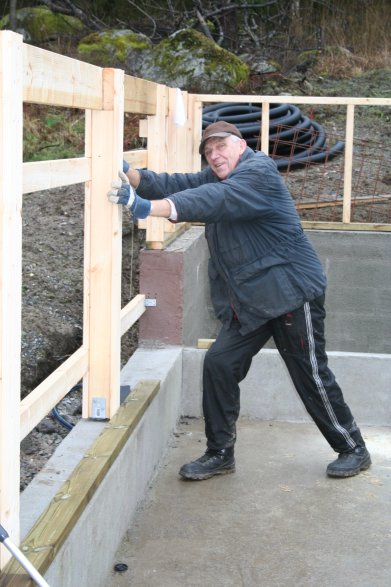
Fits like a glove!
It was that Sika variant I also used (which I thought was expensive but good). It's not an ordinary glue tube even if it looks like it. The nozzle contains some sort of labyrinth where the two components (both come isolated out of the same hole in the tube) are mixed.
I got the idea that you needed a special device for the glass ampoules, but maybe that was just to ensure a precise crushing of the glass?
I got the idea that you needed a special device for the glass ampoules, but maybe that was just to ensure a precise crushing of the glass?
What was explained to me is that it's just a matter of crushing them. It's not a problem when you have a construction fitting to smash with. It should also be stirred around a bit since there are two vials in the glass ampule. As you say, it's a two-component product.
/fredrik
/fredrik
Yes, the father-in-law could let go and it stayed put!
The back part that's built higher is screwed with special screws and plugs that I bought at Beijers for the purpose. I can tell you it was super expensive, don't remember exactly how much it cost, but it was several hundreds for that small supply. It wasn't as stable as chemical anchors.
If it's a high wall, I would definitely use chemical anchors and post shoes, imagine if someone leans against the fence and it gives way? Leca is quite porous so it might be problematic to get anything else to hold. Chemical anchors in a leca wall become very solid, it's as if the post shoes were cast into the wall.
It's also relatively little work, drill holes, spray in chemical anchors, press down the fittings, and ensure the chemical anchor fills out.
I'm going to put down more fittings in the slab and wall, will definitely buy another cartridge!
/Fredrik
The back part that's built higher is screwed with special screws and plugs that I bought at Beijers for the purpose. I can tell you it was super expensive, don't remember exactly how much it cost, but it was several hundreds for that small supply. It wasn't as stable as chemical anchors.
If it's a high wall, I would definitely use chemical anchors and post shoes, imagine if someone leans against the fence and it gives way? Leca is quite porous so it might be problematic to get anything else to hold. Chemical anchors in a leca wall become very solid, it's as if the post shoes were cast into the wall.
It's also relatively little work, drill holes, spray in chemical anchors, press down the fittings, and ensure the chemical anchor fills out.
I'm going to put down more fittings in the slab and wall, will definitely buy another cartridge!
/Fredrik

Yep, see the previous addition.Funkybase said:
I used 25 mm, that's what I had, maybe something smaller could have worked. I should add that I had post shoes for thicker posts (95x95).Funkybase said:
Ideally, you would drill deep enough to reach the bottom, but it's probably hard to drill with such precision. I think I put a piece of tape on the drill bit to see how deep I should drill and went about half a centimeter deeper. There's a lot of dust in the hole, so ideally, you would have compressed air available. I didn't. The mass didn't want to stick in the wet state to the walls of the hole due to the dust, but it doesn't seem to have impacted the result. I placed a couple of strips between the wall and the underside of the post shoe to fix the height.Funkybase said:
Depends on the temperature. It dries relatively quickly. About a day with the current temperatures, I recall (but I might be wrong). You could use it (Sika's) at relatively low temperatures as long as you made sure the chemical anchor was warm when you used it.Funkybase said:
If there's not too much slope on the wall, I would aim to drill straight down instead of trying to bend the pins.
/fredrik
It is usually not fun to drill holes to larger dimensions in stone material, I think it just tends to chip and get stuck. But it does help to have the right tools, I was able to borrow a hefty atlas-copco from my dad's company, but on the other hand, leca is quite brittle.
Fredrik
Fredrik