OSB covered with a few layers of plasterboard. Only need studs in the corners. Heavy enough and cheap. All materials are available at ByggMax. Assuming that what you mention in TS about ventilation and service hatches is included in the planning. Studs by the way. A little lath is enough. Regards, Findus
RB: Well, it wasn't primarily your attitude I was referring to, you only need to take as much as you think you deserve.
The side topic of car engines can be discussed endlessly. There are many efficient and quiet car engines, and it's probably a power compromise, but I'm not looking to tune the compressor either. Just want the airflow to be sufficient for the power used.
I believe in empirical studies, i.e., attempts. So, I will test it out. Often I do something not because it's easy, but because that's how I want it. If the project turns out well, perhaps I'll share it here so others can learn from my experiences. There's no point in posting anything in advance since I don't know if it will be as good as I want or if it will even be the final result.
Thanks for the tips regarding material selection, I haven't decided yet, plywood, OSB, or MDF it will probably be. Considering the material consumed, I probably can't afford more than this. Because it's not just boards that need to be purchased; hardware, screws, joists, shelves, and more will be needed before this is "finished." Hopefully, a couple of weekdays in between will be enough to complete, but I'm normally a time optimist, and it usually takes about three times as long, at least, so we'll see...
When I got halfway through the thread, I thought of suggesting that you build with a strong but cheap material, then glue/screw on a layer of plasterboard to increase the weight and introduce another resonance frequency (prevents some frequencies from accidentally being amplified).
But then I saw that findus42 had already come up with that proposal.
An interesting proposal, which seems more well-founded now that two people have made the same suggestion. I'll consider it.
I was sitting again yesterday with the sketch and shopping list, and the pieces are slowly falling into place, and yesterday I came across an interesting thread about "ljudfällor" on some forum, and what was mentioned there follows my principle. I don't have sophisticated measuring equipment and not enough professional expertise, so for my part, it will have to be a bit of "trial and error."
It should be mentioned that I'm not after a world championship, but rather to furnish the room it's in and maybe gain a decibel or two. I won't be watching a movie and varnishing the boat at the same time anyway!
This weekend came the real test for the compressor box. Even though it has been "finished" for a couple of weeks, it wasn't until now that the compressor was run to a greater extent. Upon startup and the first test, it's noted that the noise level now is as if the compressor were in another room; so far, I am satisfied.
Then I get a slightly odd effect because the intake air is taken via the backside, towards the outer wall. This results in the temperature dropping during operation, only to increase again when the compressor shuts off. When the compressor starts after being idle for a while, it must pump up from zero (in principle) and therefore runs longer than during usual more continuous use. During this first test, the temperature in the box rose to about 25 degrees and lingered for a little over an hour before dropping again. I thought I would probably need to come up with a good ventilation solution if I were to use it more continuously. But to my great surprise, the temperature never rose above 25 degrees despite a whole day of tinkering and several wheel changes where the wrench was running hot. Each time the compressor kicks in, it cools itself so that it starts to heat the space it's in again. I'm not getting ahead of myself yet; more tests will come, the temperature gauge will remain in place, and the max/min values will be reset each time to easily keep track of the temperature. The measuring probe hangs just above the compressor block at a distance of about 10 cm.
The final design choice was a "sandwich construction" of OSB, asphalt felt (which I had lying around), and gypsum. The hatch on the front is so bizarrely heavy that I can barely lift it, but the boards feel really solid; if you hit the middle of a surface with your fist, it only gives a dull thud. I would also like to thank for the tip about using lath as thin framing, it has been really useful, not just in this construction. Pictures will come for those who are interested, once everything is completely finished. The "furniture" is also intended to provide clothes storage, and that part is still pending.
Since evaluation was previously asked about in the thread:
I have now run the compressor more, mainly with the large nut driver which consumes a lot of air, but also with other tools, and no matter what I do, it doesn't get warmer than 25 degrees in the "cabinet." Either I just start it, run it once, and turn it off, then it gets maximally warm in the cabinet, then the temperature naturally drops if it doesn't run anymore, but every time it starts up, it cools itself, the temperature in the cabinet falls, and it has to start heating up the air in the cabinet again. Maybe I have an advantage because this is placed in a cold basement, maybe because it takes in air from the back, so all the air passes the cold outer wall? But it feels nice anyway to know that the biggest concern with this project did not materialize. Overheating issues seem not to be a problem with this construction.
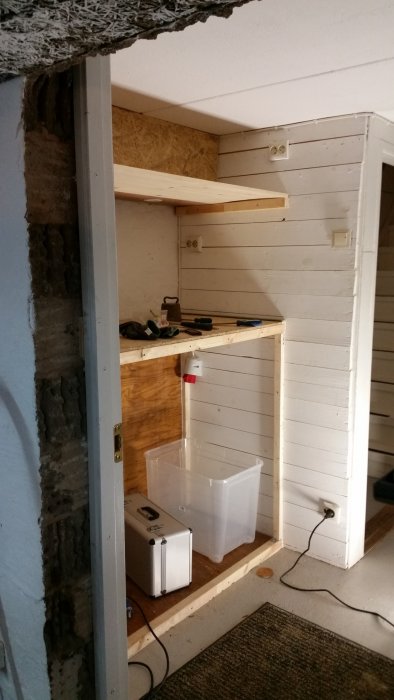
Half-finished project, in the background, you can see the board that functions as an air intake, air is drawn in through holes in the back of the top board and enters the cabinet underneath at floor level. In the picture, you can also see that a board has been placed on the floor, this is to counter resonance through the floor. Even though it's in solid concrete, it can hardly hurt, plus I got a suitable height on the "floor" inside the box that corresponds to the beam in the front. Easier to roll the compressor in and out then.
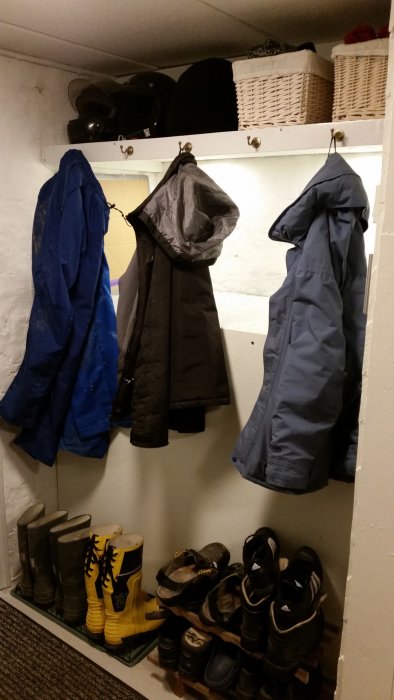
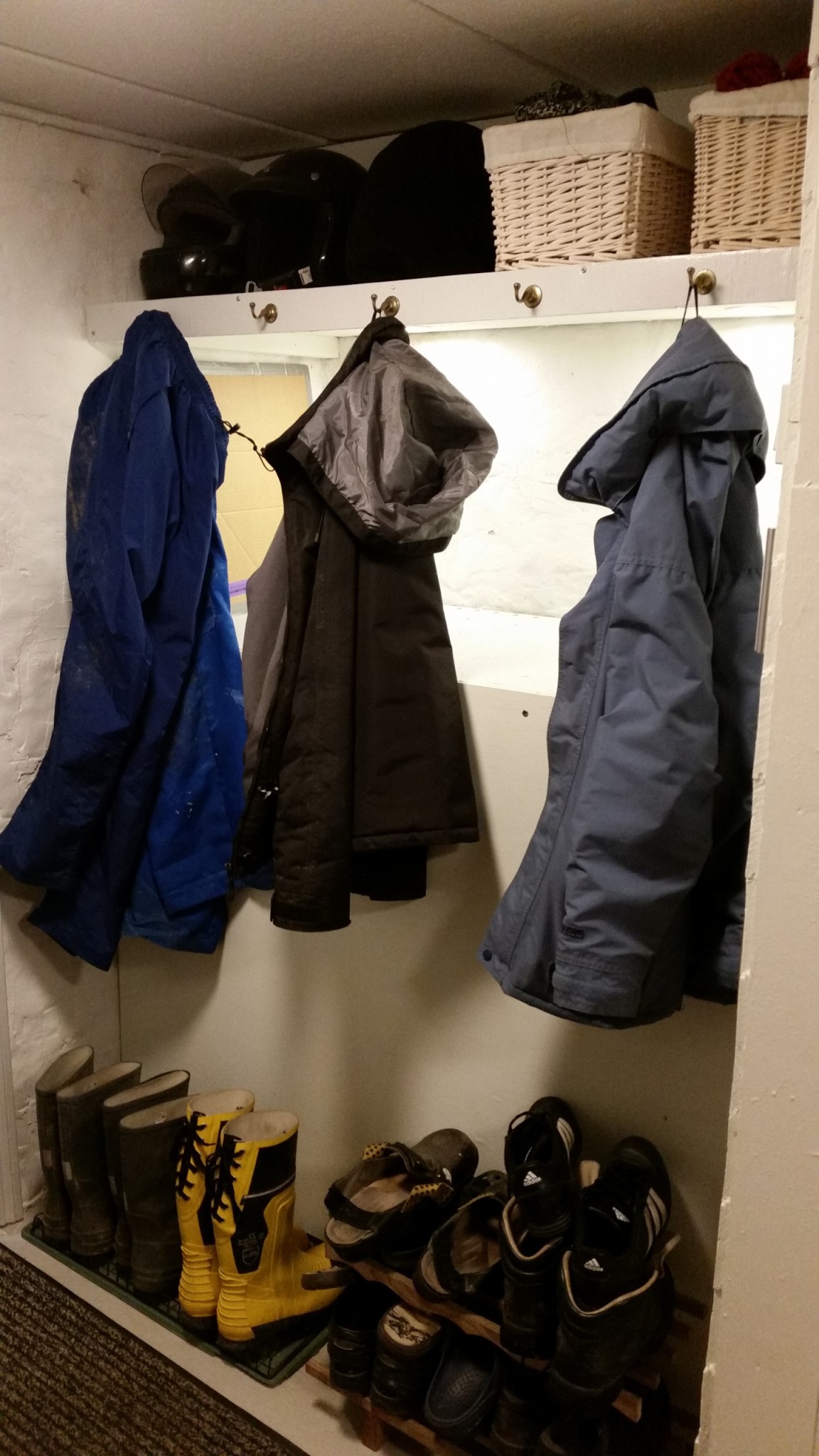
Type "finished" project. There were some compromises in this solution. I actually wanted to build it "the other way around" with the compressor on top and storage underneath, but I deemed this even more difficult, especially being able to take the compressor in and out for service and repairs. Additionally, you might get further resonance issues if the compressor were placed on a shelf and not, as now, on the floor. The large board at the front is attached with ten M6 screws that are threaded into both beams, one at the top and one at the bottom.
The next idea, to sort of finish the project, is to do something with the "empty space" behind the jackets. One idea I have is to make a couple of sliding doors out of frosted plastic glass. In this way, you can "hide" ugly storage while still enjoying the lighting inside. I admit that the placement of the spotlights was hardly necessary, but I had them lying around from another project and the cables were already in place. Any thoughts on how to proceed with this "furniture"? I can hardly get too much smart storage!
A small compressor sucks in up to 200 liters of air/min, bringing quite a bit of cooling air into the box when using the compressed air. So, you hardly get any heat problems.
...Which I have now shown with a few attempts at empirical investigations. The reason I felt such a necessity to demonstrate this was due to the skepticism with which the thread began. However, it feels good to have proven this to myself, so I don't have to think. The thermometer will stay in place, partly for continued monitoring, but as it has an outdoor/indoor function, I can also see the surrounding room temperature, which is interesting to have in various places in a house with different heating sources.
One could probably reason that a compressor located in a warmer room, with less air volume inside the box and with poorer airflow, might experience an unhealthy working temperature after a while. So it's definitely a point to consider, but nothing that makes it impossible to enclose a compressor.
Constructive criticism like "you should consider this" or similar is certainly good. But the climate on the internet has become tougher, with less cheering and more questioning. Soon one might not dare to post anything at all, but the driving force is in the enjoyment of sharing! The design turned out to be simpler than I had imagined, but with some compromises on function.
I need to take a step back and admit that I may have been a bit hasty in my conclusion that the ventilation to the compressor is sufficient. After using an air-powered grinder one afternoon, I see that the temperature inside the cabinet has risen to nearly fifty degrees! Since I want to be able to use the grinder and other air-demanding machines, this problem needs to be resolved. I'm thinking a thermostat-controlled fan that I have on the shelf should work.
To still have sound insulation against the residential part of the house, I thought of making a hole towards the garage, but that wall is 20cm lightweight concrete, so I wonder how to make the hole for the fan. I have both a demolition hammer and a large hammer drill, but I was thinking of drilling several smaller holes (about 20 mm) with the hammer drill in a circle and then "opening up" the holes with a chisel hammer. I think that even if the hole is a bit uneven, it doesn't matter much once the fan is in place.
I recently drilled a 25 cm deep hole through a basement wall with a drill like this, purchased at Jula. Worked perfectly fine. However, the wife got a bit annoyed because it was "a bit" noisy on the floor above
Sure, hole saws are great, but I didn't think hole saws for concrete in a 100mm design were reasonably priced for a one-time job. But I see that Jula also has a hole saw for this for a hundred. Hmm, I'll check what I have "on the shelf" first, I don't think I have one in such a large diameter.
Build the frame with OSB and line the inside with gypsum + some absorbent material, e.g., speaker insulation. Gypsum is cheap, and you can layer it multiple times. You're looking for weight if you want to achieve soundproofing. MDF is quite heavy and can also be used, while plywood doesn't provide significant sound insulation.
If running continuously, the ventilation requirement is approximately 100 liters/sec per kW of output from the compressor. A bathroom fan can handle around 50 liters/sec and should be sufficient for a typical small 1kW compressor if not running continuously all the time (which is rarely the case if you are alone; the recommendations primarily apply to industries with multiple users per compressor).