
6,798 views ·
66 replies
7k views
66 replies
Is the beam load-bearing or not?
M MrDizzy said:
I really hope it doesn't collapse. But the question I'm pondering is whether the rule is part of the originally calculated construction or just part of a standard wall construction.Rejäl said:
M MrDizzy said:
I really hope it doesn't collapse. But the question I'm pondering is whether the beam is part of the originally calculated construction or just part of a regular wall construction.Rejäl said:
The post is on top of the strip flooring. It is attached to the house's bottom beams, which in turn rest on a foundation wall in the crawl space.Matti_75 said:
M MrDizzy said:
I really hope it doesn’t collapse. But the question I’m pondering is whether the beam is part of the originally calculated construction or just part of a typical wall structure.Rejäl said:If you remove the single beam, the girder is unlikely to collapse, but you should keep an eye on the girder if it starts to show signs of weakness. I can say with a high degree of certainty and from experience that it will hold with just the large post remaining, but remove the post and keep an eye on the girder for a couple of weeks.
The post stands on the plank floor, which is attached to the house's bottom beams that, in turn, stand on a wall in the crawl space foundation.
M MrDizzy said:
I really hope it doesn't collapse. But the question I'm pondering is whether the rule is part of the originally calculated construction or just part of a standard wall structure.Rejäl said:If you remove the single rule, the beam is unlikely to collapse, but you should keep an eye on the beam if it starts to give way..
Based on experience, I can almost certainly say that it will hold with just the large post remaining, but remove the post and keep an eye on the beam for a couple of weeks..
The post is on top of the plank floor, which is attached to the house's base timbers that in turn stand on a wall in the crawl space foundation.
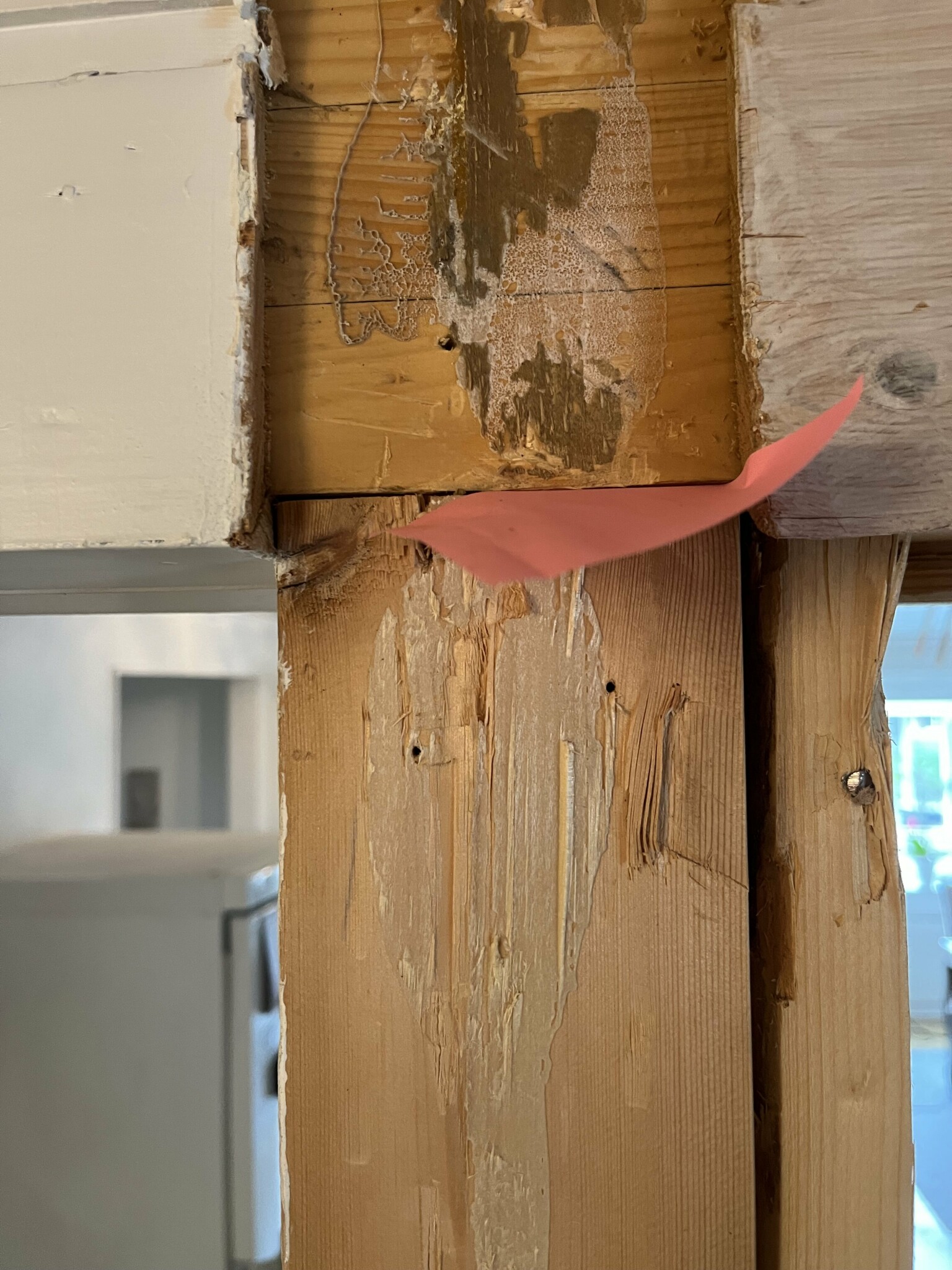
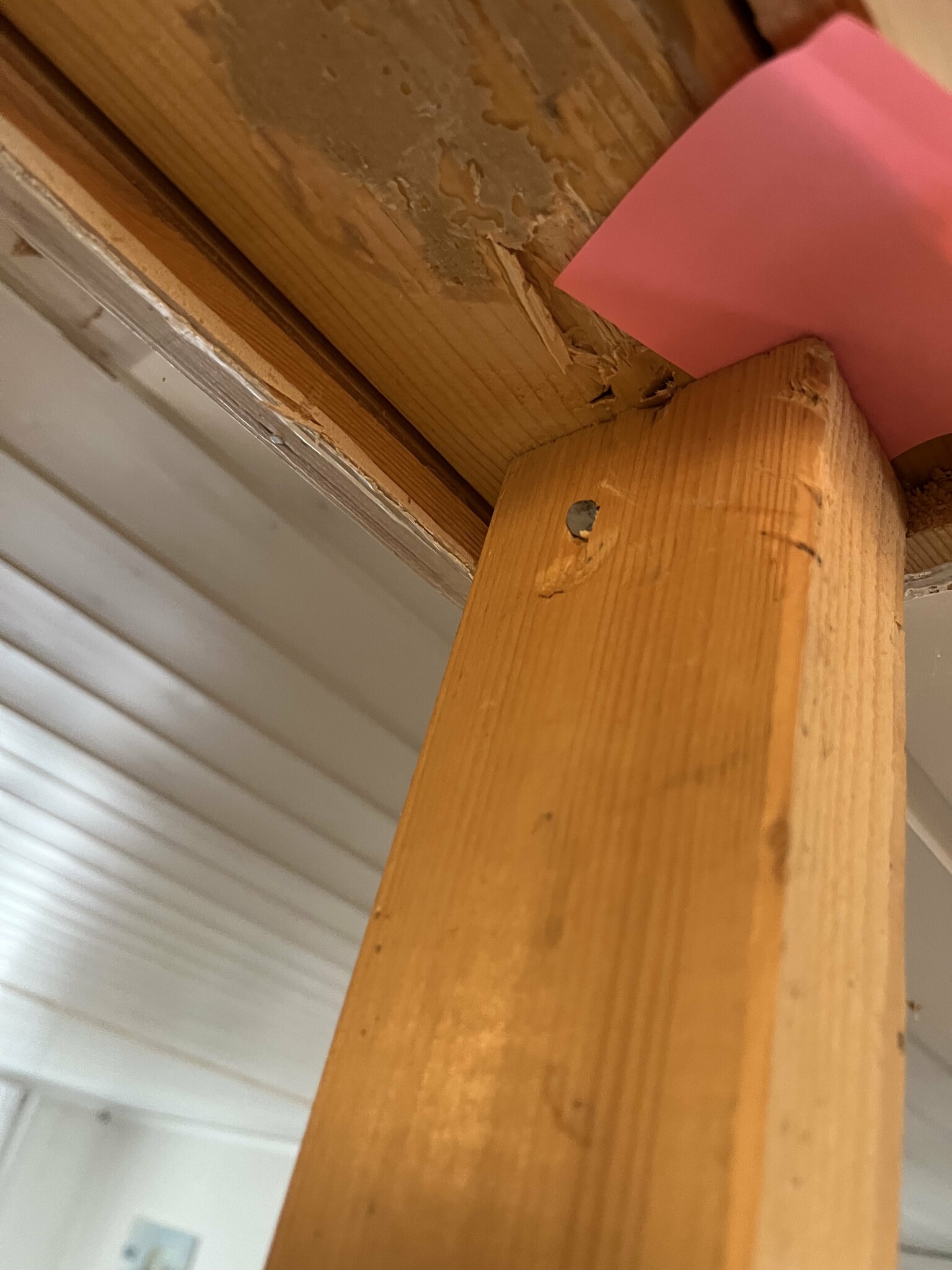
Yes, paper gaps both on top and bottom of the rule. Paper gap also at the top of the postP PappasHammare said:
M MrDizzy said:
I really hope it doesn't collapse. But the question I'm pondering is whether the rule is part of the originally calculated construction or just part of a regular wall construction.Rejäl said:
The post stands on the plank floor. Which is attached to the house's bottom joists that in turn rest on the wall in the foundation.
Yes, paper gap both at the top and bottom of the rule. Paper gap also at the top of the postView attachment 804275View attachment 804276P PappasHammare said:
The post is also on the floor plank.pacman42 said:
Is there anyone who has read even the smallest bit of strength of materials who can explain to the gentlemen how holes in different directions affect the strength. They have decided that I am wrong, so it probably doesn't matter what I write.
No, not at all. It's just that my memory says the opposite... however, as I wrote, it's been 30 years, so I might very well remember incorrectly. I thought you had good feedback; I just haven't had the time to go through it yet as other things have taken my time. It could very well be that when I look at it, I change my mind and say that my memory played a trick on me. It may also be that I don't think it fits (and then I'll look into it even more, but it might take time).D Daniel 109 said:
Pacman: I have already linked to that page. As I wrote then, it doesn't address holes in that way at all.
In a horizontal beam with a load from above, there are compressive forces at the top and tensile forces at the bottom. In the middle, there are essentially no forces. That's why lightweight beams work. A hole in the middle from the side therefore has very little impact. A vertical hole removes material over the entire height of the beam. The strength decreases by as much as the beam's cross-section decreases in the hole.
In a horizontal beam with a load from above, there are compressive forces at the top and tensile forces at the bottom. In the middle, there are essentially no forces. That's why lightweight beams work. A hole in the middle from the side therefore has very little impact. A vertical hole removes material over the entire height of the beam. The strength decreases by as much as the beam's cross-section decreases in the hole.

Why are you so stubborn. Quote or tag "the gentlemen".D Daniel 109 said:
Because it was not a response to a specific post.

No.. what mostly withstands forces from above (and below) is the upper and lower part of the beam's cross-section..D Daniel 109 said:Pacman: I have already linked to that page. As I wrote then, it does not cover holes in that direction at all.
In a horizontal beam that has load from above, there are compressive forces at the top and tensile forces at the bottom. In the middle, there are basically no forces. That's why lightweight beams work. A hole in the middle from the side therefore has very little impact. A vertical hole removes material across the entire height of the beam. The strength therefore decreases as much as the beam's cross-section is reduced by the hole.
That's why IPE, HEA, and HEB beams are so effective (despite very little material in the middle)..
Now, wood is a bit more complex than steel (unless we are talking about pre-tensioned beams) because it has fibers and is not completely homogeneous, but the principle is the same..