
13,980 views ·
20 replies
14k views
20 replies
Approach, building a mobile motorhome from a light truck
Hello!
I am planning a campervan build from a light truck, like a Mercedes Sprinter Chassis, and I'm pondering how to lay the groundwork for the project.
Question: Should I seal the inside with some type of barrier paint or primer beforehand?
The idea is a classic box that is 4200x2000x2000 inside which I will furnish as a motorhome, planning to install doors and windows for regular homes and 50 mm insulation as well as some type of underfloor heating.
But before all that, I'm wondering if anyone might have some ideas on how to prepare the box. The original interior is some type of sandwich construction. The floor usually consists of some type of plywood, the walls in some composite.
My thought, as I mentioned, is to seal the existing layer with some type of primer, then glue insulation boards, frame up a structure, and attach different types of board materials depending on what kind of furnishings will be there.
I know nothing about building houses (or campervans) so this is all very new, super fun!
I am planning a campervan build from a light truck, like a Mercedes Sprinter Chassis, and I'm pondering how to lay the groundwork for the project.
Question: Should I seal the inside with some type of barrier paint or primer beforehand?
The idea is a classic box that is 4200x2000x2000 inside which I will furnish as a motorhome, planning to install doors and windows for regular homes and 50 mm insulation as well as some type of underfloor heating.
But before all that, I'm wondering if anyone might have some ideas on how to prepare the box. The original interior is some type of sandwich construction. The floor usually consists of some type of plywood, the walls in some composite.
My thought, as I mentioned, is to seal the existing layer with some type of primer, then glue insulation boards, frame up a structure, and attach different types of board materials depending on what kind of furnishings will be there.
I know nothing about building houses (or campervans) so this is all very new, super fun!
https://explorista.se/el-i-campervan-info-lanklista-komplett-guide-till-att-bygga-campervan-del-5/Anders.Pettersson said:
Hello!
I'm in the process of planning a campervan build with a light truck, like a Mercedes Sprinter Chassis, and I'm considering how to lay the foundation for the project.
The question: Should I seal the inside with some type of barrier paint or primer beforehand?
The idea is a classic box that is 4200x2000x2000 internally, which I will furnish as a motorhome. I'm planning to install doors and windows for regular housing and 50 mm insulation as well as some type of underfloor heating.
But before all that, I'm wondering if anyone might have some ideas about how I should prepare the box.
The interior to begin with is usually some sort of sandwich construction. The floor is usually some type of plywood, the walls in some composite.
My idea, as I said, is to seal the existing layer with some type of primer, then glue insulation boards, build a frame, and apply various types of board materials depending on what furniture will be there.
I know nothing about building houses (Or campervans) so this is all very new, super fun!
There's a lot to read there about different steps...
Personally, I would have torn out the existing interior and started from plåtis, then you know it's okay with insulation and possible rust.
I think you misunderstand what I'm starting from, there is nothing to tear out, see the picture below =) This is the intended object, it's some type of 27-40mm wide construction sandwich variant.skoge said:
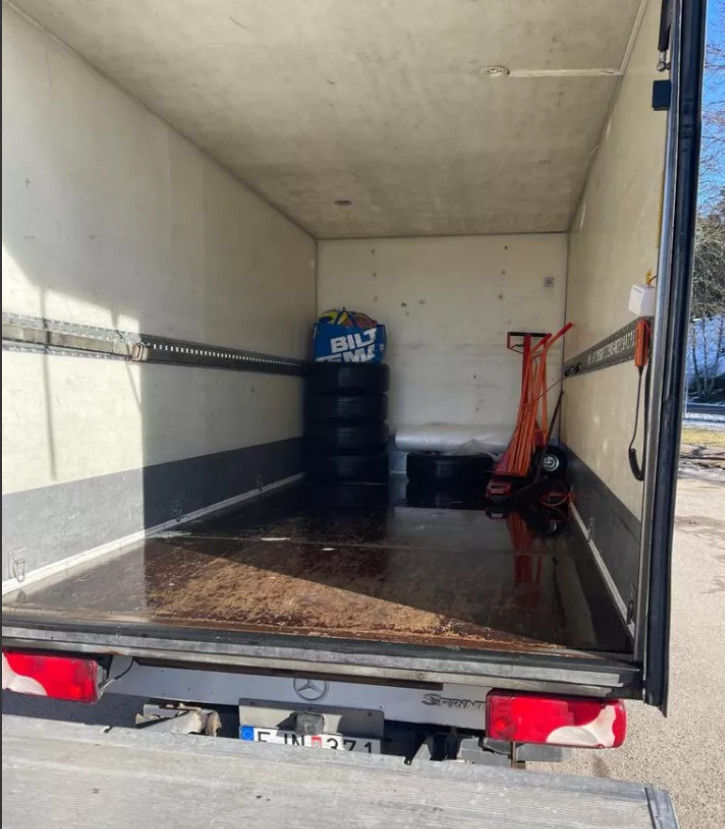
The walls are usually made of fiberglass with foam in between. If the walls are 50 mm, you don't need extra insulation, unless you plan to winter camp in Lapland, as the foam has a very good insulation value.
Then you should think light, light, light. Everything should be as light as possible; forget about regular windows and doors.
What you need can be found at a caravan scrapyard. Plastic windows and a fiberglass door with an aluminum frame.
I would cover (glue) the interior of the cabinet with thin plywood to ensure good installation of the interior.
For caravans, there is foil with underfloor heating if you plan to have the vehicle parked with an electrical outlet, otherwise, you should have water-based heating with glycol. Heaters can also be found at a caravan scrapyard.
Then you should think light, light, light. Everything should be as light as possible; forget about regular windows and doors.
What you need can be found at a caravan scrapyard. Plastic windows and a fiberglass door with an aluminum frame.
I would cover (glue) the interior of the cabinet with thin plywood to ensure good installation of the interior.
For caravans, there is foil with underfloor heating if you plan to have the vehicle parked with an electrical outlet, otherwise, you should have water-based heating with glycol. Heaters can also be found at a caravan scrapyard.
Thanks for the response! Absolutely - light is the keyword =) A light vehicle without a tail lift can load about 1000 kg, so that's my starting point. I have a mix of 4, 6, 10, and 12 mm boards in my sketches depending on what needs to be mounted. Most of the ones I'm looking at aren't refrigerated vehicles and have 27 mm walls (or thereabouts), which I don't think will be sufficient insulation. With insulation counted, inner walls, batteries, solar panels, sofa, kitchen (though no kitchen appliances), toilet, some electronics, I'm currently at an estimated load weight of 730 kg, which should mean about 250 kg left for two people+gear+kitchen items. Of this, the insulation weighs 75 kg for the XPS300 boards, maybe I should go for the 25 mm boards instead if it's overkill?Isakare said:
The walls are usually made of fiberglass with foam in between. If the walls are 50 mm, you don't need extra insulation unless you're planning on winter camping in Lapland; the foam has a very good insulation value.
Then you should think light, light, light. Everything should be as light as possible, forget regular windows and doors. What you need can be found at a caravan scrap yard. Plastic windows and fiberglass doors with aluminum frames.
I would line (glue) the interior of the cabinet with thin plywood to secure the fixtures well. For caravans, there is foil with underfloor heating if you plan to have the vehicle parked with an electrical outlet; otherwise, you should have water with glycol in it. You can also find heaters at a caravan scrap yard.
But the basic question is, do I need to block the inside before I insulate?

Hi!
Not completely sure, it looks interesting anyway! "only" driven 170,000 km, which is like half of what they usually have driven =) There are, as you say, refrigerated trucks too, but not as many so it might be a bit "take what I can get".
Aha, I didn't think about the Sprinter with an extension, I was thinking more of a Sprinter van with panels on the walls.

Smart alek
· östergötland
· 2 775 posts
I think it's aluminum flooring, it's built to handle goods, pallet trucks, and pallets