You see a lot of different types of angle irons and the like when people are building decks, sheds, and other home projects, and I'm trying to understand when they are truly needed and when it's overkill. I think that in many cases you can just use a couple of skewed screws for the same function. At least when it's not load-bearing; for example, a beam support I can understand because screws may not be designed to carry that force.
A clear example is attaching a framework on top of support beams when building a deck. Would you use angle irons then or just drive screws diagonally down through the beams into the support beams?
Or for that matter, when building a standard stud wall, do carpenters drive a skewed screw down or use angle irons? Of course, there are advantages with angle irons since you get perfect 90 degrees automatically and avoid a crooked stud if the angle iron is strong enough, but what is the standard for DIY?
Angle brackets, well - I basically never use angle brackets. Decks - Nope, studs are screwed diagonally against carrying beams. Studs against carrying beams - Joist hangers if it's the best solution and they can't rest on it.
Walls - Always use metal studs so the only place with wood is around doors. No angle there.
I don't believe an angle bracket is exactly 90 degrees either. Might have to dig one out and check...
So briefly, there aren't many times I've used angle brackets in any regard.
Well, once - Posts on L-foundations. We used thick angle brackets against the concrete to attach the posts so the trellis could go all the way down past the L-foundation.
Then I probably have a couple in the carpentry shed at the cabin holding the roof trusses when I think about it... even though they're screwed from underneath. Mostly because it wobbled a bit too much when I laid the tongue and groove on the roof..
DIY likely includes a fair amount of angle brackets and I think it's mostly because one "thinks" it'll be better and stronger.
Your example of studs against carrying beams, the force is just downwards so the screws are only there to prevent shifting. No need for an angle bracket for that purpose.
Well, I avoid angle brackets and have still worked part-time as a carpenter for quite a few years - It's rare that they're really needed. If someone has sprinkled angle brackets all over, it screams DIY/lack of knowledge/home fixing to me.... "The chair wobbles, I'll stick on a couple of angle brackets with the included screws!!!" - The right answer is to take it apart, scrape off, re-glue.
Of course, there are use cases, but I think most people think "belt and suspenders" where the angle bracket is maybe the suspenders that aren't actually needed...
Thanks for the response! It's somewhat the answer I was hoping for, so I haven't missed anything important.
What I have in progress right now is a deck where the joists rest on a bearer, so that matter is settled, thanks for that—it will be toe-screwing.
But also a playhouse where I'm considering which method to choose to stabilize the wall studs (prevent it from collapsing like a house of cards). Angle brackets have that advantage, as mentioned, but what would you choose instead? You could, for example, use diagonal studs in the corner sections, but my wife complains that it might interfere with her plans for shelves and windows, etc., or perhaps the exterior paneling is enough to stabilize it? How does one learn about this??
thanks for the response! kind of the answer I was hoping for, so I haven't missed anything important.
What I have going on right now is a deck where the joists rest on the beam, so that matter is settled, thanks for that, it'll be pocket screw fastening.
But also a playhouse where I'm considering which method to choose to stabilize the wall studs (to prevent it from collapsing like a house of cards). Angle brackets have that advantage, as mentioned, but what would you choose instead? I could, for example, install diagonal braces in the corner sections, but the wife complains that it might interfere with her plans for shelves and windows, etc., or maybe the exterior paneling is enough to stabilize it? How do you learn about this??
A playhouse is not a complex structure, I would build the walls in separate blocks - Like flat packs. Overlap them at the corners, and you already have quite a bit of rigidity there. The wall plate contributes somewhat. A diagonal brace in selected sections also solves a lot. It doesn't have to go from top to bottom either; it can be a narrower stud at 45 degrees in the lower part of the section, taking away a lot of the wobble. The second alternative is to attach metal straps corner to corner on the wall, under the paneling, screwed into all the studs. It stiffens things up considerably!! The paneling depends a bit on what kind of paneling it is, but it certainly helps a bit. If you cover the inside with plywood or something similar, you get an incredibly stable build.
Edit:
Another solution is to lay the sill first - Wall studs are screwed into the sill straight up, floor joists after that. Then the floor - It's a playhouse, doesn't have to be technically correct!
A playhouse is not a complicated construction, I would build the walls in separate blocks - Kind of like flat packs. Overlap them at the corners and you've got quite a rigid structure right there.
A diagonal brace in selected spaces also solves a lot. It doesn't need to go from top to bottom either, it can be a narrower brace at 45 degrees in the lower part of the space and greatly reduces wobbling.
The second option is to place a patent band corner to corner on the wall, under the paneling, screwed into all the studs. That really stiffens it up!!
The paneling depends a bit on what kind it is, but of course, it helps a bit.
If you line the inside with plywood or similar, you get an incredibly stable construction.
I have actually thought of building the walls separately "in packages" so that sounded interesting, what exactly do you mean by overlapping?
Patent band is intriguing, I hadn't thought of that at all. I assume you lay two in a cross then so they hold in both directions, because one wouldn’t be enough?
If it becomes reasonably stable just by building in separate packages, then the best solution is probably to set it all up and let the wife go wild and then stabilize it once I know where it fits. Just having the neighborhood kids survive in the meantime is the challenge.
Edit:
Another solution is the sill first - Wall studs are screwed into the sill directly up, floor joists after that. Then the floor - It's a playhouse, doesn't need to be technically correct!
Do I not need to stabilize it if I have a sill and screw from underneath? As mentioned, I will be building the walls separately, so I'm thinking of doing just that, if by sill you mean a horizontal beam and screw from underneath?
thanks for the reply! A bit of the answer I was hoping for, so I haven't missed anything important.
What I have going on right now is a decking where the joists rest on the bearer, so that issue is resolved, thanks for that, it will be toe-screwing.
But also a playhouse where I'm considering which method to choose to stabilize the wall studs (to prevent it from falling like a house of cards). Angle brackets have that advantage as mentioned, but what do you choose instead? I could, for example, run diagonal studs in the corner bays, but my wife complains that it might interfere with her plans for shelves and windows, etc., or the outer paneling might be enough to stabilize it? How does one learn about this??
An angle bracket cannot replace a diagonal brace and will not be sufficient to take up the shear forces that arise, not even in a small playhouse. Typically, a framed wall needs to be diagonaled in some way. A smaller house (like a playhouse) might only require a diagonal brace in one bay. You can also use steel bands in a cross (they only take tensile forces). If you're going to attach the paneling to nailers, you can place a nailer diagonally (but also horizontally, of course, the diagonal is only for stabilization, not for nailing the panel into).
All types of sheathing also take up the shear forces. Gypsum on the inside or outside, for example. However, something temporary is needed until you've put up some sheathing.
I have actually thought about building the walls separately "in packages" so that sounded interesting, what exactly do you mean by overlapping?
Perforated strip is exciting, I haven't thought about that at all. I suppose you lay two in a cross then, so they hold in both directions, because one probably won't be enough?
If it becomes reasonably stable just by building in separate packages, then the best solution is probably to build everything and let the wife go wild before stabilizing it when I know where it fits. The challenge is just to keep the neighborhood kids alive in the meantime.
I found a picture here on BH of how I meant;
Perforated strip is clearly best in a cross. A quick, simple, and relatively cheap solution.
If you run a top plate, it will reinforce the walls a lot and remove a lot of wobble.
I found another picture here on BH regarding top plates;
Ha! Yep, the big challenge will probably be keeping the kids away during construction time, also plan for extra time since you'll surely need to hunt down tools that have wandered off on little feet!!
Don't I need to stabilize it if I have a syll and screws from underneath? As mentioned, I'm going to build the walls separately so I'm thinking of building just like that, if by syll you mean a horizontal beam and screwing from underneath?
I was thinking of a frame that functions as a syll, beam on its side, then screwing standing wall studs against the frame which thus constitutes standing wall studs.
Perhaps a more complicated solution in the end.
Perfect, thank you so very much for the answers, both of you. Now I feel much wiser!! From a previously unreasonably low level, but still =)
Thinking+building anything at all with small children around deserves some kind of prize. If one manages to get them involved so it becomes a bit of quality time with dad, the Nobel Prize should be close!!! Especially if it has to be finished before they move out. Yes, I'm a little bit frustrated if that's not clear =)
I was thinking of a frame that functions as a sill, a stud on edge, then screw vertical wall studs to the frame, which then constitutes vertical wall studs.
Perhaps a more complicated solution in the end.
aha then I get it. Not a bad idea either...I'll remember it for the future if nothing else!
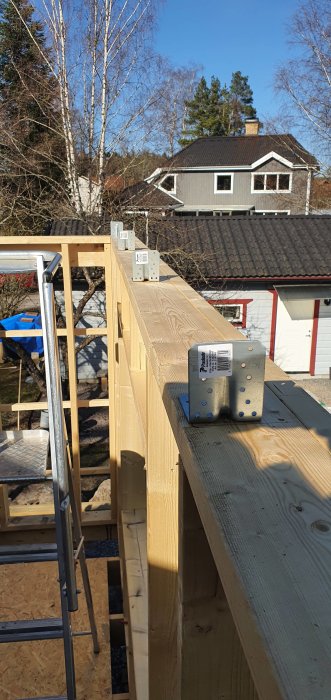
I've just set angles on the hammarbandet for upcoming trusses. It's not really an option to toenail there, right?
[image]
Since I got a nail gun, I've done a lot of toenailing, as an amateur it's easier than toe-screwing I think.
Using angles for trusses is mainly practical because you get them at the right distance immediately. As a klåpare, I would never toenail a truss because they can easily be knocked sideways, and even the slightest deviation becomes a hassle to deal with.
Vi vill skicka notiser för ämnen du bevakar och händelser som berör dig.


slacker said:
A playhouse is not a complicated construction, I would build the walls in separate blocks - Kind of like flat packs. Overlap them at the corners and you've got quite a rigid structure right there.




maah said: