I am planning to set up a chestnut fence, approximately 1.6m high. The section I am considering is 3m long and is quite exposed to the wind, I would say.
The entire fence will be angled, so L-shaped, but the section that is wind-exposed is, as mentioned, 3m long.
The location is on Öland and the soil can probably be considered quite sandy.
The fence will, over time, have some vegetation climbing on it, even though it will not cover the entire fence.
Would ready-made pillars be sufficient here with a base of geotextile and gravel? How large and how closely placed would be appropriate?
If you are going to have plants climbing on it, you might want to add some more horizontal boards higher up for stability, regardless of how you anchor it in the ground? It sounds like three concrete blocks in the ground will do the job, but I'm a bit concerned about the rest of the structure's ability to withstand the wind actually (with plants).......
If you're going to have plants climbing on it, you might want to add another horizontal board higher up for stability regardless of how you anchor it into the ground? It sounds like three ground anchors will do the job, but I'm a bit concerned about the rest of the structure's ability to withstand wind actually (with plants).......
A horizontal board at a slight angle at the top could be added. I'm curious about what in the construction makes you uncertain about its durability? What would you say is the weak point, so to speak?
These fences are basically split chestnut sticks that are then twisted together with wire, in other words, there is some "flex" in them. Is this perhaps not advantageous, considering how often completely rigid constructions perform worse with movement?
Ok I looked more closely, it seems to be ok. But it will be a rather large wind catch, easy to underestimate how well anchored it needs to be in the ground I think.
Ok I looked more closely, it seems to be ok. But it will be quite a large windbreak, easy to underestimate how well it needs to be anchored in the ground, I think.
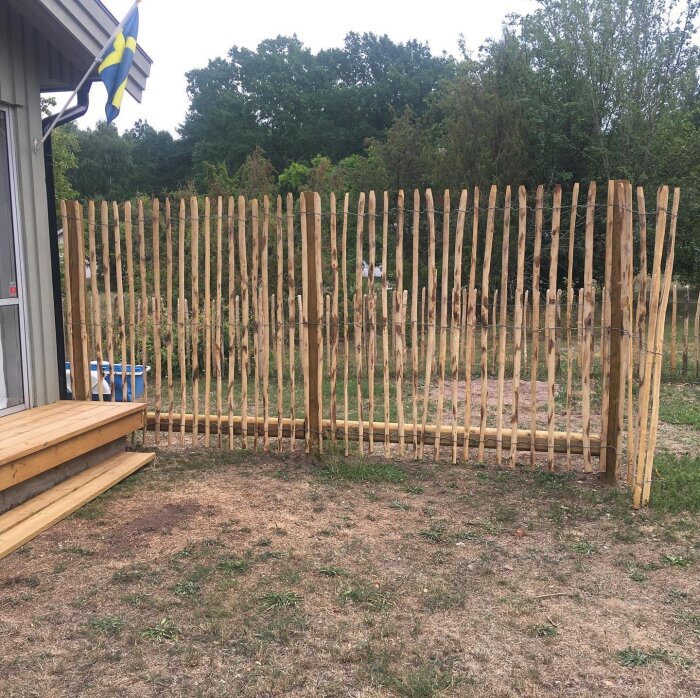
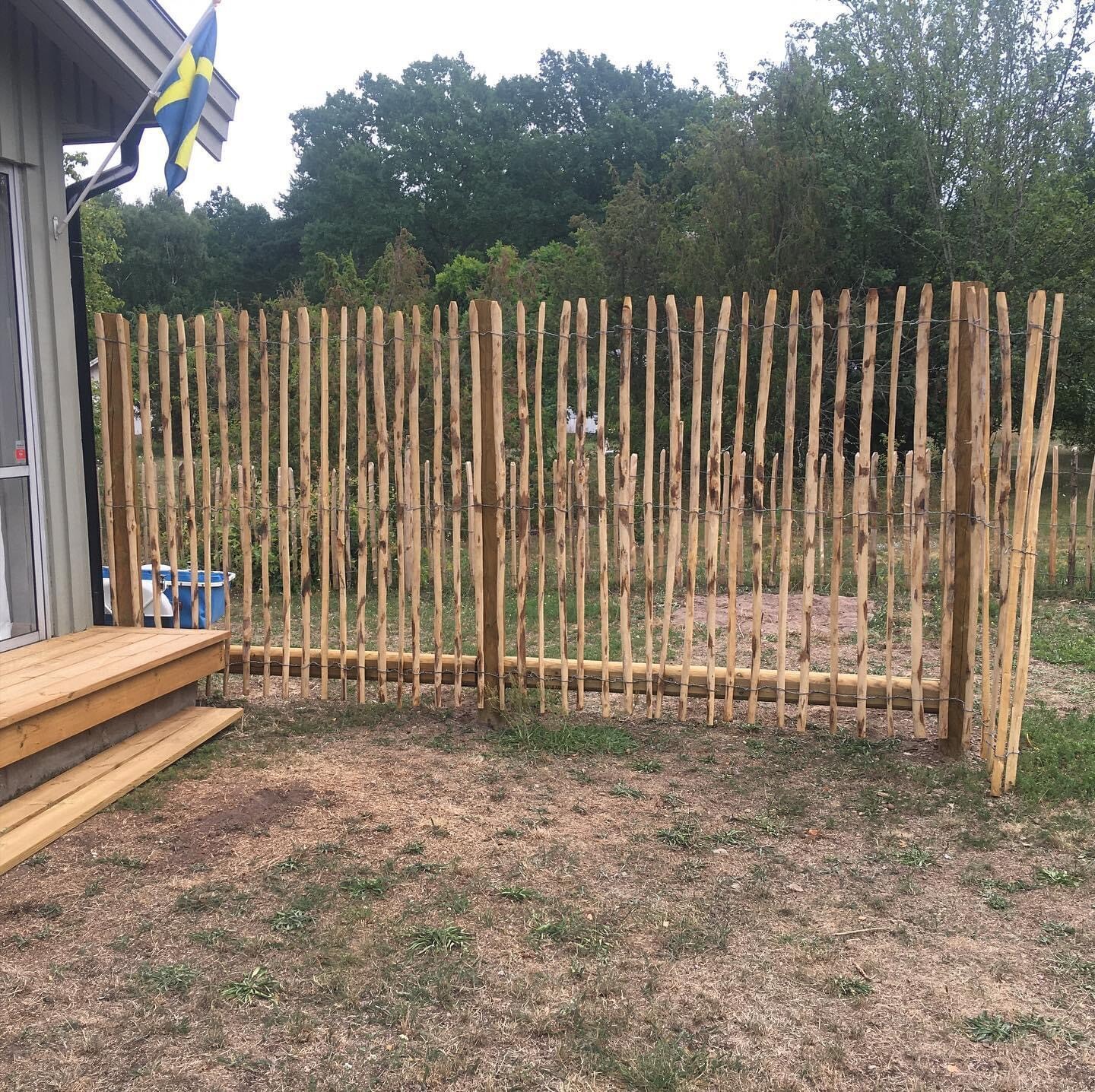
I obviously missed writing that the picture is just as a reference. To show what type of fence I meant. I have tried to edit the post but can't do it afterward now.
On the other hand, the fence will be about as large as the picture shows so it's a suitable reference.
Yes exactly, I do understand that, of course, I want them to hold, but it's hard to know when it's overkill. I guess I'll just have to try, if it fails, I guess it will be pouring concrete.
By the way, does it make any major difference regarding the size of the posts, I'm considering 70x70 as I think 95x95 might be a bit too bulky relative to the fence, that it looks odd with the dimensions.
I obviously missed writing that the picture is just as a reference. To show what type of fence I meant. Tried to edit the post but can't do it afterwards.
On the other hand, the fence will be about as large as the picture shows, so it's a suitable reference.
Yes, exactly, I understand that, of course, I want them to last but it's hard to know when it's overkill. I'll simply have to try, if it fails, I guess I'll have to cast.
By the way, does the size of the posts matter significantly, I'm considering 70x70 because I think 95x95 might be a bit too bulky in relation to the fence, that it looks strange with the dimensions.
The neighbors have built something similar but with treated wood, and the force from the wind is really strong. What I think matters most is how it is anchored. If you stick 70x70 into a post shoe or whatever it's called that goes up a bit, it's probably okay. Especially if you build it as an L, it provides extra support.
Posts 70x70 should suffice; I find it hard to believe that the post will be the weak link here.
If the fence will act as a windbreaker, the foundation should be 700-900 with fixed iron, not post shoes. If it is possible to dig deep enough for a 900 foundation, I would do that. When the fences were completed at the houses where we live, an autumn storm came and knocked them all over, and they had to be replaced with more substantial foundations. The wind subjects fences and barriers to extremely large forces, and on Öland, it can get quite windy.
Posts 70x70 should be sufficient, I have a hard time believing that the post will be the weak link here.
If the fence is going to be a wind catcher, the plinth should be 700-900 with fixed iron, not post shoes. If it's possible to dig deep enough for a 900 plinth to fit, I would do it. When the fences were completed in the houses where we live, an autumn storm came and blew them all down and they had to be replaced with heavier plinths. The wind exposes fences and planks to incredibly large forces and in Öland, it can get really windy.
Yes, I'm considering 700 plinths with fixed iron, got some from a neighbor here.
What kind of plinths did you have for the fence that blew down and what did you switch to?
Yes, I was thinking about 700 plinths with fixed iron, got some from a neighbor here.
What type of plinths did you have for the fence that blew down, and what did you switch to?
It was 700 and now it's 900 The construction company replaced them in all the houses (it's an area where all the houses were built at the same time). However, it's a privacy fence, so it's denser than your chestnut fence. With plants, even a chestnut fence becomes dense.
We have built fences ourselves that are just mesh, and these also catch a lot of wind when it storms.
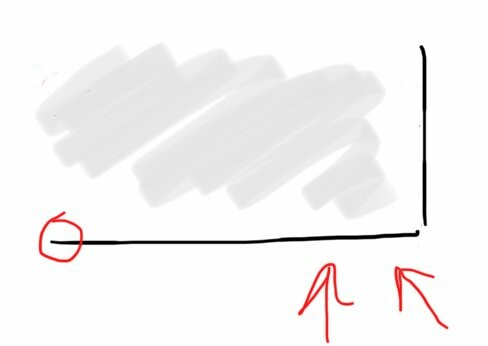
If you want to use the 700-plinths that I understand you are getting from the neighbor (a factor not to be underestimated), I would have complemented with a brace/support that has its own plinth in the part, marked in red in my very schematic drawing, which does not have support from the fence angle. (As a counter-support relative to the wind direction.)
it was 700 and now it's 900 It was the construction company that replaced for all the houses (it's an area where all the houses were built at the same time). However, it's plank, so it's denser than your chestnut fence. With plants, however, even a chestnut fence becomes dense.
We ourselves have built fences that are just mesh and even those become large windbreaks when it storms.
If you want to use the 700-piles that I understand you are getting from the neighbor (a factor not to be underestimated), I would have complemented with an angled brace/support that had its own pile in the part, marked in red in my very schematic image, which does not have support from the fence angle. (As a counterhold in relation to the wind direction.)
Fence seen from above.
[image]
Hm, yes I've considered that. I'll take your sketch further and draw out the conditions.
The fence is intended as a small privacy screen around our parking area (shaded gray). The view from the road over the parking and our property, which then continues down behind the fence, is a bit too much today.
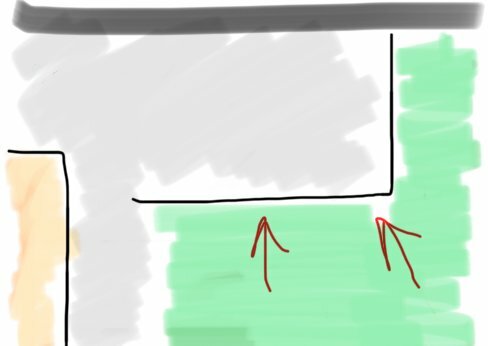
If I were to place a support on that part, it would get a bit clumsy as the support would end up in the parking area. The support should, as you write, be on the opposite side from the wind (red arrows). It's also gravelled there and I'm not sure if I can manage to dig in it.
In the part next to the red circle, a path is intended to go, further to the left that is. Beyond that is a façade to a garage (storage). I'll draw a slightly more detailed sketch of the entirety. Possibly, one can support the fence partly via the façade, even if there needs to be a path.
- The black area at the top represents the main road.
- The yellow area is an older garage with a brick facade.
- The gray area is primarily a gravel parking space, but a gravel path also runs along the garage.
- The black lines represent the proposed fence.
- The green area is parts of the property
it was 700 and now it's 900 The construction company changed them for all the houses (it's an area where all houses were built at the same time) However, it is plank, so it is denser than your chestnut fence. With plants, even a chestnut fence becomes dense.
We have also built fences that are just mesh and even these become large wind catchers when it storms.
If you want to use the 700-plinths as I understand you're getting from your neighbor (a factor not to be underestimated), I would have supplemented with a diagonal brace/support with its own plinth in the part marked in red in my very schematic image, which does not have support from the fence angle. (As a counterhold relative to the wind direction.)
Fence seen from above.
[image]
Maybe aiming to try to get some 900 plinths down (however that's going to work).
By the way, why aren't there ready-made plinths with feet? Shouldn't that be significantly more stable? Like an upside-down T. Then there would be good pressure downwards on the plinth as well and the risk of it tipping over would be reduced.
Click here to reply
Vi vill skicka notiser för ämnen du bevakar och händelser som berör dig.

Farstatjej90 said:
If you're going to have plants climbing on it, you might want to add another horizontal board higher up for stability regardless of how you anchor it into the ground? It sounds like three ground anchors will do the job, but I'm a bit concerned about the rest of the structure's ability to withstand wind actually (with plants).......Jokmok said:
I obviously missed writing that the picture is just as a reference. To show what type of fence I meant. Tried to edit the post but can't do it afterwards.Jiji said:
Posts 70x70 should be sufficient, I have a hard time believing that the post will be the weak link here. The construction company replaced them in all the houses (it's an area where all the houses were built at the same time). However, it's a privacy fence, so it's denser than your chestnut fence. With plants, even a chestnut fence becomes dense.