
5,446 views ·
35 replies
5k views
35 replies
Aluminum foil in the wall
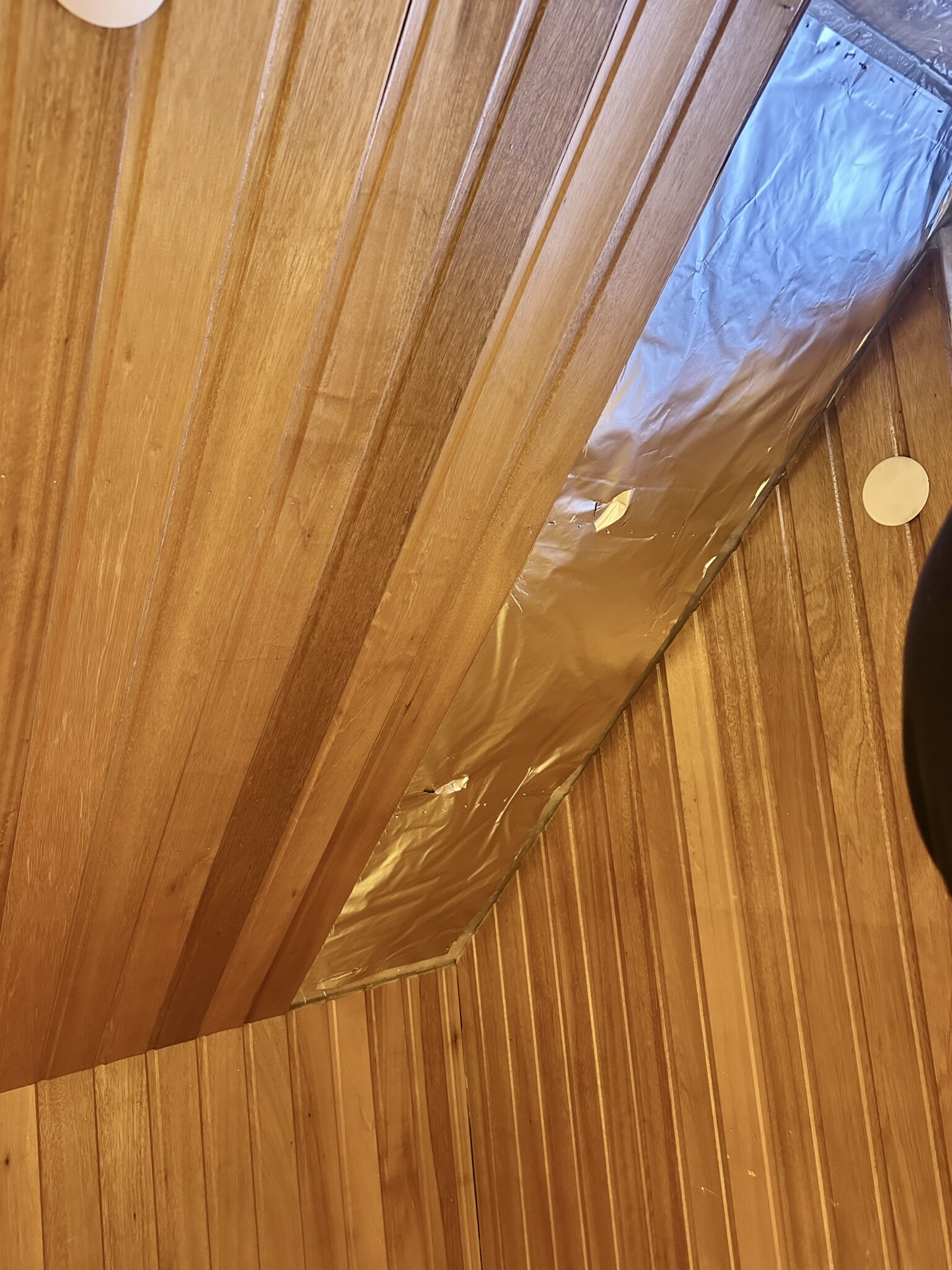
Hi, we are renovating a large room on the top floor. There has been wood paneling throughout the room, but now the idea is to install regular drywall. Under the wood paneling, there was first a layer of aluminum foil, then a layer of plastic, and then insulation. The question is, should we put aluminum foil there again?

Tomture61
Self-builder
· Född i Luleå
· 6 574 posts
Tomture61
Self-builder
- Född i Luleå
- 6,574 posts
I guess the aluminum foil is to reflect back heat radiation, to some extent. It can reflect back up to 95% of the infrared heat radiation that hits the surface. However, it's important that the foil has as little contact with other materials as possible. Aluminum conducts heat very well.
Last edited:
Probably a way to save some energy, during the oil crisis in the seventies, there was a focus on maximum insulation. Commonly, foil-coated material is placed behind radiators to reflect the heat so it doesn't pass through the wall. Otherwise, this construction would likely be in demand among those afraid of radiation, as it shields better than a foil hat.😆
A very inefficient way to save energy.Guessing that the aluminum foil is to reflect back thermal radiation, to some extent.
It can reflect back up to 95% of the infrared thermal radiation that hits the surface.
However, it is important that the foil has as little contact with other materials as possible.
Aluminum conducts heat very well.
The infrared thermal radiation that hits the foil comes from the outside of the wood, which is at pretty much the same temperature as the foil and the back of the foil. So there is a radiation balance and nothing significant is reflected.
It would have been different if the foil was ON the wood facing the room.
It was probably a sales trick without technical background.

Tomture61
Self-builder
· Född i Luleå
· 6 574 posts
Tomture61
Self-builder
- Född i Luleå
- 6,574 posts
Alufolie that is insulated on both sides works best.T Thomas_Blekinge said:A very inefficient way to save energy.
The infrared heat radiation that hits the foil comes from the outside of the wood, which is roughly the same temperature as the foil and the back of the foil. So there we have a radiation balance and nothing significant is reflected.
It would have been different if the foil was ON the wood facing the room.
It has probably been a sales trick without technical background.
In tropical countries, the foil is used extensively.
But the fact that the foil reflects heat radiation cannot be ignored.

Equally useless. Do the following experiment:
Take a stainless steel pot and place your hand inside. You'll notice a warm sensation, which is because IR radiation from your warm hand is reflected from the pot's shiny interior back to the hand, creating the warm sensation.
Now line the inside of the pot with paper towel (tape it in place, even on the bottom) and test again with your hand. No warm sensation because the IR radiation from the hand does not reach the reflective surface.
Ask a random physicist from the nearest university.
Tomture61
Self-builder
· Född i Luleå
· 6 574 posts
Tomture61
Self-builder
- Född i Luleå
- 6,574 posts
I wonder how the metal coating on windows works then.T Thomas_Blekinge said:Equally useless. Try the following experiment:
Take a stainless steel pot and put your hand inside. You'll notice a warm sensation because IR radiation from your warm hand is reflected from the pot's shiny interior back to your hand, causing the warm feeling.
Now line the inside of the pot with kitchen paper (tape it down, even on the bottom) and test again with your hand. No warm sensation since the hand's IR radiation does not reach the reflective surface.
Ask a random physicist from the nearest university.
This is for thermal radiation.
Have we fooled the entire scientific community?

There is probably a certain difference between a metal layer on a window and a metal layer behind the wood panel. It's probably more IR radiation hitting the window than penetrating 20 millimeters of wood.
Member
· Västra Götaland
· 3 617 posts
In windows, it breaks the UV radiation, i.e. it prevents it. Wrapped in a wall, I think a foil layer doesn't do anything at all unfortunately.
Tomture61
Self-builder
· Född i Luleå
· 6 574 posts
Tomture61
Self-builder
- Född i Luleå
- 6,574 posts
IR radiation = heat radiation, do we agree on this? If aluminum foil evidently reflects heat radiation, even behind building material, where is it supposed to go according to you?useless said:
No. The metal layer on the window is reached by the IR radiation. Glass is transparent to IR radiation except for the longest wavelengths. And then IR radiation can be reflected.
If you don't have a metal layer on the glass, all the IR from the sun enters the room, making it quite warm. However, if you have a metal layer on the window, it reflects a large portion that never enters the room.
But a foil behind wood paneling is never reached by the IR radiation from inside the room.
A foil behind the radiator is reached by the IR radiation from the warm radiator and can reflect it nicely.

Not for heat radiation, but it is an excellent vapor barrier with fantastic durability, so I'm more inclined to believe that.I InsidersUnited said:
That is, the predecessor of the plastic we use today. There is still some metal foil-covered insulation.
Tomture61
Self-builder
· Född i Luleå
· 6 574 posts
Tomture61
Self-builder
- Född i Luleå
- 6,574 posts
What is IR radiation 😉T Thomas_Blekinge said:No. The metal layer on the window is reached by the IR radiation. Glass is transparent to IR radiation except for those with the longest wavelength. And then the IR radiation can be reflected.
If you don't have a metal layer on the glass, all the IR from the sun enters the room, and it gets quite warm. However, if you have a metal layer on the window, it reflects a large portion that never enters the room.
But a foil behind wood paneling is never reached by the IR radiation from inside the room.
A foil behind the radiator is reached by the IR radiation from the warm radiator and can reflect it nicely.
However, the foil should not be insulated on both sides (as I wrote earlier).
An air gap is better.
Last edited: