We are planning to furnish our cold attic, but we are now considering one thing. The air gap should go from the eaves up to the ridge and continue to the next eave.
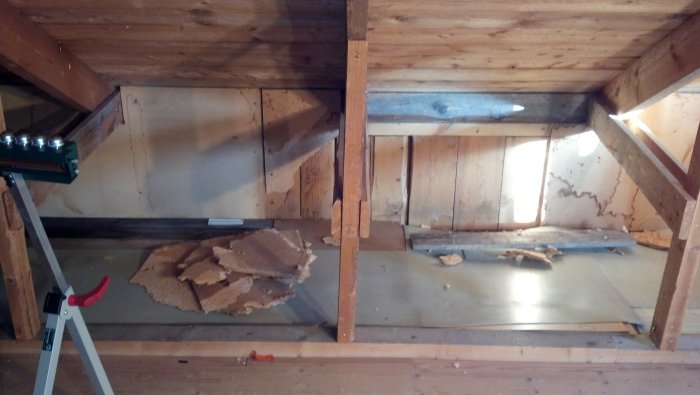
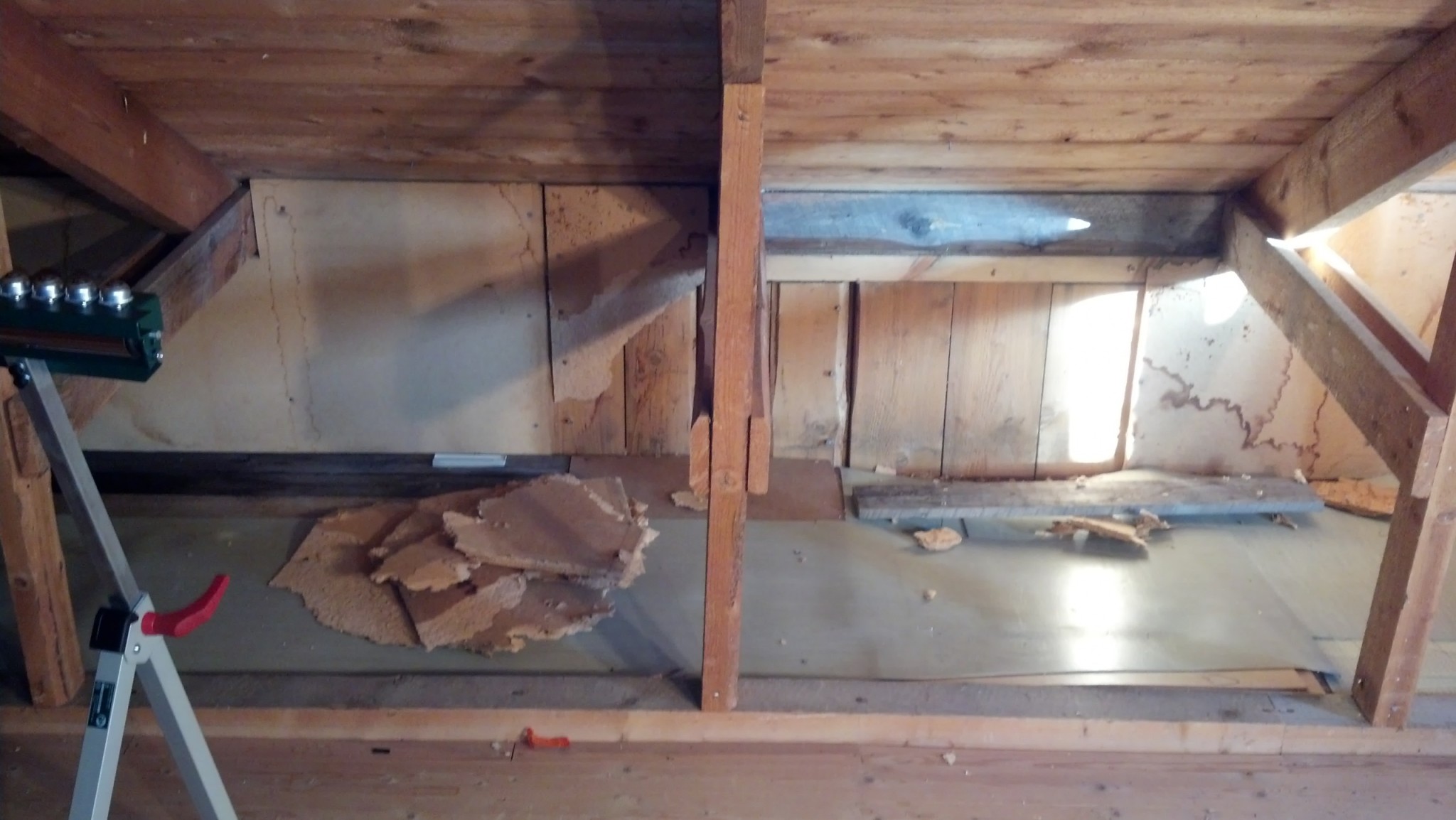
Right now, there are some boards that are about 20mm thick, I broke these off in one place to check if you could see out behind them. But it is tight with boards, and the plaster on the facade goes all the way up to the roof boards.
Is it something you might have to drill holes through so the air has a chance to get in and circulate? Similarly, at the ridge, should there also be an "outlet" there? Right now, it is tight there as well, although it is made of roofing felt, and you'd prefer to keep that intact?
Yes, just as you say, there should be an air gap between the eaves, which you can see from the underside, and the sheet material (we used masonite). What does it look like under the eaves? If you make holes in the facade, are these holes visible from the outside then? If that is the case, you can "build in" the holes you make (I wouldn't have drilled but removed everything) by placing boards sparsely under the eaves. Don't forget the netting against insects...
Yes, the holes will be visible, but that is something that can be built in afterwards.
We were thinking of using 70mm foam plastic against the "råspont" and with this fix an air gap, laying 22mm studs that the foam plastic is then mounted against, followed by regular mineral wool.
I also have those boards on the gables; is that something that can be framed on, or should they be removed? The gables consist of plaster, hemp/chicken wire/vertical boards as seen in the picture, and then these soft boards.
Have been pondering the air gap for a while.
We will only insulate up to the supports and finish with a wall there, so there will be "kattvind" behind the supports with inspection hatches. Wouldn't it work with a vent on each corner of the long sides to get air circulation that can travel via the roof? That way, you avoid making a lot of holes that would end up in the same space as everything else?
I've been pondering the air gap for a while.
We will only insulate up to the supports and finish with a wall there, so there will be a "kattvind" behind the supports with inspection hatches. Shouldn't it work with a vent in each corner of the long sides to get air circulation that can travel via the roof? That way, you avoid making a lot of holes that end up in the same space as everything else?
Regards, Jonny
Aha, I see... Well, if you open vents in, that should be enough! This construction method is something I've never had to face myself, so ask more people, just to make sure there are no problems in the future.
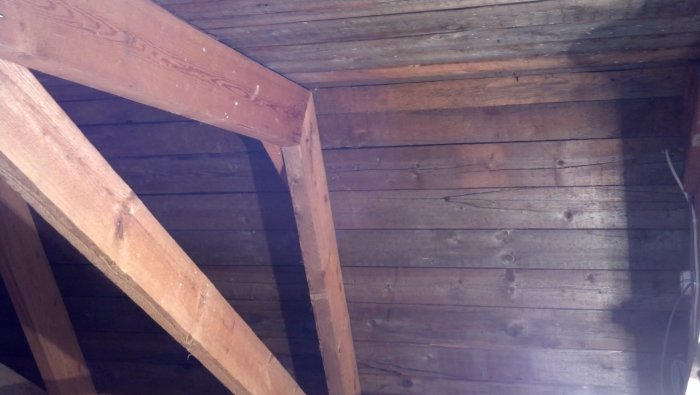
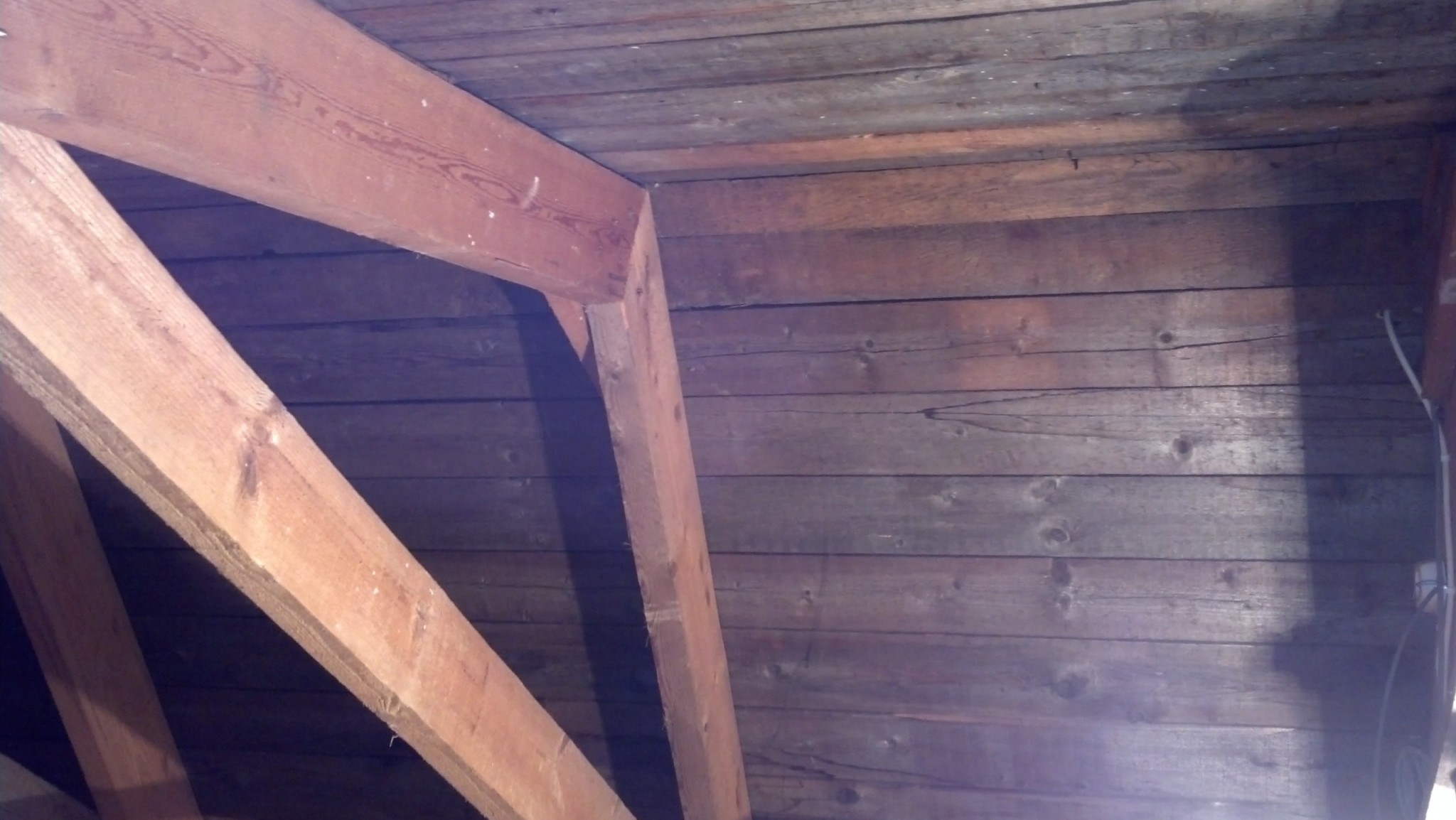
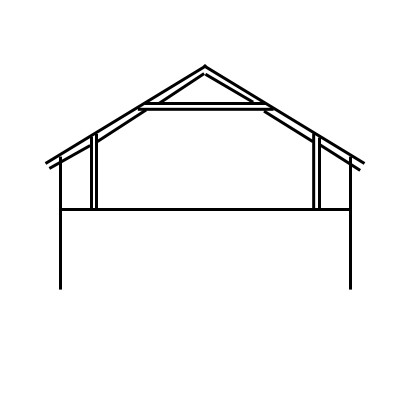
That's what the structure looks like.
Another question regarding the roof truss, are there any available programs/calculations for the strength of roof trusses?
I would like to move up the "crossbar" 125mm as the rule is.
Today, it is 195mm to the bottom edge, which feels low.
The question is whether such a thing weakens the trusses too much, or if there won't be any significant difference.
It's black tiles on today.
[image]
This is what the structure looks like.
Another thought regarding the roof truss, are there any available programs/calculations for the strength of roof trusses?
I would like to move the "crossbeam" up 125mm as the rule is.
Today it is 195mm to the bottom edge, which feels low.
The question is whether such a thing weakens the trusses too much, or if it doesn't make much difference.
It is black brick today.
Kind regards, Jonny
Yes, certainly! But whether a private individual can access one, that I don't know...
Try calling a truss manufacturer, search online and you'll find several. If you are "a little cheeky," you could say that you are planning a build, measure your truss exactly, and then say you want the crossbeam at the height you desire. If this is not possible due to strength, the truss manufacturer will inform you...
The question of whether or not to use plastic in walls has many different answers... Some new houses are built with heating and ventilation systems that rely on the house being airtight. They simply test the pressure, and then it is obviously a must. However, I know nothing about that, but regarding our house from 1895, no plastic is coming into the walls anyway. Why? Well, I think it makes the most sense to let the house "breathe" as much as possible. Then I don't know why you want plastic in the ceiling between the 70-board and the 45-board? The vapor barrier should (as far as I know) be on the inside, directly underneath the indoor ceiling covering. There may be different construction methods, but double-check it anyway.
Interesting project. I will "eventually" (I have several such projects) insulate/decorate an attic, ventilation at the eaves is already in place with masonite board.
BBJB, you plan to use expanded polystyrene, which I'm also considering for several reasons. I have no experience, I can only express thoughts and considerations.
- The 22 mm air gap sounds small, but it might be sufficient
- If you don't extend the air gap down to the eaves, is there a risk that any condensation forming on the top of the polystyrene might run and drip onto the insulation in the knee wall space? Or in case of leakage through the subroof?
On the other hand, you probably have crawl space and can access it for inspection.
Interesting project. I will "eventually" (I have several such projects) isolate/furnish an attic, ventilation at the eaves is already in place with a masonite board.
BBJB, you plan to use EPS, that's something I'm considering too, for several reasons. I have no experience, I can only have opinions and ponder.
- The 22 mm air gap sounds small, but it might be enough
- If you don't extend the air gap down to the eaves, is there a risk that any condensation that forms on the top side of the EPS might run and drip down onto the insulation in the knee wall? Or if there would be leakage through the roof sheathing?
But on the other hand, you likely have crawl space and can inspect.
There will be an opportunity to crawl in and check the knee walls, where there will also be no insulation, only the existing one which today is sawdust covered with old vinyl flooring.
We're using EPS to avoid having to install a lot of masonite. Insulation and air gap in the same board is convenient and should work, EPS is also water-resistant.
I will probably skip the plastic on the gables, it doesn't feel necessary.
Last edited:
Vi vill skicka notiser för ämnen du bevakar och händelser som berör dig.