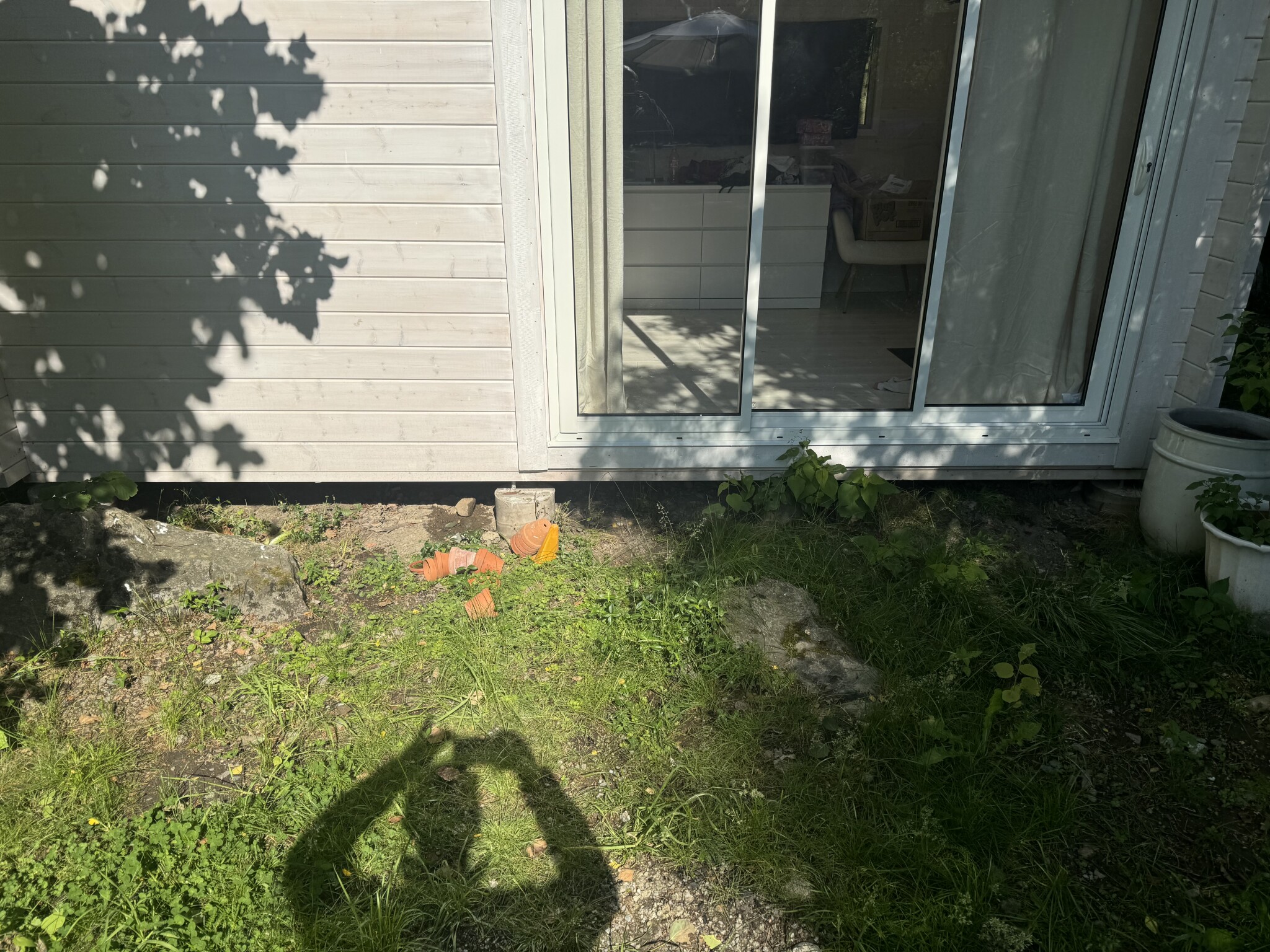
A year ago, I built a 14 sqm extension on my property, on 4x3 custom-cast pillars with dug holes about 70-80 cm deep. On one long side, about 5 meters, I now want to lay paving bricks or stones for a patio. I've read that you also need to lay edging stones for stabilization. My question: shouldn't one, on the side of the patio facing the house structure and 4 of the pillars, be able to utilize the support from these pillars in a smart way instead of having to dig a trench almost 50x50 cm deep (as Stenbolaget recommends for edging stones) closest to the house? And instead, on this side, only need to dig what is necessary for the paving stones themselves? What could this support be in that case? Could one cast a long edge here in concrete with lots of rebar. An edge that would run along all 4 house pillars and block the paving stones from moving towards the house?
Isn't it easiest/nicest to lay paving stones a bit under the garden shed?
Yes, nicest, but doesn't sound so simple. But do you mean that several paving stones underneath could replace a potential edging stone or as I suggested, a cast edge? It might not matter much if these paving stones under the garden shed start to give way and slide away. The purpose of the edging stone is precisely to keep the paving stone package together if I've understood everything correctly.
I have placed paving stones under the sauna and an outhouse so that there is no need to build a skirt to avoid seeing the ground under the buildings.
Under the houses, the paving stones are unlikely to move since there is no load on them.
Do you have such poor ground under your buildings that you are afraid it will slide away?
I have placed paving stones under the sauna and an outbuilding so you don't have to build a skirting to avoid seeing the ground under the buildings.
Under the buildings, the paving stones are unlikely to move since there will be no load on them.
Is your ground so poor beneath your buildings that you fear it might slide away?
As a novice, I often rely entirely on what others with experience say, which sometimes means I unnecessarily complicate things a lot. It's also difficult to know when a company is mainly looking to sell, in this case edging stones, and when they're actually stating facts. It might be as you say; maybe it's not needed. It would be great to avoid...
As a novice, I often rely entirely on what others with experience say, which sometimes makes me undoubtedly complicate things unnecessarily. It's also difficult to know when a company is mostly after making a sale, in this case, edging stones, and when they are actually stating facts. Maybe it's as you say, maybe it's not needed. It would be super nice to avoid it...
I've laid tens of thousands of square meters of paving stones, and we usually only install edging stones in public areas. I don't think you need edging stones unless you know the edge will be subject to a lot of pressure, such as carts or bicycles frequently rolling onto the paving stones. Sometimes we've placed a 4-5mm thick 40x40 angle iron at the edge to keep the stones in place until, for example, the grass has established itself.
I have laid tens of thousands of square meters of paving stones, we usually only set kerbstones in public areas. I don't think you need kerbstones unless you know the edge will receive a lot of stress, such as frequently pushing a wagon or riding bikes onto the paving stones. Sometimes we've laid a 4-5 mm thick 40x40 angle iron at the edge to keep the stones in place until, for example, the grass is established.
Ok, that sounds really good. Interesting with the angle iron. Can you get those at a building market? In response to your question, the shed is frequently used both as a daily room for my teenage daughter every other week and as a workspace for me. There's a lot of coming and going. And the plan is to have outdoor tables and chairs, some heavy pots, etc. So it will definitely be used heavily. Do you, with your stone-laying experience, have any opinion on clay brick instead of paving stones? Because I'm leaning towards brick.
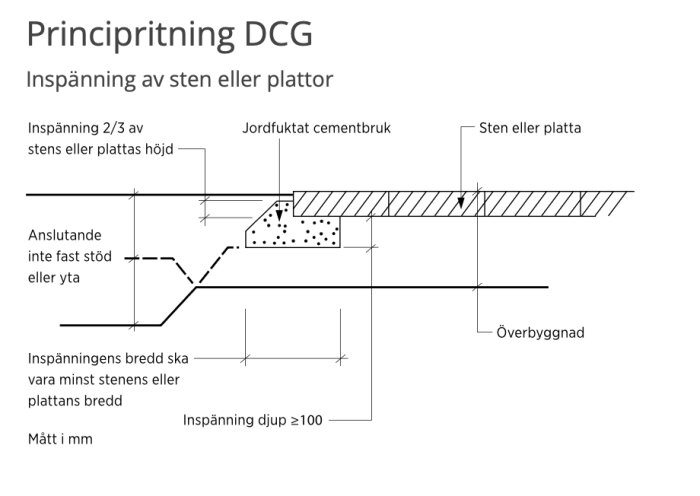
This is how you perform the tensioning of flat surfaces if you do not use edge support. This is from AMA anläggning.
[image]
I like this kind of thing. Thanks! I really want to create a solution that lasts 80 years or something. And this reminds me of the solution I suggested myself in the first post. The difference I can see is the small "step" where the slab lies. Any idea why the first stone couldn't just lie directly on a bearing layer (stone chippings/mill) like the other slabs?
I like this kind of thing. Thank you! I really want to make a solution that lasts 80 years or something. And this reminds me of the solution I suggested myself in the first post. The difference, as far as I can see, is the small "step" where the slab lies. Any idea why the first stone couldn't just as well lie directly on a support layer (stone dust/flour) like the other slabs?
Do you mean the concrete? Well, that's what provides the stable edge/reinforcement. The outermost row is set in earth-moist concrete. If the surface connects to another hardened surface, like asphalt, edge support, or facade, it doesn't need reinforcement as it already has support.
Ok, that sounds very good. Interesting with the angle iron. Can you get those at a hardware store? In response to your question, the shed is used frequently both as a daily room for my teenage daughter every other week and as a workspace for me. There's a lot of going back and forth. The idea is that there should be outdoor tables and chairs, a few heavy pots on it, etc. So it will absolutely be in use a lot. Have you laid a lot of stone and have an opinion about using clay bricks instead of paving stones? I'm leaning towards bricks.
Clay bricks or paving stones are really just about personal preference as long as you choose bricks/stones that can withstand the pressure from the traffic moving on top. Pedestrian traffic does not count as heavy load. I see you've gotten different solutions for edge reinforcement, and if you're willing to do that extra work and cost, I'll conclude my involvement in this thread unless you have specific questions for me. Good luck....
Do you mean the concrete? I mean, it's what provides the stable edge/support. You set the outermost row in damp concrete. If the surface is connected to another hard surface, like asphalt, edge support, or a facade, it doesn't need to be anchored as it already has support.
No, I meant the first slab kind of rests on a shelf that is cast in the damp concrete. I was just thinking that in my specific case, the vertical support could just as well come from the base layer. Because I only need one wall. The support in the horizontal direction would be secured by the fact that my wall would lean against the shed's plinths. See my first post and image.
No, I meant that the first plate rests on a shelf that is cast in the earth-moist concrete. I just thought that in my particular case, the support vertically could just as well come from the bearing layer. Since I only need one wall. The support in the horizontal direction would be secured by my wall leaning against the plinths of the small shed. See my first post and picture.
However, there is most likely a reason why the standard drawing in the AMA installation looks the way it does. The slab is supposed to be set in the concrete, i.e., you don’t cast a ledge and then set the slab.
Vi vill skicka notiser för ämnen du bevakar och händelser som berör dig.

wildeside said: