
4,129 views ·
13 replies
4k views
13 replies
Saw door opening in interior wall
Hello everyone,
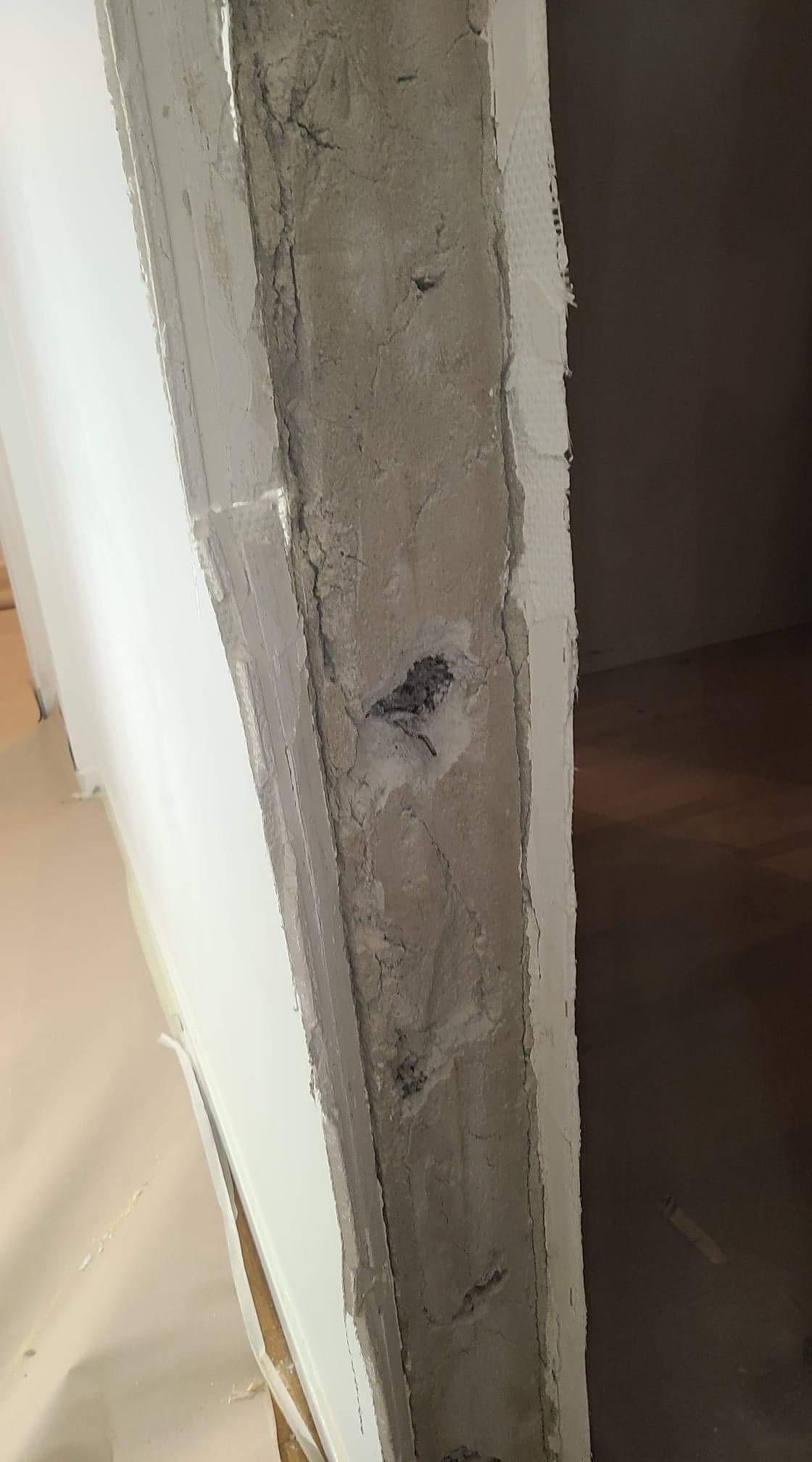
You are reading the words of happy amateurs here, and we encountered (unsurprisingly) some surprises when we "just" wanted to saw a doorway in a non-bearing wall. There had previously been a door in the wall, which was confirmed when we started sawing and found a completely intact old door frame. We want to put in a module that is 13.3x21, but the current door frame is significantly smaller, so we sawed and tore it down. Our hope was, of course, to be met by nice studs, but instead, we face plaster and probably lekablock. The surface layers don't seem to be more than fiberglass wallpaper, so the question is - how do we continue to "saw" the door opening and how do we attach new studs for the door frame?
You are reading the words of happy amateurs here, and we encountered (unsurprisingly) some surprises when we "just" wanted to saw a doorway in a non-bearing wall. There had previously been a door in the wall, which was confirmed when we started sawing and found a completely intact old door frame. We want to put in a module that is 13.3x21, but the current door frame is significantly smaller, so we sawed and tore it down. Our hope was, of course, to be met by nice studs, but instead, we face plaster and probably lekablock. The surface layers don't seem to be more than fiberglass wallpaper, so the question is - how do we continue to "saw" the door opening and how do we attach new studs for the door frame?

Hi Tompafix,T Tompafix said:
The condominium was built in the late 40s - so above us are our neighbors. We are not entirely sure about the module size, but the width on the "outside" of the door frame is 82 cm wide and just over 2 meters high, so probably 8x21 in module size.
You should probably check with the association if you are allowed to make such a modification. The wall might be load-bearing. It's also difficult to determine what material it is. If you're unlucky, it's blåbetong which contains radon. You shouldn't tear it down just like that.
Best answer
Provided that it is a non-load-bearing wall made of lightweight clinker/slag plates or lightweight concrete, the easiest way to create the opening is with a reciprocating saw with a blade intended for lightweight clinker. If it's brick, then use a saw with a diamond blade.
Be prepared that the masonry above the door opening may fall if you widen it as much as to 13 module, there is probably no beam there today, and the old frame acted as a "beam" to hold up the blocks against the joists. The frame was probably bricked together with the door, where the nail was placed between the courses and "caulked" with mortar.
You don't need studs for the door frame, frame screws and plugs work perfectly fine. If it becomes too uneven, you can apply some plaster and smooth it out with a straightedge so it's reasonably flat for the frame screws. Personally, I caulk interior doors in masonry with foam sealant, it feels more secure and the installation feels more rigid.
Be prepared that the masonry above the door opening may fall if you widen it as much as to 13 module, there is probably no beam there today, and the old frame acted as a "beam" to hold up the blocks against the joists. The frame was probably bricked together with the door, where the nail was placed between the courses and "caulked" with mortar.
You don't need studs for the door frame, frame screws and plugs work perfectly fine. If it becomes too uneven, you can apply some plaster and smooth it out with a straightedge so it's reasonably flat for the frame screws. Personally, I caulk interior doors in masonry with foam sealant, it feels more secure and the installation feels more rigid.
T Tompafix said:
Hello again!T Tofe said:
Thanks for the concern, we have received approval for the door opening from the association, which also confirmed that it is not load-bearing. We also know that neighbors have done the same maneuver

Hi KjellTimell!K KjellTimell said:Provided it's a non-load-bearing wall of lightweight concrete/slagg blocks or aerated concrete, the easiest is to make the opening with a reciprocating saw with a blade intended for lightweight concrete. If it's brick, use a saw with a diamond blade. Be prepared that the masonry above the door opening may collapse if you widen it to 13 modules, likely there's no beam there today, and the old frame acted as a "beam" to hold up the blocks against the floor structure. The frame was probably fastened together with the door, with nails placed in between layers and "packed" with mortar.
You do not need studs for the door frame; frame sleeves, plugs, & screws work just fine. If there's too much unevenness, you can apply some plaster and smooth it out with a straightedge so it's reasonably flat for the frame sleeves. Personally, I pack interior doors in masonry with foam sealant, it feels more secure and the installation feels more solid.
Many thanks for your help
According to the guide, it is non-load-bearing! Thanks for the great tips - is there any way to prevent the masonry above the door opening from collapsing? Because that's exactly the feeling we got that it's going to do
. Your description of how the door frame was installed sounds exactly as it looks! Our reciprocating saw is battery-powered 18 volts - can it handle the task with the right type of blade?
The solution you describe feels reassuring - THANK YOU!
Blåbetong does not contain radon, it emits radon. Radon is a gas.T Tompafix said:


It's the alum shale in the blue concrete that contains radium, and when radium decays, Radon gas is formed, as well as gamma radiation. The amount of Radon gas & gamma radiation formed depends on where the alum shale comes from.T Tompafix said:
https://www.stralsakerhetsmyndigheten.se/omraden/radon/vad-ar-radon/radonkallor-i-inomhusluften/
Well, I think the safest is to take down the masonry. If you were just changing the frame, it would work, the blocks lock quite well into each other. But since you are increasing the span, I would address it at once, instead of later when everything is "finished."T Tofe said:Hello KjellTimell!
Many thanks for your help
According to the association, it is non-load bearing! Thanks for the good tips - is there any way to prevent the masonry above the door frame from collapsing? Because that was exactly the feeling we got that it is going to do
Your description of how the door frame is installed sounds exactly like it looks! Our reciprocating saw is battery powered 18 volts - does it have the power for the task with the right type of blade?
The solution you describe feels safe - THANK YOU!
You can place a horizontal plank and prop it up until you have cut the wall, then assess if it will hold.
If it won't hold, you can leave the plank and cut the lintel in "blocks" and take it down in somewhat controlled forms, then remove the prop/support.
The simplest is to frame a new lintel and plasterboard it. Then fill until the walls align with each other.
Yes, if it's lightweight concrete, slag blocks, or aerated concrete then that reciprocating saw will work fine, I am convinced of that. Some battery change/charging might be required. These materials are very porous and easy to saw through. Not much force is required.
Hello KjellTimell,K KjellTimell said:Well, I think the safest approach is to take down the masonry. If you had only replaced the frame, it would have worked, as the blocks lock together quite well. But since you're increasing the span, I would address it now instead of later when everything is "finished."
You can place a horizontal plank and prop it up until you've sawed through the wall, then assess if it will hold.
If it doesn't hold, you can leave the plank in place and saw the lintel into "blocks" and take them down in somewhat controlled forms, then remove the prop/support.
It will be easiest to frame a new lintel and drywall it again. Then skim coat until the walls align with each other.
Yes, if it's lightweight concrete, slag blocks, or aerated concrete, the reciprocating saw will work well, I'm convinced. Maybe a battery change/charging might be required. These materials are very porous and easy to saw into. Doesn't require much force.
Thank you so much for the reply and quick help - very concrete and clear
Now we feel hopeful and encouraged for tomorrow's continuation.All the best and have a great weekend!
Click here to reply