I want to phase out an old air heating system, now unused, with embedded ducts in the base plate. The house is a 1.5-story villa built in 1955, with a brick facade and uninsulated slab on the ground. Current heating is district heating. Previous heating: Svenska Fläktfabrikens Termovent air system.
There is no description of the system, but I understand it as follows: An oil burner heated water to a fan convector located on the upper floor. The air was taken from air intakes in the ceiling of the lower floor hallway and mixed with some fresh air through fresh air intakes. The heated air was directed down via a vertical shaft from the upper floor to a horizontal duct centrally located in the base plate with dimensions 20 * 40 * 1300 cm. The horizontal duct runs along the entire base plate and branches out the warm air through embedded ducts 5 cm in diameter to the edges of the slab where an air gap between the slab and the wall ventilates the air into the rooms via ventilated floor moldings.
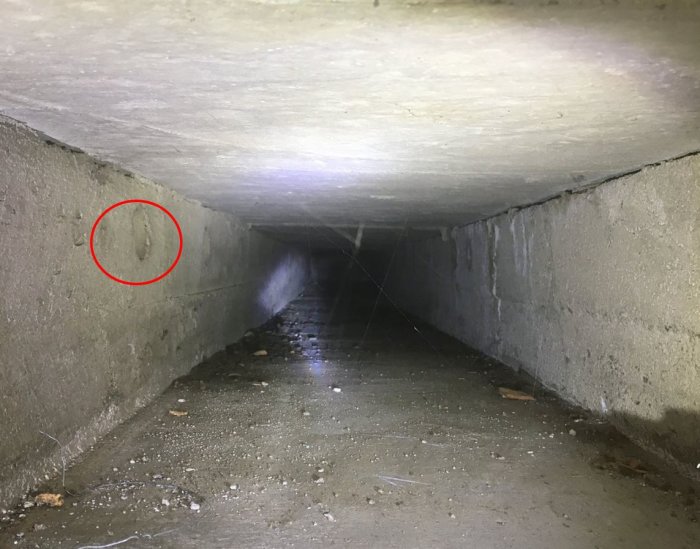
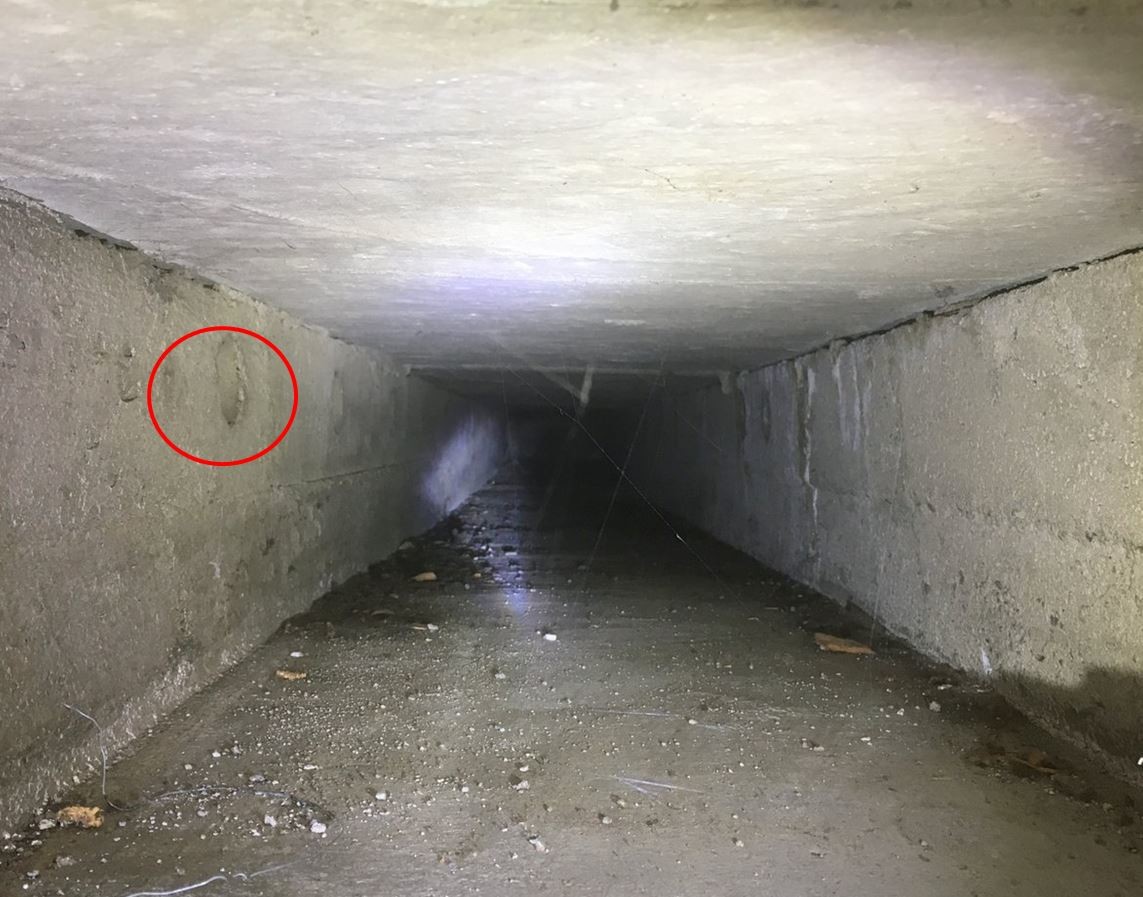
Image from inside the horizontal main duct in the base plate, circled is an outlet duct leading to the molding at the outer wall:
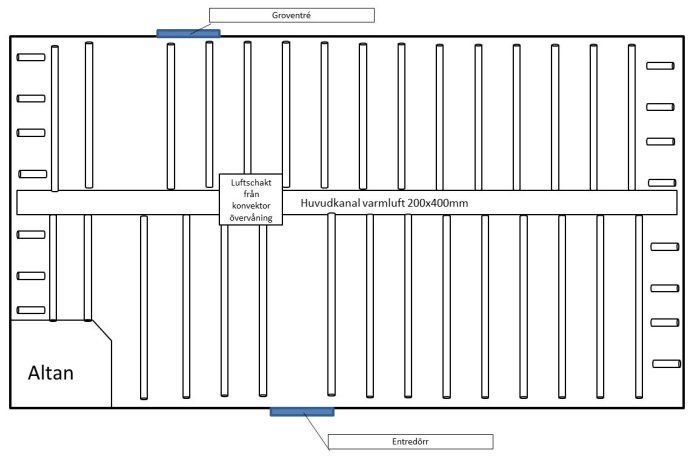
A description of the channel system in the base plate seen from above:
Exactly how the ducts on the short sides connect to the main duct I do not know, it is a few meters away from the inspection hatch in the air shaft from the upper floor.
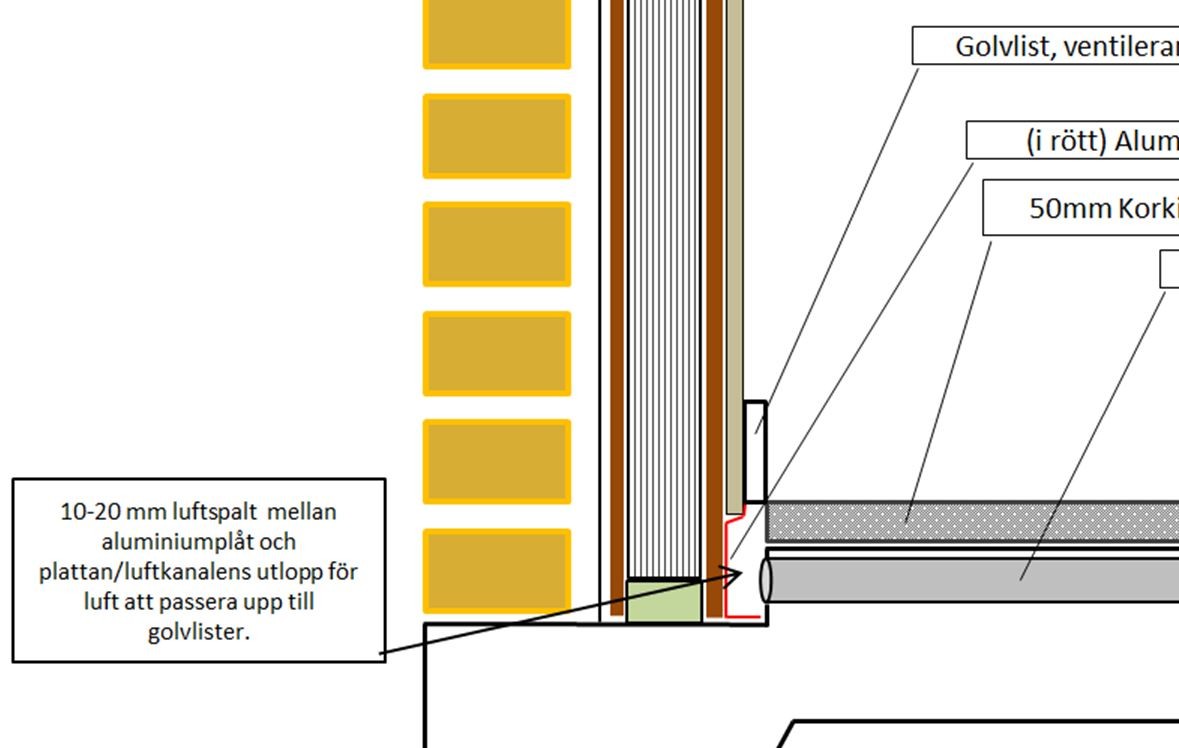
Description of the construction seen from the (short) side of the house:
The system was taken out of use just over 15 years ago and replaced with radiators and waterborne district heating.
The fan convector has been removed, but the air shaft leading down to the slab and the main air duct and branching ducts in the base plate remain.
Some floor moldings have been replaced with regular ones without vents, but nothing else has been done. The previous owner had the shaft open on the upper floor in the space that housed the convector. I have covered the opening with a board.
Since the system in the base plate is open, air can move in different ways and sometimes carries out a smell from the base plate, kind of musty .
In addition to preventing air from entering the residence, I also want to fill the cavity under the moldings that collect dust and dirt.
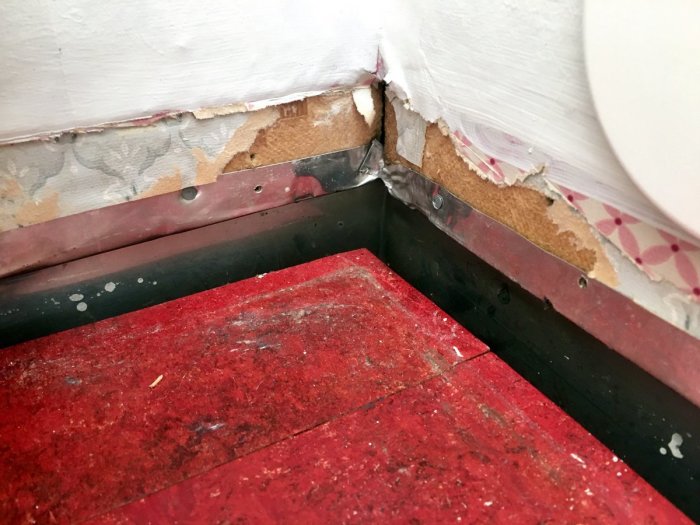
I have exposed the floor ventilation in one room so you can see the original construction with aluminum sheet:
The immediate solution would have been to seal the inlet from the upper floor and fill all outlets with foam, but is it a good solution since it leaves a large unventilated air-filled space in the base plate?
Come up with your ideas for a solution, which materials might be suitable, what problems you might need to watch out for, etc.
A difficult but interesting problem. In one way, it's a shame that such a good and advanced system can no longer be used. It probably became too expensive to operate. In colder parts of the USA, warm air systems are still very common, but they have a completely different energy price level.
I don't think filling the ducts with foam is a good solution because it's too small of an area to have any significant effect. I can imagine two main approaches: 1) Turn the ducts into a closed ventilation system that never contacts the indoor air, just to vent away moisture. 2) Use the ducts for a water-based underfloor heating system.
You need to talk to one of the larger HVAC design firms, like Dahlgrens or similar. Quite a lot of expertise is required to grasp all aspects.
Using them for channeling new pipes and electricity, not a bad idea, but for underfloor heating they probably won't work, it needs to be just below the floor.
A difficult but interesting problem. On one level, it's a shame that such a good and advanced system can no longer be used. It probably became too expensive to operate. In colder parts of the USA, hot air systems are still very common, but they have a completely different energy price level.
Filling the ducts with sealant foam I don't think is a good solution because it's ultimately too small an area for it to have any major effect. I can imagine two main approaches: 1) Make the ducts a closed ventilation system that never comes into contact with the indoor air, just to vent out moisture. 2) Utilize the ducts for a waterborne underfloor heating system.
You need to talk to one of the larger HVAC design companies, like Dahlgrens or similar. It requires quite a bit of expertise to grasp all the aspects.
Yes, the system was probably in its infancy in 1955. It was likely high-tech in the construction industry, and I know the air heating technology was developed and used into the 80s at least. However, I have never heard of anyone having the ducts embedded in the ground slab. As you say, the system must have been an energy guzzler.
As for sealant foam, it would more be a blob in each opening to stop any air flow, alternatively, you can pour mortar into the space under the threshold and at the same time, even out the floor against the wall.
Regarding your suggestions:
1) -like a fan that ventilates the space. Requires creating a channel to the façade, perhaps on both short sides of the house. Where should the air intake be?
2) I believe there will be large losses in the slab, so I have ruled that out.
After the holidays, I will check with a few companies, but after having talked to a "building technology expert" this week who immediately began to waffle and thought I should start by contacting a mycologist, I felt that BH might be able to come up with more interesting suggestions and it is already more interesting, I think
If you install thick baseboards that cover the gap and seal with latex caulk, musty air shouldn't be able to rise into the room.
LLiteavvarje said:
The idea of using them for conduits for new pipes and electricity isn't a bad idea, but for underfloor heating, they probably won't work as it needs to be just below the floor.
It is possible to use for underfloor heating because it's a system for underfloor heating. However, it's air-based and not water-based.
If you install thick baseboards that cover the gap and seal with latex caulking, musty air should not be able to seep up into the room.
It can be used for underfloor heating as it is a system for underfloor heating. However, it is air-based and not water-based.
Yes, definitely, the baseboards in a room fit tightly against the wall/floor and rarely do you notice any smell. If I seal with latex caulking everywhere, it will certainly be better but not completely airtight unless I, like, smear the backside of the baseboard too. Then there's the rest of the system remaining.
And regarding underfloor heating, I will not attempt it.
What if you reverse the system? So you suck in air from the baseboards. Then you avoid the smell and you should get some comfort heat in the floors as a bonus.
What if you reverse the system? So you draw air in from the baseboards. Then you avoid odor and might get some comfortable warmth in the floors as well.
Yes, that would be an alternative. Probably a very weak fan would be enough, or even connect it to a chimney duct. What I'm hesitant about is drawing warm indoor air into a cold space, there might be a risk of condensation? It wouldn't be the same speed as in the original system directly. Then you also add dust and dirt that travels with the air if you don't put dust filters on the baseboards. But definitely an alternative I've wanted to know more about potential consequences on.
My main idea is that it is important to keep the slab slightly heated to prevent condensation from indoor air, which otherwise always occurs in uninsulated slabs on the ground. Both weak air circulation and hoses with hot water should give this effect, without intending to be a heating system for the house. If air is to be channeled down, it should definitely be warm indoor air, not cold outdoor air. The situation is comparable to crawl spaces.
Those who created these systems are probably outdated today, but if you call someone, explain and ask for the oldest (really old) person in the company, what type of contractor carried these out I don't know, I have seen a facility
The best approach would most likely be to use the system as it was originally intended. Then you should have a warm and dry foundation, warm and cozy floors, and good ventilation. I am also not at all convinced that there will be any significant energy losses. Until someone conducts a scientific empirical study that unequivocally shows how large the losses are compared to other alternatives, I will maintain that the losses are moderate. Then one must weigh any additional costs against the advantages that the system has.
Now, this is probably not relevant here since the heating system has been converted quite a while ago. One might think that if, in 15 years, the only issue is a slight musty smell, then it is probably not a problem to not use the system. (15 years is not quite enough to establish anything, but it's a good indicator.) Plugging the system probably changes the rules a bit, as it has likely moved a little so far (the air).
Fun to hear your thoughts on this! It's a bit more fun to think about it on your own.
The plan is to remove the shaft from the upper floor and create flooring where it connects to the main air duct in the slab. We want to access the space on both the upper floor and ground floor during the renovation. This will eliminate the main opening that allowed air to rise, leaving only the small pipe openings by the wall moldings connected to the main air duct.
If we go with justusandersson's suggestion, there could be a pipe in the chimney to connect to the duct and bring in the air through the base slab via wall moldings. However, I would prefer to avoid that space as a wall is going to be plastered, and I will build over the moldings, requiring cutting out holes and fixing things. In some places, the moldings don't quite cover, so there are gaps, which can be fixed easily.
Using the system as originally intended won't be possible anyway. It also feels like a gamble. If one were satisfied with the installation of district heating, the simplest solution should have been to just connect the district heating to the convector instead of installing a dozen new radiators.
Ideally, I would fill the channels and pipes with concrete to get a "regular" base slab. But such an operation is likely to be complicated?


 .
.





BigR said: