
6,227 views ·
15 replies
6k views
15 replies
Tongue and groove boards, experiences and suppliers

Hello
We do not have this product (råspontluckor) in Norway :'( and I am wondering the following:
1) Have you used them yourself and what is your experience?
2) Where are they available for sale?
3) Are they usually included when ordering a roof?
4) Links to manufacturers/suppliers are highly desirable
5) Do they compete against OSB (wood fiber boards) in price?
6) Is there some form of approval (SP)?
Finally, if I want to take a closer look at the use of the product (house/garage/etc.), is there anyone delivering/using this now in the Karlstad-Uddevalla area, who can be visited?
I hope someone can help me with user experiences, both positive and negative " :-* "
We do not have this product (råspontluckor) in Norway :'( and I am wondering the following:
1) Have you used them yourself and what is your experience?
2) Where are they available for sale?
3) Are they usually included when ordering a roof?
4) Links to manufacturers/suppliers are highly desirable
5) Do they compete against OSB (wood fiber boards) in price?
6) Is there some form of approval (SP)?
Finally, if I want to take a closer look at the use of the product (house/garage/etc.), is there anyone delivering/using this now in the Karlstad-Uddevalla area, who can be visited?
I hope someone can help me with user experiences, both positive and negative " :-* "
Hello!
I used råspontluckor for our house construction, bought from the local wood dealer at Orust Högströms. It was very quick to lay the roof with these, the only downside was the small metal pieces they were joined with, they are very sharp...
// Goerana
I used råspontluckor for our house construction, bought from the local wood dealer at Orust Högströms. It was very quick to lay the roof with these, the only downside was the small metal pieces they were joined with, they are very sharp...
// Goerana
Hei goerana
What thickness did you buy and do you remember the price? Did the metal connecting "pieces" go all the way through so they were visible on both sides? Is it normal for building supply stores to have roof hatches in stock?......and lastly, couldn't your roof truss supplier provide these? Thanks a lot for the answers.
What thickness did you buy and do you remember the price? Did the metal connecting "pieces" go all the way through so they were visible on both sides? Is it normal for building supply stores to have roof hatches in stock?......and lastly, couldn't your roof truss supplier provide these? Thanks a lot for the answers.
Hi!
At http://www.siggestatra.se/index.htm, the principle for manufacturing is shown; the metal pieces almost go through the entire board. When we built a custom-built house, the carpenters also made the roof trusses. So it wasn't the price, but the time that was decisive. Then we paid about 140kr per hatch 3600 *610 mm, not so expensive, I think. Here, the builder's merchant had råspontluckor in stock; otherwise, it usually has to be ordered.
Regards,
Goerana
At http://www.siggestatra.se/index.htm, the principle for manufacturing is shown; the metal pieces almost go through the entire board. When we built a custom-built house, the carpenters also made the roof trusses. So it wasn't the price, but the time that was decisive. Then we paid about 140kr per hatch 3600 *610 mm, not so expensive, I think. Here, the builder's merchant had råspontluckor in stock; otherwise, it usually has to be ordered.
Regards,
Goerana
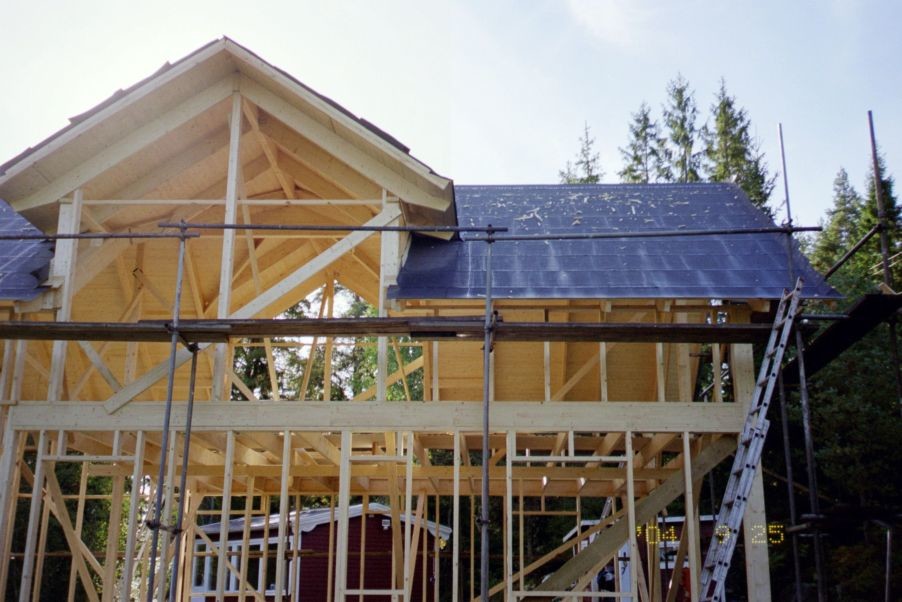
Have experience with a roof of about 80 m2.
Advantages
Saves time
Disadvantages
Many general seams
The hatches are quite heavy and cumbersome, so make sure to have them lifted with a crane if it's high.
Preferably have a larger roof for it to be profitable, involves a fair amount of measuring.
Had to pay about 50sek/m2 at Beijer.
Advantages
Saves time
Disadvantages
Many general seams
The hatches are quite heavy and cumbersome, so make sure to have them lifted with a crane if it's high.
Preferably have a larger roof for it to be profitable, involves a fair amount of measuring.
Had to pay about 50sek/m2 at Beijer.
Guessing that tykkelse is roof tiles?
No, normally they don't stock rårpontluckor, they just happened to have a stack at home that I got cheaply.
When nailing regular råspont, there are rules for the joints; for example, two are not allowed to be directly under each other. With råspontluckor, it becomes 6 pieces.
No, normally they don't stock rårpontluckor, they just happened to have a stack at home that I got cheaply.
When nailing regular råspont, there are rules for the joints; for example, two are not allowed to be directly under each other. With råspontluckor, it becomes 6 pieces.

My house and garage were delivered with 22mm tongue-and-groove decking that was also primed in the right spots. The main advantage of using these panels is that it makes roofing faster, protecting against rain, and the primed panels skip the dull painting step.
I have no problem with "general seams," meaning there's no sagging due to heavy concrete tiles over the seams.
The choice between tongue-and-groove panels or end-jointed tongue-and-groove in loose timber isn't a big issue for me. When I built my garage on my own, I found it good to quickly get the roof + underlayment + battens up.
I have no problem with "general seams," meaning there's no sagging due to heavy concrete tiles over the seams.
The choice between tongue-and-groove panels or end-jointed tongue-and-groove in loose timber isn't a big issue for me. When I built my garage on my own, I found it good to quickly get the roof + underlayment + battens up.
In Norway, we have a standard c-c 600 between roof trusses and not c-c1200 as you do, this reduces this problem as the loads are not transferred directly to the board but to the truss, with exceptions: turf and shingle roofs.ClasseClas said:
Painted on both sides or just one, priming or also with topcoat? Price addition for this, do you remember it?
Painted on both sides or just one, primer or also with topcoat? Remember the additional price for this?[/quote]Bidd@ said:
Some of the hatches were either primed down at the eaves or at the gable overhang. Only primed hatches. I can't specify the price. I bought a kit at an agreed total price.
The tongue-and-groove boards surely save time. (Though I suppose two people need to work together on them up on the roof.)
The question is how much time can be saved. I, lacking experience in roof construction, nailed 100 m[sup]2[/sup] of "regular" tongue-and-groove boards in a day. Sometimes, you spend considerably more time thinking about how to simplify the task than it takes to do the actual work.
The question is how much time can be saved. I, lacking experience in roof construction, nailed 100 m[sup]2[/sup] of "regular" tongue-and-groove boards in a day. Sometimes, you spend considerably more time thinking about how to simplify the task than it takes to do the actual work.
