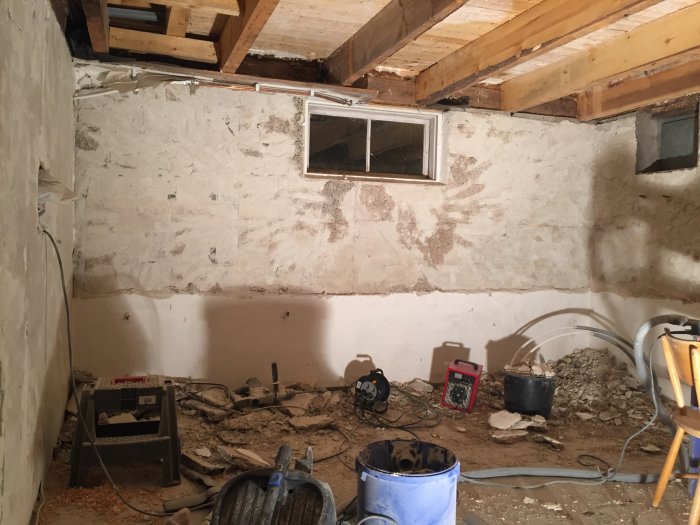
I'm considering refreshing our boiler room. It's in the basement of a 100+ year old house, with a granite foundation that has been plastered. After 100 years, or however long the plaster has been there, it's not exactly rock hard and has come loose in some places. The wall surface is also not very smooth, with a few centimeters difference between the highest and lowest points.
My plan is to tile the walls, and I think it would be best to frame a smooth wall inside the foundation wall. So I'm considering framing with 35x70 and attaching some form of board to it, then tiling over that.
Do you think this is a good idea, or do you have any better suggestions?
What type of board is appropriate to use? Regular drywall doesn't seem great considering any moisture that might come from the foundation wall.
But it doesn't feel great to just add new plaster when the old one is sticking so poorly and has come off in some places. How long will the new one last, and then the tiles, there's a risk they might fall off too.
Then there will be quite a bit of plastering needed to get an even wall. Maybe that's manageable, as long as you know it will be good and last. But will it really?
Here's a picture that might give some idea of how it looks.
100 years is not a bad time span between renovations. I agree with the above, knock off the loose plaster and redo it, then let your great-great-grandchildren fix the surface in another 100 years.
That looks exactly like our boiler room, a CTC boiler even? Anyway, the existing plaster has come off due to moisture trapped by too dense paint. If you plaster and tile, you won't prevent moisture movement, and the tiles will stay on for a long time. Then the wall looks absolutely straight enough for tiles.
Cladding the basement with studs and boards is a makeshift solution for people who can't accept that an old basement has 100% straight walls. The basement walls will be just as crooked after boards and studs; the only difference is that you have covered them with a new fake room, thereby eating up some of the room's volume and potentially getting a risky construction in return.
It is a CTC yes, but they're not exactly uncommon even though our 453B might not be one of the more common models
I agree that it's a temporary solution to frame it up, so sure, if it's possible to repoint it, that's obviously a much better alternative. However, I'm still not completely convinced it's a good option. I might need to let it sink in and read more about it, maybe.
What's the best way to remove the old plaster then? Well covered, with a respirator, and a wire brush on the angle grinder? Maybe a little water mist too to dampen the dust, then you have to put on the galon as well
I would probably write an old CTC, I have a 266K from -68, but it will be out by summer.
The walls I have repointed in the basement, I first sanded with a diamond sanding disc on an angle grinder. I started with some cheap grinders and built my own dust cover, which I connected to a shop vacuum. After the second angle grinder burned out before the first room was finished, I bought a blue Bosch with an accompanying cover, and it's one of the best purchases I've made, strong, durable, and dusts almost nothing with proper handling.
If you're just going to repoint, you don't need to remove all the plaster, just the paint on the plaster, and then it's probably kalkputs you should use. If you're going to tile, you have to remove most of the existing kalkputs and then plaster with regular b- or c-bruk.
Our CTC is from 83, if I remember correctly. I'm also looking into replacing it. I'm a bit interested in a Biomatic 20i with lambda and wifi
Here, a diamond blade is definitely not the way to go, as the plaster is way too soft. But a hood connected to a shop vac could be an option, although first via a dust separator so you don't have to empty/clean the filter constantly.
I have a Biomatic 20+ standing in the boiler room, waiting to be connected, found it on Blocket.
You most likely have kalkputs, the same as I do, and it works great with a diamond blade. In fact, I went at it in the last room in the basement today:
Ok. Well, I do have the equipment. Maybe I should bring out the Husqvarna cutter with water cooling But it's probably a bit too big, heavy, and unwieldy for this job.
Do you possibly have a picture of, or a link to, the dust collection cover you're using?
Thanks for the picture, my motivation to tackle this increased immediately
Yes, there are a few Biomatic on Blocket. There was a fairly new one that slipped right under my nose the other week for just 5 grand, it wasn't you who snagged it, was it? It was in the Borås area, a bit far from you I think
Yes, btw, the wall here is far from as flat as the picture suggests, there are several cm difference from the highest to the lowest point, but most of the difference is a bit higher up, outside the picture, I think.
Otherwise, you can rent a renovation grinder for about 300:- per day. My basement is a bit special, the first three courses are built with stones 5 cm thicker, and the gap has been covered with träullitskivor which they then plastered. Everything is plastered with lime plaster that must be removed before tiling, I will work a bit with the angle grinder later in the week. Then I will build up lecablock to the height of the edge to create a support surface along the room's outer walls. After that, I will plaster everything with c/b mortar before tiling. I probably have some unevenness on my wall too, but the worst can probably be removed with the plaster.
No, I bought mine in the Skellefteå area for 8000, including everything, such as a weekly supply, expansion tank, circulation pump, etc.



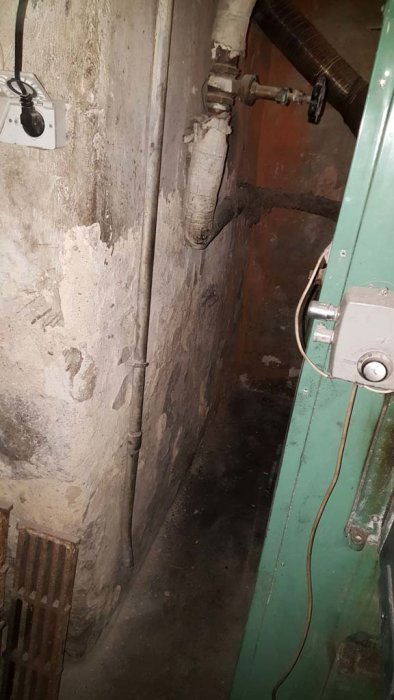

 even though our 453B might not be one of the more common models