
1,816 views ·
16 replies
2k views
16 replies
Slim interior wall - sound, stability, and thickness?

Hello!
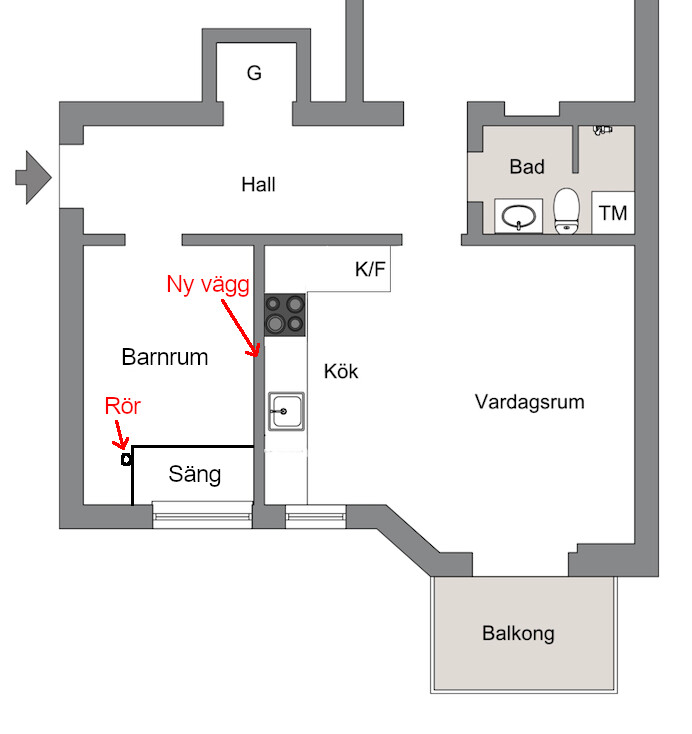
We are in the process of building a new interior wall between the children's room and the kitchen/living room in our apartment, and we're trying to balance the wall's performance against a desire to maintain as wide a passage as possible towards the living area.
Currently, we have achieved exactly 80.5 cm of free opening, and we would like to keep the width somewhere that preferably doesn't fall below 80 cm. The problem is that we have no margins left to take from - the children's room just fits a 2-meter bed, and on the kitchen side, there is an L-shaped kitchen with IKEA Metod where we have already shaved down the trim so that the oven doesn't hit the countertop. There are therefore no extra millimeters to take from.
Planned wall construction:
The goal is a wall as slim as possible, but still with decent sound insulation (the children's room is adjacent to the kitchen), some form of fire protection (even if it is within the same fire cell), and the ability to attach things on the children's room side (lighter shelf, hook, etc.)
Is this a sustainable wall construction? Will it stand stable without flexing or feeling "spongy" - even without OSB or other rigidity boards? We will have quite a few items in the overhead cabinets.
Other questions we would appreciate input on:
Attaching an image that shows the wall and how it is placed.
We gratefully receive all tips, experiences, or suggestions for improvement!
We are in the process of building a new interior wall between the children's room and the kitchen/living room in our apartment, and we're trying to balance the wall's performance against a desire to maintain as wide a passage as possible towards the living area.
Currently, we have achieved exactly 80.5 cm of free opening, and we would like to keep the width somewhere that preferably doesn't fall below 80 cm. The problem is that we have no margins left to take from - the children's room just fits a 2-meter bed, and on the kitchen side, there is an L-shaped kitchen with IKEA Metod where we have already shaved down the trim so that the oven doesn't hit the countertop. There are therefore no extra millimeters to take from.
Planned wall construction:
- Length: 4 meters
- Height: 3 meters
- Placement: Wall is tensioned between two existing and stable walls
- Frame: Studs 34×45 mm, c/c 300 mm
- Insulation: Isover Piano 35 (30 mm, high density)
- Surface layer: 9.5 mm standard gypsum on both sides
The goal is a wall as slim as possible, but still with decent sound insulation (the children's room is adjacent to the kitchen), some form of fire protection (even if it is within the same fire cell), and the ability to attach things on the children's room side (lighter shelf, hook, etc.)
Is this a sustainable wall construction? Will it stand stable without flexing or feeling "spongy" - even without OSB or other rigidity boards? We will have quite a few items in the overhead cabinets.
Other questions we would appreciate input on:
- Is 9.5 mm gypsum on both sides sufficient, or should we consider 12.5 mm, double gypsum, or possibly something like Habito?
- Do we need to reinforce for rigidity? The height is 3 meters – would, for example, an OSB/fiberglass sheet or some noggings improve stability, or is it sufficient since the wall is tensioned between two fixed walls?
- In terms of sound – is this sufficient? We understand it won't be completely quiet, but we'd still like to dampen kitchen clatter and children's noise as much as possible without making the wall thicker.
- Behind the IKEA base cabinets: Since it is an L-shaped kitchen, it is really only the depth of the base cabinets that affects the passage. We have considered not placing gypsum behind the base cabinets, but attaching directly to the studs, in order to gain 9.5 mm of wall thickness. Does that work? One could also place OSB or similar only above the countertop, as it does not affect the passage width.
Attaching an image that shows the wall and how it is placed.
We gratefully receive all tips, experiences, or suggestions for improvement!
Last edited:

Because I know. As mentioned earlier, 9mm gypsum is intended for outdoor use. 45mm walls become weak, and you will want 34mm studs.
70mm studs with double layers of boards build 120mm and tend to make an acceptable wall for a bedroom.
70mm studs with double layers of boards build 120mm and tend to make an acceptable wall for a bedroom.
Maybe it can work with a completely different type of wall? I see that lightweight concrete is available down to 50 mm thickness at least.
But I don't dare to comment on how it compares otherwise (strength, fire protection, sound)
But I don't dare to comment on how it compares otherwise (strength, fire protection, sound)
Where is the passage that you want to keep at 80.5? Into the kitchen?
If you skip the suspension rail on the lower cabinets for IKEA Metod, you gain 10mm (or slightly less, don't remember exactly), but maybe you've already utilized that...?
If you skip the suspension rail on the lower cabinets for IKEA Metod, you gain 10mm (or slightly less, don't remember exactly), but maybe you've already utilized that...?
Should there be a door in the opening?
If there isn't supposed to be a door, you can base it on the measurement you would have in a module 8 door when it's open (inside frame to inside frame), which is about 70cm and probably feels reasonably okay to walk through...
If there isn't supposed to be a door, you can base it on the measurement you would have in a module 8 door when it's open (inside frame to inside frame), which is about 70cm and probably feels reasonably okay to walk through...
An open question.
I guess that two OSB and two gypsum boards dampen close to the small amount of insulation that it actually becomes. At least 15% is already gypsum and wood.
The question is how stable it becomes and/or how to make it stable?
I guess that two OSB and two gypsum boards dampen close to the small amount of insulation that it actually becomes. At least 15% is already gypsum and wood.
The question is how stable it becomes and/or how to make it stable?