
25,305 views ·
15 replies
25k views
15 replies
Ridge beam, load distribution

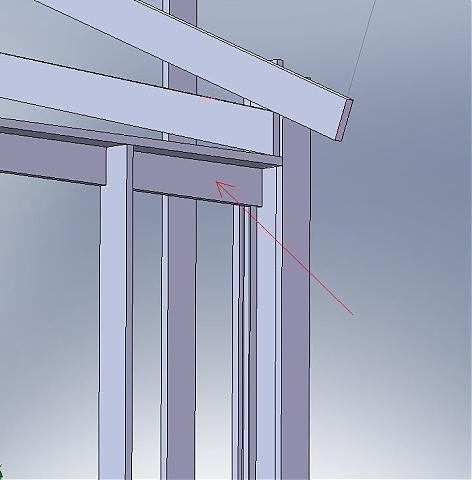
Often, a beam is recessed under the roof plate (on edge) in the studs, sometimes placed closest to the outside of the house, and sometimes closest to the inside. Is there any philosophy behind which method is used, or is it just a coin toss?

I want to remember that it matters and I almost think it should be on the inside ...
But I would like someone to confirm, because idiot-proof it is absolutely not.
Why... I could imagine it might be because roof trusses and floor beams transfer greater force downwards to the raised wall on the inside of the studs. (i.e., because the floor bows and puts most weight on the inside and maybe even possibly lifts slightly on the outside).
But someone ...? Builder, you know, right ??
But I would like someone to confirm, because idiot-proof it is absolutely not.
Why... I could imagine it might be because roof trusses and floor beams transfer greater force downwards to the raised wall on the inside of the studs. (i.e., because the floor bows and puts most weight on the inside and maybe even possibly lifts slightly on the outside).
But someone ...? Builder, you know, right ??
Quoting Byggaren from another thread:
imported_Byggaren said:Indeed. It certainly matters which side the support beam is on. It should be on the inside for three reasons. The first is that it's better to have the thermal insulation on the outside, i.e., to block the cold as soon as possible. The second is that the roof trusses (which do not lie over a wall stud) have a shorter span, and the angle change at the support is properly absorbed. The third is that it's good to have some wood to attach the curtain fixtures in behind the drywall.
__________________-
Byggaren
Thanks for the response, interesting, I had been wondering if that could be the case with the insulation.
I have now looked through all the site-built houses I have access to pictures of:
out of 11 houses, 7 have it on the outside, and 4 on the inside...
Fiskarheden has 4 houses in that collection, and of those, 3 have it on the outside.
I have now looked through all the site-built houses I have access to pictures of:
out of 11 houses, 7 have it on the outside, and 4 on the inside...
Fiskarheden has 4 houses in that collection, and of those, 3 have it on the outside.
Interesting...Snailman said:Thank you for the response, interesting, I had been wondering about the insulation if that could be the case.
I have now looked through all the stick-built houses I have access to pictures of:
out of 11 houses, 7 of them have it on the outside, and 4 on the inside...
Fiskarheden has 4 houses in that collection, and 3 of them have it on the outside.

I have also sometimes looked at it on stick-built constructions, not counted how many but noticed that some have it on the outside and some on the inside. I guess it doesn't have very life-changing significance.
But the given reasons are enough for me to choose the inside. Unless someone can present a nice reason to choose the outside.
I have heard that it is not supposed to matter much, but it is preferable to have it on the inside to facilitate screwing drywall/OSB and any ceiling molding.


aha, then my numbers above aren't quite right, because your house was one of the ones I counted..
but I actually have pictures of a house like domherren (a symmetrical house) that has a couple of load-bearing interior walls where the trusses are placed, and they had them inward on the right side and outward on the left side (or vice versa). But otherwise, they have been consistent around the exterior walls of the entire house, and I guess you have too, if you look at the floor plans individually
but I actually have pictures of a house like domherren (a symmetrical house) that has a couple of load-bearing interior walls where the trusses are placed, and they had them inward on the right side and outward on the left side (or vice versa). But otherwise, they have been consistent around the exterior walls of the entire house, and I guess you have too, if you look at the floor plans individually
Hehe, I like stable constructions!
Yes, the exterior was according to the K-drawing and the interior came after an "on-site discussion" with the engineer regarding the support over a larger door/window section. I didn't want any visible protruding wall studs between the window frames, just a thin trim. To ensure the wall's strength, double K24 45*220 were placed on edge - then it was simply decided to do the same in the rest of the building. Sure, there is a bit less insulation, but I usually have 45+170+45, so it's enough anyway!
Yes, the exterior was according to the K-drawing and the interior came after an "on-site discussion" with the engineer regarding the support over a larger door/window section. I didn't want any visible protruding wall studs between the window frames, just a thin trim. To ensure the wall's strength, double K24 45*220 were placed on edge - then it was simply decided to do the same in the rest of the building. Sure, there is a bit less insulation, but I usually have 45+170+45, so it's enough anyway!
I wanted to hear what you had to say first , but otherwise I think the outer side fits well on the upper floor with your construction where the trusses load the outer edges instead of the inner edges, which would be the case with regular trusses.
On the lower floor good for the same reasons already stated.
But these are just my reflections, if the trusses are on a beam it probably shouldn't matter...
, but otherwise I think the outer side fits well on the upper floor with your construction where the trusses load the outer edges instead of the inner edges, which would be the case with regular trusses.On the lower floor good for the same reasons already stated.
But these are just my reflections, if the trusses are on a beam it probably shouldn't matter...