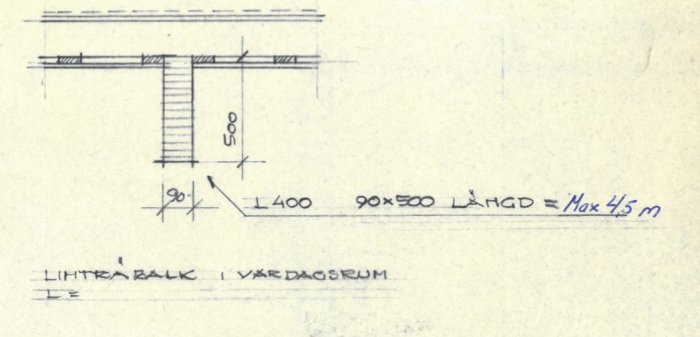
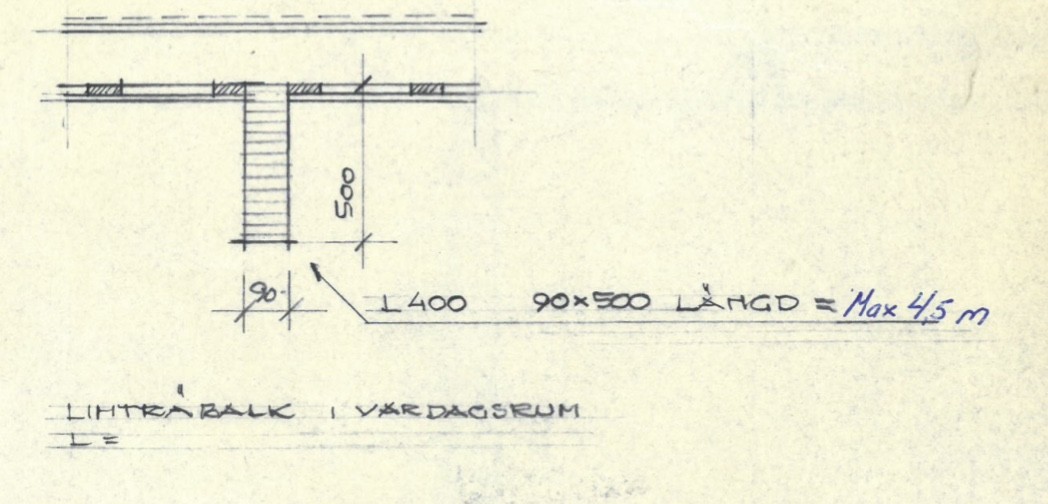
I am new to the forum and need your opinions on how to replace a glulam beam with a steel one. Unfortunately, I am not very familiar with construction or have been a homeowner before.
We are looking at a house we are interested in, but a glulam beam is positioned so low that it needs to be replaced with something of a smaller height. My question to you is whether the height of 500 mm can be halved, and how a layperson can calculate these dimensions themselves.
What is the ceiling height? The problem is mostly that a steel beam is not automatically stronger just because it is a beam. At that span, you also have to account for the beam's own weight, and if you now halve the height, you will probably get some sagging. But everything depends on what it carries?
My thought with steel was that the height wouldn't be exactly like the wooden beam's height, allowing free passage in the room without hitting one's head on the wood. Above the beam is an open area that functions as a living room.
SStefan1972 said:
What is the ceiling height? The problem is mainly that a steel beam isn't automatically stronger just because it is a beam. At that span, you also have to consider the beam's weight, and if you halve the height, you'll likely get some sag. But it all depends on what it's carrying?
The steel beam that most closely matches your glulam beam is an HEA 220. It is 210 mm high and 220 mm wide. Additionally, one must consider that fire protection insulation also requires some space. The comparison is valid regardless of span. One simply compares the flexural rigidity of the different options. Flexural rigidity is the product of the modulus of elasticity and the moment of inertia for a given beam made of a specific material. It is usually abbreviated as EI. The modulus of elasticity is a material-specific constant (which can have different values depending on the application situation). The moment of inertia is a geometrical quantity that depends on the cross-sectional dimensions of the beam. For a beam with a rectangular cross-section, it is calculated using the formula bxh^3/12.
The steel beam that most closely matches your glulam beam is an HEA 220. It is 210 mm high and 220 mm wide. You also need to consider that fire protection insulation requires some space. The comparison applies regardless of the span. You simply compare the bending stiffness of the different options. Bending stiffness is the product of the modulus of elasticity and the moment of inertia for a given beam of a specific material. It's usually abbreviated as EI. The modulus of elasticity is a material-specific constant (although it can have different values depending on the application situation). The moment of inertia is a geometric quantity that depends on the cross-sectional dimensions of the beam. For a beam with a rectangular cross-section, it is calculated using the formula bxh^3/12.
Click here to reply
Vi vill skicka notiser för ämnen du bevakar och händelser som berör dig.