Hi. I'm in the process of renovating an apartment. It's an attic with a concrete floor that I want to convert from electric to waterborne underfloor heating (95 sqm). My question is whether I can embed the heating pipe with approximately 70 mm of concrete. In this case, the entire slab will be heated. I wonder if this will work? I'm concerned about heat leakage through the outer wall since it's old flooring in a brick building. When building new, there's usually insulation to prevent the heat from escaping the wrong way through the wall. I don't want to waste energy. The alternative is to use grooved insulation with plates, but I'd prefer a cast slab. Will 70 mm be sufficient? I don't have any load-bearing walls, so it's currently one big room, which is why a cast slab would be ideal! (It's an old workshop, hence the concrete floor in the attic). Grateful for answers and feedback / Jonas
I'll borrow this thread a bit - I've had a raised floor on concrete slab in the basement (classic 70s house) which is now gone for various reasons. Now, a new floor on the upper floor needs to be fixed. There is a total of 140mm height between the concrete and what should become the finished floor, and we're talking about an area of 110 sqm.
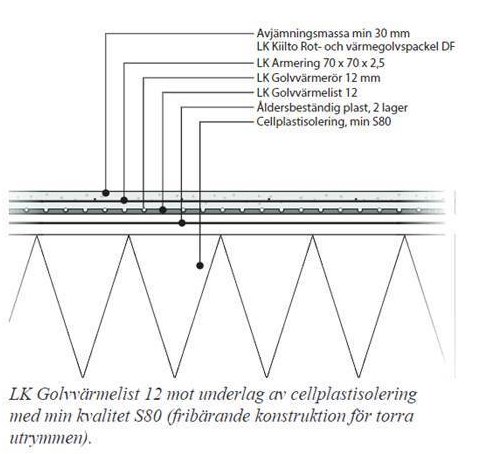
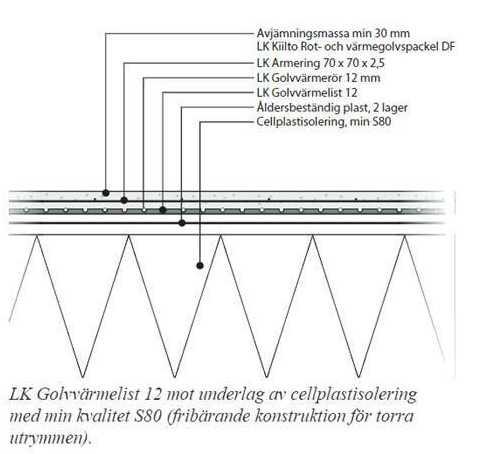
Looking at polystyrene EPS s100 100mm + underfloor heating + reinforcement + self-leveling compound (30mm) + Floor according to LK's installation method:
However, this leveling compound becomes quite expensive.
Are there any alternatives to self-leveling compound / leveling compound?
Borrowing this thread a little - had raised floor on concrete slab in basement (classic 70s house) which is now gone for various reasons. Now the new floor on the upper floor needs fixing. There's a total height of 140mm between the concrete and what will be the finished floor, and we're talking an area of 110 sqm.
Looking at EPS s100 100mm + underfloor heating + reinforcement + self-leveling compound (30mm) + floor according to LK's installation method:
[image]
However, this leveling compound is quite costly.
Are there any alternatives to self-leveling compound?
Sounds like an excellent solution. Buy EPS in a bag where you only add water.
I'm borrowing this thread a bit - I had a raised floor on a concrete slab in the basement (classic 70s house) which is now gone for several reasons. Now a new floor on the upper floor needs to be fixed. There is a total height of 140mm between the concrete and what will be the finished floor, and we are talking about an area of 110 square meters.
Looking at cell plastic EPS s100 100mm + underfloor heating + reinforcement + leveling compound (30mm) + floor according to LK's installation method:
[image]
However, this leveling compound becomes quite expensive.
Are there any alternatives to leveling compound / smoothing compound?
Forgot one thing, there is a long drying time with your solution since the moisture can only travel one way, measure continuously.
I thought about that too, but my concern is whether there are alternatives to self-leveling compound since it becomes very expensive over such a large area.
There is something called ROT-concrete as well. For example, Ardex A38. But I have no idea about their pricing.
I suspect that there are basically only 2 options:
1. Self-leveling compound or ROT-Concrete, expensive but gets done quickly.
2. Regular concrete, cheaper but then you'll have to wait a long time before the moisture level decreases enough to lay flooring on it.
Xx45 studs with insulation in between. X depending on building height.
Lattice panel 28x70 with heat distribution plates.
And then the floor on top of that is probably the cheapest solution. It's probably the lightest solution too in terms of weight. Could be nice if it is going up in an attic. Now I'm mainly answering TS's question.
Click here to reply
Vi vill skicka notiser för ämnen du bevakar och händelser som berör dig.