
84,021 views ·
51 replies
84k views
51 replies
Fireplace - brickwork, leca blocks or what?
We are going to have one or rather three fireplaces with cassettes in the house. All three are placed so that the pipes will be drawn into the same chimney. I want straight lines, functional style. Sending pictures so you know roughly what I have in mind.
But how do you build such a fireplace? If you build it with bricks, it will be quite heavy. Or do you use lecablock, or can you do it differently? What is the most convenient/easiest way and what does the price look like?
But how do you build such a fireplace? If you build it with bricks, it will be quite heavy. Or do you use lecablock, or can you do it differently? What is the most convenient/easiest way and what does the price look like?
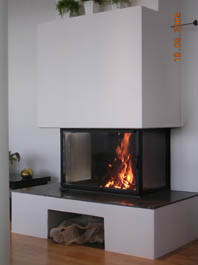
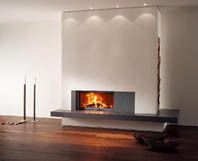

We (my husband and father-in-law) built our fireplace last fall. They used lightweight concrete blocks and it was very easy to work with. Especially considering they built an entirely new round fireplace into which we placed an insert! The lightweight concrete blocks range from 50-100 SEK each, in comparison to leca blocks they are more expensive, but for us who sawed and shaped the blocks ourselves, it was the best material. Including a link to Beijer so you can check out both the leca and lightweight concrete blocks...
Beijer Byggmaterial
Beijer Byggmaterial

I have for me that one does not use them because they 1) cannot withstand high heat 2) store heat poorly.
Use bricks or ytong blocks. Ytong blocks are glued with a special mortar. Bricks are built with masonry mortar. The brick construction becomes significantly heavier.
We made such a stove with bricks - quite similar to image 1. To get the upper part to hang in the air, we cast a solid beam on site. There are some pictures on our web during a few summer months in 2006.
We bought about 500 bricks from Poland (2 kr each compared to 8-10 kr each in Sweden). It took about 400 bricks.
In addition to this, we surely bought 1 pallet (40 bags) Serpo 222 or 224. Can't remember which one. It is a mortar suitable for building and plastering a brick stove.
Additionally, we bought spot-welded mesh (a couple of hundred kronor) and about 5 bags of Serpo 103 Rödgrund.
We nailed the mesh in place. After that, it was primed with Serpo 103. (The reason for the priming is that we had both bricks and a concrete beam to be plastered. Serpo 103 and the mesh provide a uniform base for the surface plastering.)
Last but not least, we bought 5-10 bags of a very fine plaster from Serpo. It was expensive - at least 100 kr per bag - to get a very smooth surface. I don't remember the number of that bag, "finputs C" I think it might be called.
ps. Oh, right, a bit of concrete and reinforcement to cast beams were added, but that's peanuts in the grand scheme of things.
ps2. Forgot that it should also be painted. Lime paint from Målarkalk has been purchased.
Sandkalk, Std-kulör / Mineraliska Färger - Målarkalk AB (color WHITE - not the standard color which is more sand-colored). The bucket cost over 1000 kr, but then we have paint for repainting every year for 100 years... kind of.
Use bricks or ytong blocks. Ytong blocks are glued with a special mortar. Bricks are built with masonry mortar. The brick construction becomes significantly heavier.
We made such a stove with bricks - quite similar to image 1. To get the upper part to hang in the air, we cast a solid beam on site. There are some pictures on our web during a few summer months in 2006.
We bought about 500 bricks from Poland (2 kr each compared to 8-10 kr each in Sweden). It took about 400 bricks.
In addition to this, we surely bought 1 pallet (40 bags) Serpo 222 or 224. Can't remember which one. It is a mortar suitable for building and plastering a brick stove.
Additionally, we bought spot-welded mesh (a couple of hundred kronor) and about 5 bags of Serpo 103 Rödgrund.
We nailed the mesh in place. After that, it was primed with Serpo 103. (The reason for the priming is that we had both bricks and a concrete beam to be plastered. Serpo 103 and the mesh provide a uniform base for the surface plastering.)
Last but not least, we bought 5-10 bags of a very fine plaster from Serpo. It was expensive - at least 100 kr per bag - to get a very smooth surface. I don't remember the number of that bag, "finputs C" I think it might be called.
ps. Oh, right, a bit of concrete and reinforcement to cast beams were added, but that's peanuts in the grand scheme of things.
ps2. Forgot that it should also be painted. Lime paint from Målarkalk has been purchased.
Sandkalk, Std-kulör / Mineraliska Färger - Målarkalk AB (color WHITE - not the standard color which is more sand-colored). The bucket cost over 1000 kr, but then we have paint for repainting every year for 100 years... kind of.

1. Oh yes, at least the siporex blocks withstand high heat. We built with siporex around the wood stove in the kitchen. No problems!Fasting65 said:
2. True that they store NO heat whatsoever. It's clear when we've burned, the side against the wood stove is almost scorching hot, while the other side of the block, which is 10-15 cm thick, is cool.
So to get any real benefit from the insert, it’s best to use bricks and some form of air supply. But siporex, on the other hand, is very easy to work with, and if the stove is just for coziness, it might be preferable.
Fasting65: First, I just have to start by saying, WHAT A BEAUTIFUL WEBSITE YOU HAVE! Stylish and easygoing (do you perhaps work with websites...?) Then, the house! Very nice! The house we live in now looks about the same as yours did before  . But the location for our new house will be better. You've done a great job, good taste!
Then I have to thank you for the detailed descriptions. I've just started tackling this, now I've made some progress!
A big thank you to everyone!
These options are available:
1. Red brick (though it's heavy)
2. Lightweight concrete blocks
3. Siporex blocks (Ytong blocks)
We will have the fresh air supply via the slab.
. But the location for our new house will be better. You've done a great job, good taste!Then I have to thank you for the detailed descriptions. I've just started tackling this, now I've made some progress!
A big thank you to everyone!
These options are available:
1. Red brick (though it's heavy)
2. Lightweight concrete blocks
3. Siporex blocks (Ytong blocks)
We will have the fresh air supply via the slab.
Emmi, thank you for the warming words. The site has become a bit difficult to navigate due to its size. I didn't really expect it to become so large... But we're reasonably satisfied. It's functional enough, but one often dreams of redesigning, but there's no time for such projects - and yes, Nina is a designer. That has probably helped a little
Back to the stove. I think you can equate the material lättbetong with the brands Siporex, Ytong, HHCeleron, Xella, and Aeroc. A dear child has many names.
Back to the stove. I think you can equate the material lättbetong with the brands Siporex, Ytong, HHCeleron, Xella, and Aeroc. A dear child has many names.
Fasting65: Ok, then there are only two options then. Either red brick or lättbetong. It must be more convenient with lättbetong, as the blocks are larger. It probably takes longer with red brick.
What does the pricing look like between the different options if you consider all the materials you need in total? Which method is easier/harder?
What does the pricing look like between the different options if you consider all the materials you need in total? Which method is easier/harder?
A aerated concrete construction is probably easier and cheaper to build. We didn't do it because Nina's uncle is a bricklayer and exclaimed, "You're not going to build with aerated concrete?!" He believed that an aerated concrete construction cracks more easily. We shouldn't take his word as law, but he didn't consider an aerated concrete construction to be a "real" fireplace... I don't think it really matters, but I'm just a layman who is only guessing.
What aspects do you find the most difficult in the installation of the chimney and the fireplace itself?
I am also a designer, graphic designer. I absolutely don't have time for a website, it has become a simple blog...
I am also a designer, graphic designer
. I absolutely don't have time for a website, it has become a simple blog...
Don't forget that you need to reinforce the foundation/concrete slab where the stoves will be placed. Also, remember to cast pipes for supply air to each stove.
We have two brick-built stoves with a brick chimney. The exterior at the outer wall and the chimneys are double-shelled, i.e., double brick walls with insulation in between. This retains heat and prevents cold drafts in the chimney.
We have two brick-built stoves with a brick chimney. The exterior at the outer wall and the chimneys are double-shelled, i.e., double brick walls with insulation in between. This retains heat and prevents cold drafts in the chimney.
Ok. Yes, we have realized that reinforcement in the slab is necessary. I have heard that it can be done in two ways. Either through foam plastic of higher quality (XPS) or by adding an additional 100 insulation, is that correct?
So you have double brick walls where the chimney is outdoors, but not indoors? What kind of pipes do you have in the chimney then?
So you have double brick walls where the chimney is outdoors, but not indoors? What kind of pipes do you have in the chimney then?