
9,018 views ·
15 replies
9k views
15 replies
Does the plaster have to go?

I have bought a house with a detached garage. However, it has deteriorated a bit over the years and now I want to fix it up.
It's built with quite large blocks, don't know what, and has plaster on it. Spackled and painted on the inside. Haven't been able to see, but I think there is chipboard on the roof. Cold storage on top of that.
I intend to use it as a garage/workshop/storage. I hadn't planned on a heated garage, but if I'm going to use the building as storage, I might need a bit of heat.
Now to my questions:
Do I need to remove all the exterior plaster before framing and nailing a new facade?
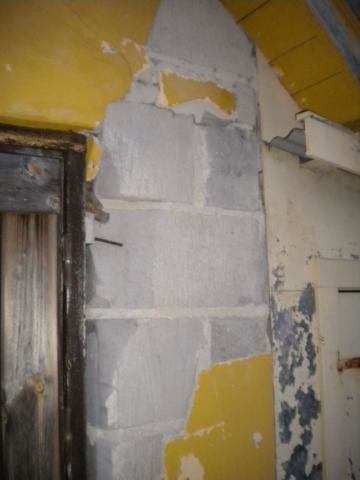
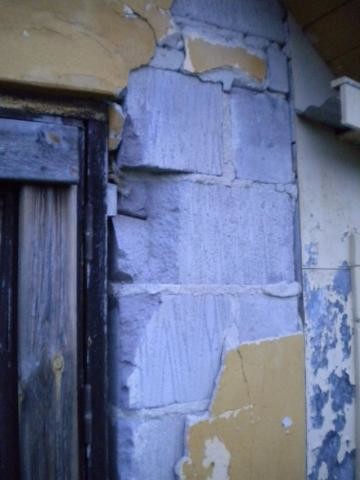
Should I repair the blocks in the door opening that have broken, and if so, how?
How is the insulation value of similar blocks, should I take the opportunity to add insulation when I'm nailing a new facade, or do the blocks insulate well?
Grateful for tips and answers.
It's built with quite large blocks, don't know what, and has plaster on it. Spackled and painted on the inside. Haven't been able to see, but I think there is chipboard on the roof. Cold storage on top of that.
I intend to use it as a garage/workshop/storage. I hadn't planned on a heated garage, but if I'm going to use the building as storage, I might need a bit of heat.
Now to my questions:
Do I need to remove all the exterior plaster before framing and nailing a new facade?
Should I repair the blocks in the door opening that have broken, and if so, how?
How is the insulation value of similar blocks, should I take the opportunity to add insulation when I'm nailing a new facade, or do the blocks insulate well?
Grateful for tips and answers.
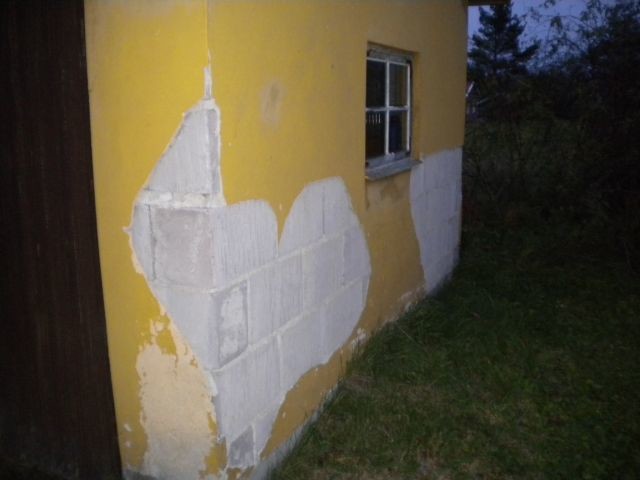
Check what color it is; if it's plastic paint, it's probably best to knock it down and redo it. I'm a bit unsure how you can tell if it's plastic paint; I think you can run something like a one-krona coin on the paint and see if it leaves marks. If it leaves gray/black marks on the paint, then it's plastic... However, I'm uncertain about this, so verify first 
Apply repair mortar where it is damaged. Preferably stone if there are holes larger than five by five cm. I would have insulated with at least 5 cm. More insulation doesn't hurt. Remove all loose plaster in any case. If it's plastic paint, you'll need to remove more.
Thank you for your answers. It seems there is quite a lot of loose plaster, so it will probably come off. I'll probably also add 45 mm extra insulation while I'm at it, so I can choose the purpose for the house as I wish.
I'm bumping my thread again, trying to get answers on what the insulation value might look like for the blocks. I intend to convert the garage into a workshop, carpenter's corner, "get away from the wife" corner, you name it.
I need to replace the doors as soon as possible, but the question is whether the blocks themselves are sufficient to maintain an okay temperature when I'm there. I will of course check the ceiling as well and insulate if necessary.
I'm considering buying a cheap air-to-air heat pump and installing it for heat when I'm there. Otherwise, I have an old wood-burning stove, but that's a bit more of a hassle and then I also wouldn't be able to use the room as a garage if I wanted to in the future.
Grateful for any tips or ideas.
I need to replace the doors as soon as possible, but the question is whether the blocks themselves are sufficient to maintain an okay temperature when I'm there. I will of course check the ceiling as well and insulate if necessary.
I'm considering buying a cheap air-to-air heat pump and installing it for heat when I'm there. Otherwise, I have an old wood-burning stove, but that's a bit more of a hassle and then I also wouldn't be able to use the room as a garage if I wanted to in the future.
Grateful for any tips or ideas.
I don't know what kind of block it is, but the more porous the material, the better it insulates. Wall thickness matters. Looks like aerated concrete, siporex? I don't think you'll make a big gain by adding more insulation if the walls are thick.
It seems like the plaster has never adhered to the blocks and was only held in place by the joints. Poorly pre-wetted, not primed when plastering the block wall that absorbs a lot of water? Wrong plaster material? Wrong surface paint?
I would probably tear down all the old stuff and replaster in the spring if it were my sanctuary
gaia
It seems like the plaster has never adhered to the blocks and was only held in place by the joints. Poorly pre-wetted, not primed when plastering the block wall that absorbs a lot of water? Wrong plaster material? Wrong surface paint?
I would probably tear down all the old stuff and replaster in the spring if it were my sanctuary
gaia
Last edited by a moderator:
I'm completely clueless when it comes to concrete materials, so I have no idea. But in my opinion, they are really thick. At least 30 cm. It feels a bit reassuring that you say it's overkill to insulate on thick walls since I've thought along those lines myself. But I should probably replace the doors and window.gaia said:Don't know what kind of block it is, but the more porous the material, the better it insulates. Wall thickness matters. Looks like gas concrete, siporex? I don't think you'll gain much by adding more insulation if the walls are thick.
It seems like the plaster never adhered to the blocks and just hung in the joints. Poorly watered, not primed when plastering the block wall which absorbs a lot of water? Wrong plaster material? Wrong surface paint?
I would probably take everything old down and replaster in the spring if it were my sanctuary
gaia
I will clad with a wooden facade to match the house, which I'll also re-clad, or alternatively bring out the old panel.
Picking up one of my old threads since it's becoming relevant. I never did anything with the garage because a lot of other stuff came up. But now I'm getting interested.
The plan is to remove all the plaster. Frame up with 45x45. Insulation. Wind barrier and finally paneling. I've just treated the wood shed with iron sulfate and am considering doing the same with the garage.
Now I'm wondering if the garage might be damaged by standing without the plaster for a while, if I don't manage to put up the paneling in time? I have to start somewhere and was thinking of removing the plaster and fixing the holes.
The fascia boards and the roof overhang are painted with a, what I believe, yellow plastic paint. It would be easiest to just wash and paint over with white acrylic paint. Or is that a bad idea? Does it even match with white fascia boards, etc., for the gray shade the wood gets from the iron sulfate?
Hoping for some answers!
The plan is to remove all the plaster. Frame up with 45x45. Insulation. Wind barrier and finally paneling. I've just treated the wood shed with iron sulfate and am considering doing the same with the garage.
Now I'm wondering if the garage might be damaged by standing without the plaster for a while, if I don't manage to put up the paneling in time? I have to start somewhere and was thinking of removing the plaster and fixing the holes.
The fascia boards and the roof overhang are painted with a, what I believe, yellow plastic paint. It would be easiest to just wash and paint over with white acrylic paint. Or is that a bad idea? Does it even match with white fascia boards, etc., for the gray shade the wood gets from the iron sulfate?
Hoping for some answers!
It looks like normal lightweight concrete in your garage. It's important to note that lightweight concrete can withstand weather reasonably well as long as it doesn't freeze. However, lightweight concrete absorbs a lot of water, so if you have an unprotected lightweight concrete wall that rain can hit, it will absorb a lot! If lightweight concrete that has absorbed a lot of water freezes, it can easily crack. Therefore, my recommendation is to cover it properly, but if you do this, there should be no problem removing the plaster.
I have framed up my garage built of blue concrete but left the render in place. Why do you want to remove it? In my world, it's just a lot of unnecessary work, taking time that you could use for something more fun.
I also insulated the garage slab afterward, with those edge elements that have a concrete coating on one side, not sure if it has any major effect but it should make some difference.
I also insulated the garage slab afterward, with those edge elements that have a concrete coating on one side, not sure if it has any major effect but it should make some difference.
If you are going to screw into it, I recommend the light concrete screws available! They have slightly special threads that actually pull. I wouldn't remove so much plaster if I'm going to cover it with paneling anyway. The other option is simply to replaster it. Blåbetong insulates quite well.
Partly, I believe it is plastic paint, which feels iffy to build on. As seen in the pictures, the plaster has come off in quite a few places, creating almost a 1 cm level difference. Sure, it is possible to shim out, but then there will be air gaps behind potential insulation. Moreover, when I tap on the plaster, it sounds hollow almost everywhere. I suspect that if I tear a little at the bottom, everything might fall down anyway. Doesn't feel like the best substrate for a facade.