I am in the process of fixing up the loft in the barn where I have my workshop. Right now I am trying to fix the north gable which has been untouched since likely long before my father bought the house in the 70s. The construction consists of 50-60 cm thick stacked limestone walls with timber beams as the floor and roof trusses. The beam by the gable is a 15 cm wide pine or spruce beam with fresh heartwood but with some woodworm holes and rotten sections on the edges. It rests directly on the top of the gable wall.
However, the beam has long been quite bent outwards by about 6-7 cm over a span of 6-7 m. The crossbeam above is not more than about 2 cm bent according to the cross laser I checked with, and the rafters are also relatively straight. I can also see that mortar has previously been filled along the beam to fill in the gap that has formed.
I have removed the upper part that was very rotten and planed it as much as I could. The thickness of what's left is about 12 cm at the ends but about 10 cm at the thinnest point as it has likely also bent upwards.
I then plan to build a stud wall at the gable for some more attachment points for the panel I intend to install later this spring and to have some space for insulation and also something to attach pegs to for storing some timber and long strips.
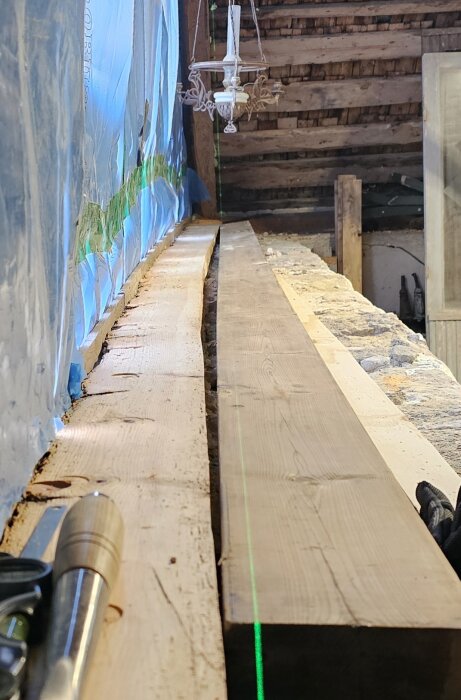
Bends can be seen in this picture where the laser can be seen touching the inner edge of the beam on both sides. The stud inside is shorter than the actual beam but is there to show the laser better.
My question is whether it's possible to straighten this beam as otherwise, it will be a bit difficult to build a relatively straight stud wall.
I was thinking of taking an angle iron that I drill several holes in and then bolt it all together. The first thing is whether it is even possible to do so and if it is, how strong an angle iron would I need to counteract the wooden beam?
Is it perhaps better to use square tubes if that would be more stable? Angle iron typically has thicker steel than square tubes, so I assume it's better.
How strong should the bolts be and how close should I place them, and should I use through bolts from the outside with nuts on the inside or use thicker French wood screws? I guess that through bolts are what's needed, but it will be more work since someone would need to stand on a ladder outside to hold on. I guess I can't use carriage bolts since I need to use substantial washers to prevent the bolts from just pushing into the wood over time. An alternative is a corresponding flat iron on the outside where I make square holes for the carriage bolts, which is an option, but the work time is likely to increase significantly.
There might also be the possibility of using a tractor with a bucket to press the wooden beam in before fixing it, but I hope that won't be necessary if the angle iron and bolts are enough to straighten the beam.
If it is not possible to straighten it, the alternative is to build the wall straight and then shave off what sticks out when I replace the outer panel later this spring, but I'm worried that this might make it too weak in width since 6-7 cm on a 15 cm beam is probably a bit too much to shave off. Plus, the 95mm stud I plan to use for the stud wall will likely protrude a bit on the inside as well.
Isn't it possible to align the beam correctly with, for example, a lever block and bolt it to the underlying wall, or is the wall too porous to bolt into?
Replace the beam if it is bad or too bent for your needs.
It's not exactly the easiest to replace it. I don't have such timber readily available as it's nearly a 7-meter long beam, and it's difficult to replace since I'm basically on my own and such a beam is very heavy. I also don't have the opportunity to take too much time as I'm trying to get things in order so that I can store more timber that is currently lying outside under a tarp, which I need to remove from the parking lot before summer.
Everything is possible, the question is whether it's worth the effort and the cost?
The cost of the material isn't too bad, just an angle iron and some bolts. The labor cost is my own time, so it doesn't cost more than the time it takes. I'm doing this in my spare time and trying to get it done as simply and efficiently as possible without compromising the structural integrity too much.
Isn't it possible to straighten the beam with, for example, a lever block and bolt it to the underlying wall, or is the wall too porous to bolt into?
Yes, I have also considered that possibility, but I am unsure if the stacked stone wall with limestone without mortar between and only plaster around it is stable enough to handle the load.
To determine if it is possible to straighten it back. Try using one or two large clamps to tension back in the middle one that is so crooked and has an internal tension in it, as it has dried and may be difficult to adjust. If you get it back, it is probably appropriate to fasten both together and anchor them to the base, with the hope that it stays in place and doesn't give way on the way out.
To determine if it's possible to straighten it back. Try using one or two large clamps to straighten a bent piece with internal tension, it's difficult to adjust once dried. If you manage to straighten it, it's probably wise to fasten both together and anchor them in the base, hoping they stay in place and don't give way.
I managed with a ratchet strap and a counterhold to bend it back to only about 2 cm curvature across the entire span. Also noted that the beam was significantly wider on one side than the other, so ultimately only about a 5 cm curvature if you follow the line the inner upper arms provided. There might be some stone underneath obstructing bending it back further, so I'll need to take a ladder outside and check if anything is in the way underneath.
So yes, it's possible to bend it back. The question now is what size angle iron might be necessary to keep it in place after releasing the ratchet strap?
I wouldn't want to fasten it to the base since it's only stacked limestone plastered on the outside (see picture above), so the force from the beam would pull the stones in the wall, which could be quite problematic.
Now you have a pull from something really tight, how much have you tightened, a little fiddle on the tension band or.
It's doubtful if you can get it in the position you want. Installing an angle iron in it probably won't hold it in place. In that case, it might be an iron that is in the style of 80 X 80 maybe. Anchoring on the inside of the wall is probably, as you say, not advisable as it's a bit loose. It might work if about 3 angle irons are attached to the wall and are long enough to go at least a meter down, then you probably get a good support with the whole wall, and then flat iron 50 X 6 is attached with an angle that hooks on the outer edge of the board and a couple of anchor screws that hold the irons in place so they don't pop up. Then the inner one can also be anchored in the flat irons. Are you following?
I have a hard time understanding how it can be so difficult to build a straight stud wall that it even comes close to the trouble of straightening the beam. Especially if you build in tensions, and it leads to movements over time? Why not just attach a horizontal stud on top?
The angle iron should be bent the other way if everything is to be straight in the end.
I would suggest that you cut notches on the inside so the beam becomes a little softer and lock it all with a plank on the top.
The angle iron should be bent the other way if everything is to be straight in the end.
I would suggest you saw notches on the inside to make the beam a bit softer and lock it all with a plank on top.
Protte
The problem that can occur with sawing notches is that they have to go far in towards the middle, and then when you tighten it up to be straight, it will crack along the grain. As mentioned, placing a piece on top is not wrong. Apparently, it is fixed at both ends and bulges outward in the middle, making it difficult to fix with a wide plank on top that will extend past the ends. You could possibly place a 45 x 150 on top and see how a panel can be attached effectively. It's a bit tricky on the outside to get it right, but perhaps move the framework for the panel outward and place a strip/rule that seals between the panel and the rule. I understand it's not enjoyable with a panel that waves at the bottom edge.
Now you have a pull from something really tight, how much have you tightened, a little violin on the tension strap or something. It's doubtful if you can get it in the position you want. Putting an angle iron in it probably won't hold it in place. If so, it will probably need to be an iron in the style of 80 X 80 maybe. Anchoring on the inside of the wall is probably, as you say, not advisable as it's a bit loose. It might work if about 3 angle irons are anchored in the wall and are long enough to go down at least a meter, then you'll probably get a good counterhold with the whole wall and then attach flat iron 50 X 6 with an angle that hooks on the edge of the board and a couple of anchor screws to hold the irons in place so they don't pop up. In that case, the inner can also be anchored in the flat irons. Do you follow?
The counterhold I had was a 95x95 post where one edge was fastened to a spacer (an old cable drum in wood) and the other side was pulled up against the ridge beam on the nearest roof truss from the gable. The tension strap wasn't quite like a violin but it was a wide one which doesn't really sound like that when it's tightened, but the post managed to hold in any case. It did become a bit bent, so the bend was temporarily transferred to that instead, essentially.
I think I understand what you mean. Perhaps take a longer flat iron that you bend so one side is at a right angle to the beam and then goes down at least a meter on the wall on the inside, kind of, then place angles on the side that goes against the beam where you then put a flat iron parallel with the beam that you use to fasten in the beam?
I find it hard to understand how it can be so difficult to build a straight stud wall that it even approaches the trouble of straightening the beam. Especially if you build in tensions, and it leads to movements in the long run? Why not just attach a horizontal stud on top?
Yes, that's an option, but the hanbjälken and the upper arms in the gable are not bent in the same way as the underarm is, which makes it a bit more difficult to build a straight wall that follows them. Then part of the underarm beam will stick out beyond the stud wall afterwards when I replace the panel on the outside. Part of the stud wall will also hang over the inside of the beam, creating a gap between the bottom of the wall and the masonry wall underneath.
Vi vill skicka notiser för ämnen du bevakar och händelser som berör dig.



pacman42 said:


