
10,970 views ·
17 replies
11k views
17 replies
Can I dismantle a chimney "stone by stone" from the top? Encased beams.
Hello good people, I continue my ever-growing renovation.
1. Can I demolish an entire chimney stack if I simply take it down stone by stone from the chimney and downward? That is, just like building it, but in reverse.
2. The floor structure is said to be embedded in some places, but I have not yet been able to see it (new floors, interior walls, built-in wardrobes, and other things have been constructed). If parts of the intermediate floor are resting on this chimney stack, is there anything preventing me from replacing the chimney stack in those places with load-bearing beams, columns, and girders of suitable dimensions and with appropriate joints?
Background, what we know:
The house is from 1929, wooden frame on a crawl space foundation, two stories.
At some point in the 70s, an extensive renovation was done. They removed all wood-fired heating and demolished a large part of the chimney stack. But not all! Because according to the gentleman who sold the house, "The builders said it was embedded in the beams." Then they put up walls and hid the remnants of the chimney stack behind them.
Now that I've demolished and fussed over it, I've been thinking about what to do with the chimney stack. In profile, it looks like in the picture. According to a roofer, the chimney is in really bad condition. How do I know it's thinnest on floor 2? Because I've measured from the outer walls to the chimney stack on two sides and noticed that the distance is longest there, and most likely narrower than the chimney in the attic. The chimney stack goes through wardrobes dividing floor 2 into two equally large rooms. I have ripped up the floors in these wardrobes and then found the ducts, now filled with gravel and brick fragments.
Why do I want to tear it down? Because even though there are many things I like about it, it's nothing I use, and I have to choose between tearing it down almost for free and gaining more space, or spending enormous sums to rebuild it and losing space (because new rules say, for example, that you cannot have wardrobes and interior walls directly against the chimney stack...).
1. Can I demolish an entire chimney stack if I simply take it down stone by stone from the chimney and downward? That is, just like building it, but in reverse.
2. The floor structure is said to be embedded in some places, but I have not yet been able to see it (new floors, interior walls, built-in wardrobes, and other things have been constructed). If parts of the intermediate floor are resting on this chimney stack, is there anything preventing me from replacing the chimney stack in those places with load-bearing beams, columns, and girders of suitable dimensions and with appropriate joints?
Background, what we know:
The house is from 1929, wooden frame on a crawl space foundation, two stories.
At some point in the 70s, an extensive renovation was done. They removed all wood-fired heating and demolished a large part of the chimney stack. But not all! Because according to the gentleman who sold the house, "The builders said it was embedded in the beams." Then they put up walls and hid the remnants of the chimney stack behind them.
Now that I've demolished and fussed over it, I've been thinking about what to do with the chimney stack. In profile, it looks like in the picture. According to a roofer, the chimney is in really bad condition. How do I know it's thinnest on floor 2? Because I've measured from the outer walls to the chimney stack on two sides and noticed that the distance is longest there, and most likely narrower than the chimney in the attic. The chimney stack goes through wardrobes dividing floor 2 into two equally large rooms. I have ripped up the floors in these wardrobes and then found the ducts, now filled with gravel and brick fragments.
Why do I want to tear it down? Because even though there are many things I like about it, it's nothing I use, and I have to choose between tearing it down almost for free and gaining more space, or spending enormous sums to rebuild it and losing space (because new rules say, for example, that you cannot have wardrobes and interior walls directly against the chimney stack...).


In the good old days, the chimney was used as support for the floor joists, perhaps even a roof truss is included. Tearing down a chimney from above is fine, and when you reach between floors 1 and 2, you'll need some creativity in figuring out what to support it with. To install bearing parts, the chimney must be removed a bit below the roof; you should then place supports underneath so it doesn't sink beyond the masonry when you continue downwards, just make sure there is something to brace against. You don't need to remove everything, just enough to get below the floor on floor 2. It depends on what you have in mind for the renovation.
You write that you need to build it up again. Why build it up if it's not being used? I can't imagine there is anyone who can complain that an unused chimney can't be enclosed with wood or other combustible materials. It just becomes a brick pillar if there is no fireplace at the bottom.
It works perfectly!torparavgrund said:
We did just that in our old house on an island in the Gothenburg archipelago.
We, the adult men, and the little boys, maybe 5-6 years old, helped out by taking down the bricks and throwing them onto a tractor trailer parked right next to the house wall.
And it wasn't a small chimney: A flue from an old stove and oven on the ground floor, and then a three-meter wide "wall" upstairs with flues between a living room and an old kitchen.
But the bricks were essentially just stacked on each other, almost all the mortar had crumbled away.
And the kids loved the job, getting to demolish without punishment

Last edited:
I phrased it unclearly. I was thinking like this: EITHER I completely tear it down and get more space + more freedom to place interior walls and such, OR I want it functional again and then it needs to be rebuilt.snuttjulle said:
This function is probably lacking in this case; from floor level on floor 2 and downwards, the flues are completely clogged with bricks, sand/gravel (crumbled and weathered mortar), and on floor 1, both openings for the channels are bricked up with bricks and generous amounts of mortar.J jonaserik said:
From floor 2, you can't see upwards towards the chimney; new ceilings have been built and insulated, so this chimney stack is unlikely to serve any ventilation function today.
Brilliant! Did you need to make any changes to the joists/roof trusses?KnockOnWood said:
It works perfectly well! We did just that in our old house on an island in the Gothenburg archipelago. We adult men, along with the little boys, maybe 5-6 years old, helped out and took down the bricks, throwing them onto a tractor trailer that was parked right next to the house wall. And it wasn't a small chimney: A flue from an old stove and oven on the ground floor, then a three-meter wide "wall" on the upper floor with flues between a living room and an old kitchen. But the bricks were mostly just stacked on each other, almost all the mortar had crumbled away. And the kids loved the job, getting to tear down and demolish without consequences
Thanks for the response! Can you elaborate a bit, what do you mean by "so it doesn’t sink outside the brickwork as you continue downward"? Do you mean setting up supports outside the brickwork?J jonaserik said:In the good old days, the chimney was used as support for the floor joists, maybe even some roof trusses are laid with it. Tearing down a chimney from above is fine, and when you get as far as between floors 1 and 2, you’ll need some creativity to support it. To install load-bearing parts, the chimney must be dismantled slightly below the roof, and you should set up supports so that it doesn’t sink outside the brickwork as you continue downward; just make sure something is holding it in place. You don’t need to remove everything, just enough to get below the floor on level 2. Of course, it depends on what you have in mind for renovations.
Like you, I’m thinking that it likely involves joists in the floor structure resting on the chimney somewhere, they have one or more support points for this. My solution, therefore, is:
- horizontally connect these joists with each other, e.g., by bolting sturdy beams on either side, and then
- provide necessary support from below, e.g., one or more "columns" (or vertical beams) of large dimensions that extend from the floor structure all the way down to proper piers cast in the crawl space foundation.
No, rather it lightened the load on the intermediate floor joists.
The wide "chimney" wall in the attic was supported by two railway tracks, which rested on the framework of the ground floor.
So a neighbor got a small, three-meter-long pretend railway to have in their garden
Then I built a modular chimney, similar to this one, for the stove on the ground floor:
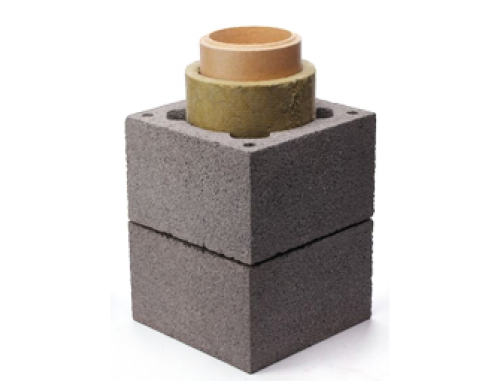
Just feel the joists when you get down to them, remove a few stones that it might be resting on and see what happens, there's no guarantee it's hanging in the air and not sagging after so many years. If it sags, you'll have to prop it outside the wall until you've removed everything and then see what's needed for reinforcement.
Thanks for the advice!J jonaserik said:Just feel the joists when you get down to them, remove some stones it might be resting on and see what happens, there's no guarantee that it's hanging in the air and not sagging after so many years. If it sags, you'll need to brace outside the wall until you've removed everything, and then see what's needed for reinforcement
Ah, interesting!No, rather lightened the load on the intermediate floor. The wide "chimney" wall in the attic was on two pieces of railway track, which rested on the lower floor's framework. So a neighbor got a small, three-meter-long pretend railway to have in their garden
If someone reads this one day, I can add how it turned out:
Everything went smoothly and was devilishly exhausting. I started on the roof and worked my way down. Once I was below the roof, I nailed a piece of OSB over the hole and put some roofing felt on top to overlap in all directions, a few pieces of battens, and tiles. This is highly temporary; the roof is to be completely replaced in 1-2 years.
Once below the roof, I continued the demolition by first building "sargar" around the chimney stack on the first floor, then I knocked out the sealed holes and cleared out gravel, etc. When the channels were free upwards, I went up into the attic and continued demolishing. It was damn incredibly hard work; dark, cramped, and the pipes clogged almost immediately, so I ended up taking down the bricks and putting all the mortar in buckets which I carefully lowered down to the floor below, then struggled my way down, emptied the buckets outside, and then climbed up again. Once below the roof to the second floor, it went faster. From a balcony, I built a "slide" from old demolition wood and filled those blue 30L plastic barrels with stone and mortar, tied a line to the barrel's handle, and could lower them down the slide and empty manually on a pile below. Once down on the first floor, I just stepped outside the front door with it. The chimney stack is now completely gone. I removed some large stones from the foundation, but the platform the chimney stood on consists of stacked natural stones the size of concrete blocks and up, so I left them. Other than that, since spring 2020, there are no traces of the chimney stack left other than that the roofs/floors are patched with new timber.
My renovation has continued throughout 2021. I still haven't done a deep cleaning since it's still a construction site. But I have vacuumed a number of times, and from somewhere that damn mortar dust still comes. It is so incredibly fine that just footsteps whip up small puffs that seem to spread across the entire room.
In hindsight, I can state that the beam structure was NOT built into the chimney stack. Rather the opposite, the chimney stack braced itself against the beam structure. Two large iron rods approximately 1.5 meters long had been embedded directly through the chimney stack (I think they are parts from a wagon, but I'm not sure), and these were fastened in notches on the top of the beam structure with loops and large nails.
This was something that delayed all other renovations by several months (I'm only there one day per weekend), surely took 60-70 hours, I often had sore wrists and back, but I would still say it was worth it. I now have almost twice as much closet space on the second floor, and on the first floor, I now have a much better layout that would not have been possible otherwise.
Everything went smoothly and was devilishly exhausting. I started on the roof and worked my way down. Once I was below the roof, I nailed a piece of OSB over the hole and put some roofing felt on top to overlap in all directions, a few pieces of battens, and tiles. This is highly temporary; the roof is to be completely replaced in 1-2 years.
Once below the roof, I continued the demolition by first building "sargar" around the chimney stack on the first floor, then I knocked out the sealed holes and cleared out gravel, etc. When the channels were free upwards, I went up into the attic and continued demolishing. It was damn incredibly hard work; dark, cramped, and the pipes clogged almost immediately, so I ended up taking down the bricks and putting all the mortar in buckets which I carefully lowered down to the floor below, then struggled my way down, emptied the buckets outside, and then climbed up again. Once below the roof to the second floor, it went faster. From a balcony, I built a "slide" from old demolition wood and filled those blue 30L plastic barrels with stone and mortar, tied a line to the barrel's handle, and could lower them down the slide and empty manually on a pile below. Once down on the first floor, I just stepped outside the front door with it. The chimney stack is now completely gone. I removed some large stones from the foundation, but the platform the chimney stood on consists of stacked natural stones the size of concrete blocks and up, so I left them. Other than that, since spring 2020, there are no traces of the chimney stack left other than that the roofs/floors are patched with new timber.
My renovation has continued throughout 2021. I still haven't done a deep cleaning since it's still a construction site. But I have vacuumed a number of times, and from somewhere that damn mortar dust still comes. It is so incredibly fine that just footsteps whip up small puffs that seem to spread across the entire room.
In hindsight, I can state that the beam structure was NOT built into the chimney stack. Rather the opposite, the chimney stack braced itself against the beam structure. Two large iron rods approximately 1.5 meters long had been embedded directly through the chimney stack (I think they are parts from a wagon, but I'm not sure), and these were fastened in notches on the top of the beam structure with loops and large nails.
This was something that delayed all other renovations by several months (I'm only there one day per weekend), surely took 60-70 hours, I often had sore wrists and back, but I would still say it was worth it. I now have almost twice as much closet space on the second floor, and on the first floor, I now have a much better layout that would not have been possible otherwise.
Last edited:
I'm facing a similar job but on a smaller scale (chimney in my cabin). What tools did you use when you demolished your chimney? It seems like it requires something with quite a bit of heft behind it.If someone reads this one day, I can add how it turned out:
Everything went smoothly but was extremely exhausting. I started on the roof and worked my way down. Once I got below the roof, I nailed a piece of OSB over the hole and put on some felt so it overlapped in all directions, a few strips of battens, and a few tiles. This is very temporary; the roof is going to be completely replaced in 1-2 years.
Once below the roof, I continued the demolition by first building "freeboards" around the chimney on floor 1, then breaking open the sealed holes and clearing out gravel, etc. When the channels were clear upwards, I went up to the attic and continued demolishing. It was incredibly exhausting; dark, cramped, and the pipes clogged almost immediately, so I ended up having to take down the bricks and put all the mortar in buckets which I cautiously lowered to the floor below, then struggled my way down, emptied the buckets outside, and then climbed up again. Once below the roof to floor 2, things went faster. From a balcony, I built a "slide" from old demolition wood and filled those blue 30L plastic barrels with stone and mortar, attached a line to the barrel's handle, and could lower them down the slide and empty manually into a pile below. Once down on floor 1, it was just a matter of stepping outside the front door with it. The chimney is now completely gone. I removed some large stones from the foundation, but the platform the chimney stood on consists of stacked natural stone in the magnitude of concrete blocks and larger, so I left them. Besides that, since spring 2020, there are no traces left of the chimney other than the ceilings/floors patched with new wood.
My renovation continued throughout 2021. I have yet to clean thoroughly since it's still a construction site. But I have vacuumed several times, and somewhere the damn mortar dust keeps coming from. It's so incredibly fine that footfalls just whip up small puffs that distribute across the whole room, it seems.
In hindsight, I can conclude that the floor structure was NOT built into the chimney. Quite the opposite, the chimney was supported by the floor structure. Two large iron bars about 1.5 meters long (I think they are parts from a cart, but I'm unsure) were embedded straight through the chimney, and these were fastened in notches in the top of the floor structure with loops and large nails.
This was something that delayed all other renovation by several months (I'm only there one day per weekend), probably took 60-70 hours, and I often had pain in wrists and back, but I would still say it was worth it. I now have almost twice as much closet space on floor 2 and on floor 1 I now have a much better floor plan that would not have been possible otherwise.