13,956 views ·
16 replies
14k views
16 replies
Can this tie beam be removed? Can all of them be removed even?
We have a 1½-story house from Modulent from the year 2000. We are in the process of furnishing the upper floor and will have a different layout than what was intended from the factory. Among other things, ceiling height up to the ridge.
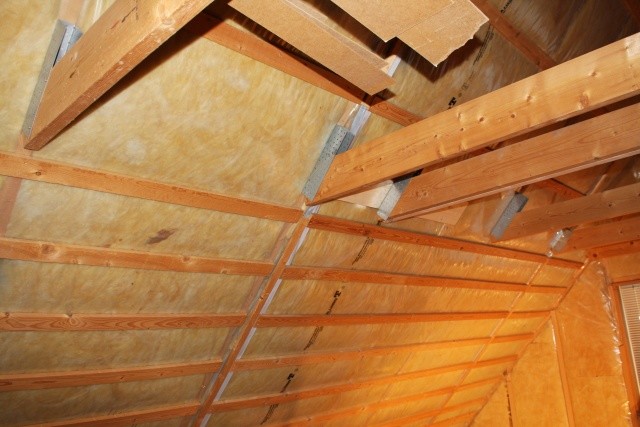
We have offset the roof beams and moved a collar tie, as well as doubled its thickness. The third one from the left in the picture. Just to make it easier to frame the wall. But, are these collar ties actually needed for anything? Are they just for attaching the ceiling and laying the attic floor on? Or are they to prevent the roof beams from sagging and are actually useful to us even if we are not going to have a ceiling on them but ceiling height up to the ridge?
It is mainly the second one from the left in the picture that we want to get rid of but preferably all if they are not of any use. The second one feels like it could be removed directly now that we have moved and doubled the thickness of an adjacent collar tie.
Grateful for a pro eye on this.
/Ola
We have offset the roof beams and moved a collar tie, as well as doubled its thickness. The third one from the left in the picture. Just to make it easier to frame the wall. But, are these collar ties actually needed for anything? Are they just for attaching the ceiling and laying the attic floor on? Or are they to prevent the roof beams from sagging and are actually useful to us even if we are not going to have a ceiling on them but ceiling height up to the ridge?
It is mainly the second one from the left in the picture that we want to get rid of but preferably all if they are not of any use. The second one feels like it could be removed directly now that we have moved and doubled the thickness of an adjacent collar tie.
Grateful for a pro eye on this.
/Ola

You cannot remove any of them. Possibly after consultation with a structural engineer.
In many constructions, the purpose of the hanbjälke is to hold the roof truss together so that they do not push out the walls of the house.
In many constructions, the purpose of the hanbjälke is to hold the roof truss together so that they do not push out the walls of the house.
Some house manufacturers construct the roofs as large panels that are sort of tilted against each other (up at the ridge) without collar beams, etc. For example, Hjältevadshus.
This applies to 1.5-story houses.
So you need to find out the house brand and check with them.
This applies to 1.5-story houses.
So you need to find out the house brand and check with them.
It is Hjältevadshus that built the house, and when it was assembled, it was precisely large blocks leaning against each other. The collar ties were added after the roof was assembled. This doesn't really say anything about their functionality, but at least it might be an idea to email Hjältevadshus and ask. Haven't even done that because it sounded like a lost cause here 
Hjältevadshus built in 2008 have no collar beams, i.e., open up to the ridge. But check just to be sure
Built a Hjältevadshus in 2000 and it has no collar beams, it's completely open up to the ridge. The roof cassettes are made of masonite beams and are attached in some sort of metal construction at the bottom and are well fastened to each other at the top (haven't checked up there but they must be connected somehow). Maybe you can check how it looks at your place. Not a professional answer but still...
Awaiting response from Hjältevadshus before I tear anything down
I'm still torn about the construction. According to the drawing, there's no metal construction at the bottom edge of the wall elements, so the collar beams here should normally prevent the roof from "splitting." At the same time, the collar beams are attached so weakly to the roof elements. Just a few measly screws a couple of centimeters into a hardboard beam. Feels rather unsteady.
Oh well, let's see if they respond at Hjältevadshus or if I'll have to abandon the idea.
I'm still torn about the construction. According to the drawing, there's no metal construction at the bottom edge of the wall elements, so the collar beams here should normally prevent the roof from "splitting." At the same time, the collar beams are attached so weakly to the roof elements. Just a few measly screws a couple of centimeters into a hardboard beam. Feels rather unsteady.
Oh well, let's see if they respond at Hjältevadshus or if I'll have to abandon the idea.
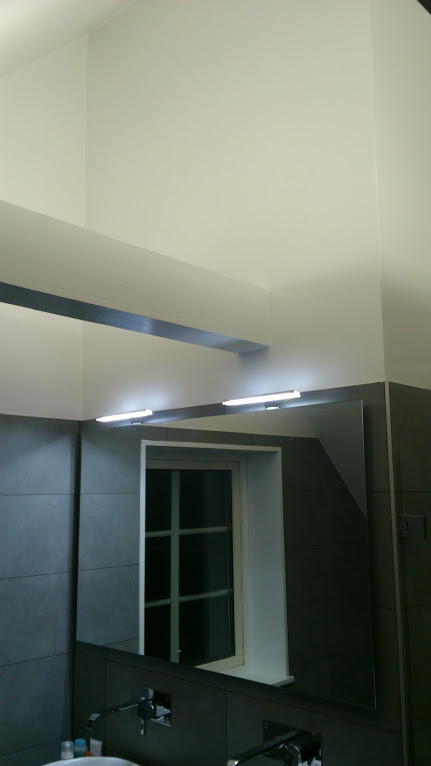
Never received an answer from the house manufacturer and didn't get any reliable answer from elsewhere either. So, the hanbjälkar were included in the design instead, and we extended them in width and embedded hidden upward fluorescent lights in them. The result was brilliant with the indirect lighting.

Upload image!