How do you handle the flooring? The shed is on stilts. The floor is insulated between the floor joists. Should you use plastic or a vapor barrier in the subfloor as well? Or only in the walls and ceiling?
Realizing now that it is not easy to create a ventilated air gap in the exterior walls. The sill is nailed on top of the floor chipboard and is directly against the wind barrier, which in turn is against the outer paneling. Should I still arrange a gap between the wind barrier/insulation and the outer paneling, even if it is not ventilated?
That sounds reasonable. Does it require cellulose-based insulation then? I already have mineral wool at home but might need to reconsider?
Then you've completely changed the conditions. Either the cabin is permanently heated, or it is not permanently heated.
If it is permanently heated, you can have good insulation, but you must ensure that it is protected from the warm indoor air that can find its way into the insulation. You also cannot negotiate with the laws of nature; the cabin must always be warmer inside than outside.
If you plan to use the cabin in such a way that it is colder inside than outside during certain periods, you cannot prevent condensation in the insulation. You need to choose a type of insulation that is not heavily affected by moisture. Cellulose is considered to have those properties. (I don't have personal experience with it.) Otherwise, there's always polystyrene.
Another approach is to use the so-called vapor retarder. This allows moisture to enter the insulation, but you hope that it will dry out later.
If the house is to remain unheated for long periods, it might be best to skip insulation altogether. Instead, build with thick wood and ensure that it is at least airtight. You would then need to spend more energy on the occasions the cabin needs to be heated, but at least you won't have to worry about the insulation molding.
The date stamp gives the earliest date when the shed could have been built, but you can't be sure that they didn't use chipboard that has been in stock for half a decade or more. Even VP pipes for electricity can be date stamped, I found such in my shed.
The date stamp gives the earliest date the shed could have been built, but you can't be sure they didn't use chipboard that had been in storage for half a decade or more. Even the PVC pipes for electricity can be date-stamped, found such in my shed.
Hasn't this post ended up in the wrong thread? I would guess it's the endless scrolling function that misled you.
The date stamp gives the earliest date when the shed could have been built, but you can't be sure they didn't use chipboard that had been sitting in storage for half a decade or more. Even VP pipes for electricity can be date stamped. I found such in my shed.
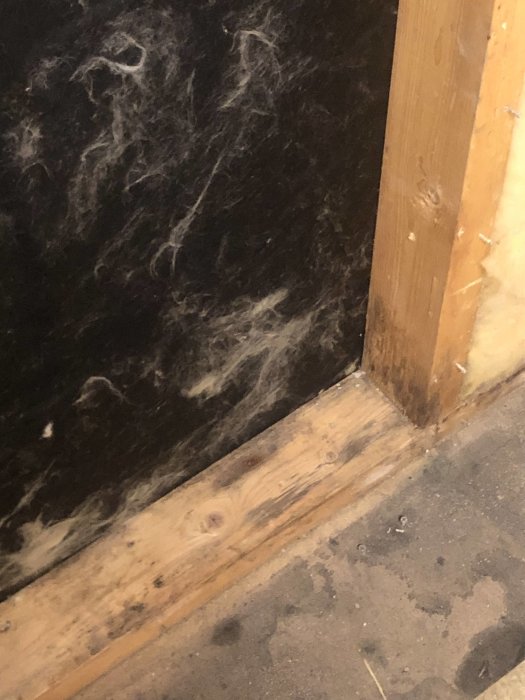
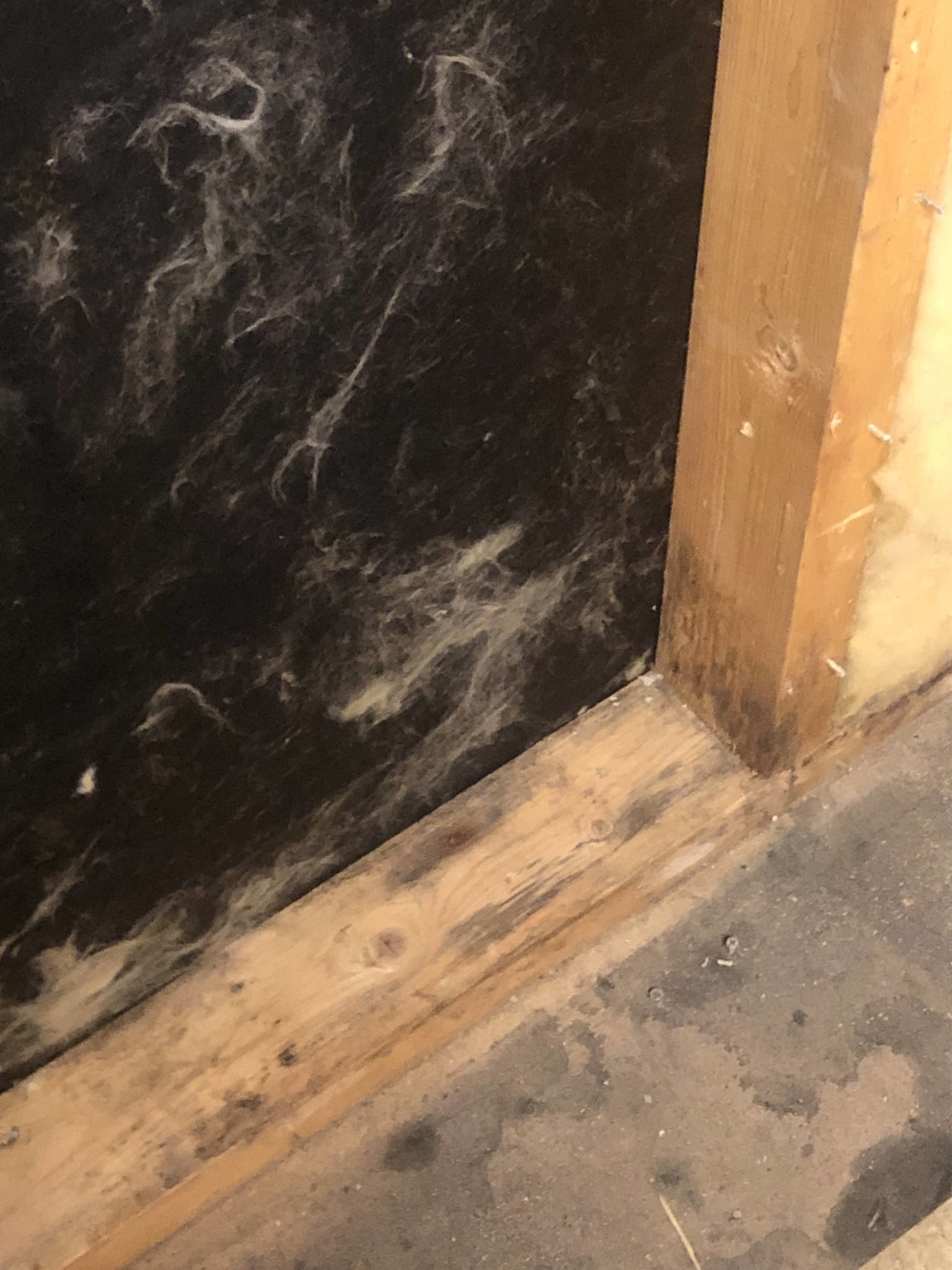
Then we can at least be sure that the black on the chipboards (which were under the plywood on the floor) is not asbestos-containing black glue.
Then you've completely changed the conditions. Either the cabin is permanently heated, or it is not.
If it's permanently heated, you can have good insulation, but you must ensure it's protected from the warm indoor air finding its way into the insulation. You also can't negotiate with the laws of nature; the cabin must always be warmer inside than outside.
If you plan to use the cabin in such a way that there are periods when it is colder inside the cabin than outside, you cannot prevent condensation in the insulation. You must then choose a type of insulation that is not greatly affected by moisture. Cellulose is considered to have those characteristics. (I have no personal experience of it.) Otherwise, there is foam plastic.
Another way is to use the so-called vapor brake. This allows moisture to enter the insulation, but you hope it will dry out later.
If the house is to be unheated for long periods, it might be just as well to disregard insulation. Build with thick wood instead and make sure it's at least airtight. Then you'll have to spend more energy heating the cabin when needed, but at least you won't have to worry about mold in the insulation.
Thanks. We aim to have the space heated for the foreseeable future. If we change our minds in the future, we'll find a suitable measure for that then (open up the walls and remove plastic).
But I'm still unsure how to solve it in the floor. According to the wooden guide's principle sketches, there is a vapor barrier in the wall but not extending over the floor in the case of an outdoor air-ventilated crawl space.
thank you. We aim to have the space heated in the foreseeable future. If we change our minds in the future, we'll find an appropriate measure for that (open up the walls and remove plastic).
But I am still unsure how we should solve it in the floor. According to the wood guide's principle sketches, there is a vapor barrier in the wall but not extending over the floor in the case of an outdoor air-ventilated crawl space.
Wouldn't it be appropriate to follow the wood guide's principle sketches?
Thanks. We aim to have the space heated in the foreseeable future. If we change our minds in the future, we'll find a suitable solution for that then (open up the walls and remove the plastic).
However, I'm still unsure about how to solve it in the floor. According to TräGuiden's principle sketches, there is a vapor barrier in the wall but not over the floor in the case of an outdoor air ventilated crawl space.
Perhaps it's assumed that the chipboard flooring is inherently diffusion tight? If so, you could just let the plastic inside the walls extend out a few centimeters and tape it to the floor.
Then it's not much more work to roll out the plastic on the floor as well, and tape the plastic from the walls to it instead.
Were you planning to lay some laminate flooring? Then you would put that impact sound insulation on top of the plastic and then lay the laminate on top of it.
Will also create a ventilated air gap in the wall by drilling holes in the sill, angled downwards through the outer panel. Will place copper mesh or mounting band over the holes in the outer panel to prevent mice from entering there. Cutting down the current windpaper and then screwing 22 mm boards at the angle between the wall stud and the outer panel, then stapling wind barrier internally on the boards so that a 22 mm ventilated air gap is obtained. I think it might be good to achieve ventilation for the wall.
We were planning to install interior panels as the surface layer in the garden shed, both on the walls and ceiling. Do we need to have some kind of board like OSb/Chipboard behind the panel? I'm thinking to stabilize the construction, or does the interior panel make the construction sufficiently rigid?
Vi vill skicka notiser för ämnen du bevakar och händelser som berör dig.

Magnus E K said: