
489 views ·
1 replies
489 views
1 replies
How to soundproof the ceiling to the apartment above
Hello!
We live in an apartment from 1910, where the house is built on a wooden framework. It's very noisy from the neighbors above, and as we are planning to renovate a room, we thought we'd try to see if we can do something about it.
The nature of the noise we experience is mainly structural noise when the people above walk around and move things (i.e., noise from the floor). Currently, there is a ceiling of white rectangular ceiling panels, and in another room, we've previously removed the ceiling and seen that there are planks above (see picture). The floor structure is about 23cm high.
We believe that a contributing reason for the noise is the lack of soundproofing/insulation in the floor structure. We are considering the following measures (from most to least important), but would appreciate input on what is worth doing and what is not ☺️
1. Tear down the plank ceiling and insulate the floor structure. We are considering using Isover stone wool boards or Huntonit wood fiber insulation, and using a slightly thicker dimension so that the floor structure doesn’t become a resonance box but dampens sound.
2. Build a floating ceiling. We think that if we can make a ceiling that isn’t mechanically directly against the floor structure but rather hangs from it, it might prevent sound from traveling through the ceiling as easily. Considering sparse panels + plaster + tongue and groove panel.
3. Install cross braces in the floor structure. I have understood that with more cross braces, the flex can decrease under load on the floor and reduce creaks, etc.
4. Try to glue the floor from underneath? This is a real long shot, but I think that if the neighbor's floor had been glued to the floor structure, it wouldn't creak as much at the base. Not sure if this is practically feasible, but it’s an idea.
What do you think, what is worth doing to solve the problem? Anything specific to keep in mind?
Of course, I will obtain permission from the housing association board before starting work!
Thanks in advance 😀
We live in an apartment from 1910, where the house is built on a wooden framework. It's very noisy from the neighbors above, and as we are planning to renovate a room, we thought we'd try to see if we can do something about it.
The nature of the noise we experience is mainly structural noise when the people above walk around and move things (i.e., noise from the floor). Currently, there is a ceiling of white rectangular ceiling panels, and in another room, we've previously removed the ceiling and seen that there are planks above (see picture). The floor structure is about 23cm high.
We believe that a contributing reason for the noise is the lack of soundproofing/insulation in the floor structure. We are considering the following measures (from most to least important), but would appreciate input on what is worth doing and what is not ☺️
1. Tear down the plank ceiling and insulate the floor structure. We are considering using Isover stone wool boards or Huntonit wood fiber insulation, and using a slightly thicker dimension so that the floor structure doesn’t become a resonance box but dampens sound.
2. Build a floating ceiling. We think that if we can make a ceiling that isn’t mechanically directly against the floor structure but rather hangs from it, it might prevent sound from traveling through the ceiling as easily. Considering sparse panels + plaster + tongue and groove panel.
3. Install cross braces in the floor structure. I have understood that with more cross braces, the flex can decrease under load on the floor and reduce creaks, etc.
4. Try to glue the floor from underneath? This is a real long shot, but I think that if the neighbor's floor had been glued to the floor structure, it wouldn't creak as much at the base. Not sure if this is practically feasible, but it’s an idea.
What do you think, what is worth doing to solve the problem? Anything specific to keep in mind?
Of course, I will obtain permission from the housing association board before starting work!
Thanks in advance 😀
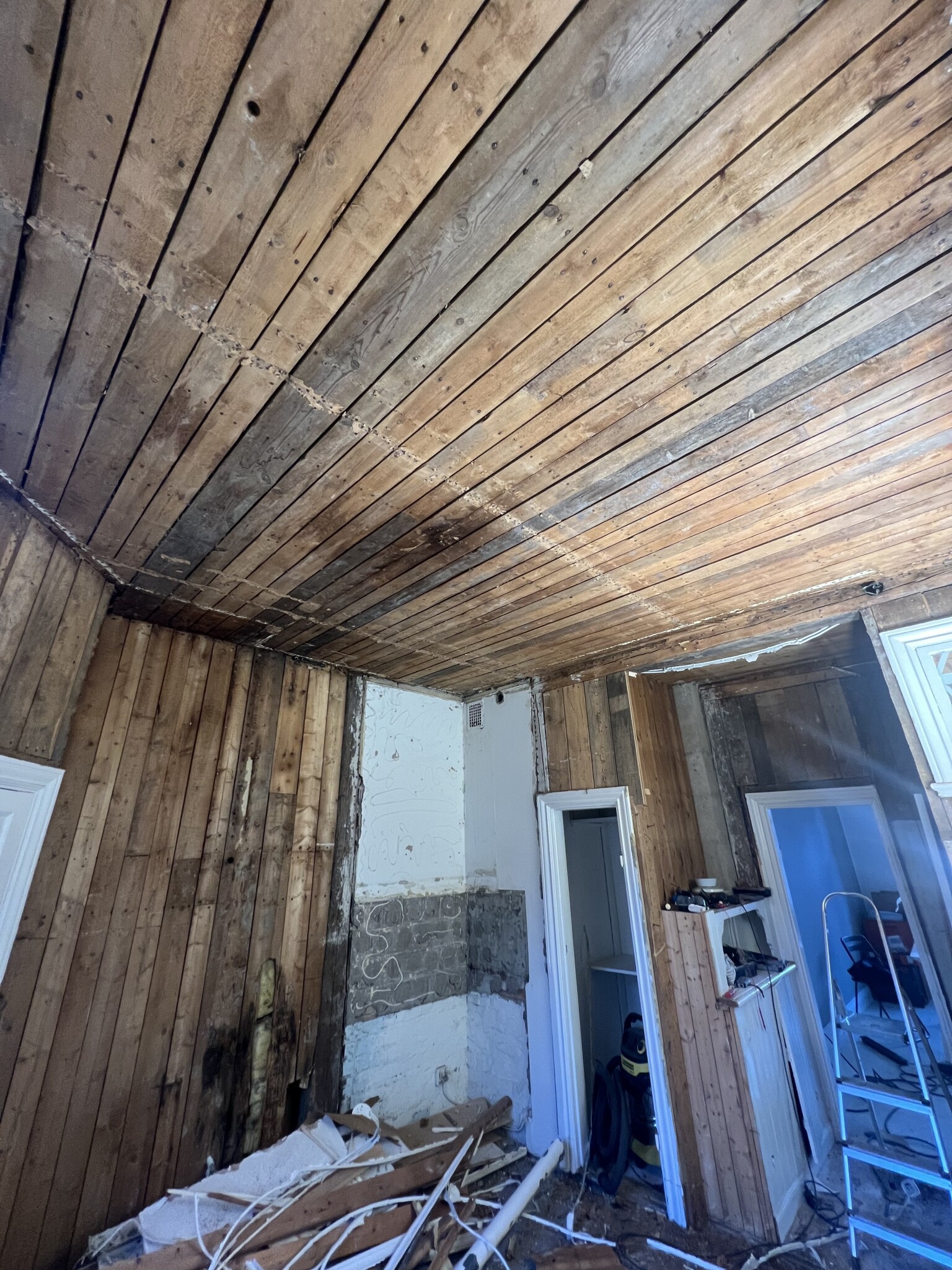
If the joists are completely "empty", it might make sense to fill the spaces between the joists with absorbent material. But you absolutely don't need to tear down the entire plank sub-ceiling. Loosen one end of a board in each space and spray in loose fill. You don't need to fill the compartments evenly or completely. An average layer of about 50-70 mm is sufficient, and you should also not significantly increase the load-bearing weight of the joist structure - see below.
Such loose "fluff" is good at damping out airborne noise in the "resonance boxes", but it is harder to do something about squeaks and impact noise, which are transmitted through the structure. For that purpose, your neighbors would actually need to install an impact sound mat under their potential upper floor or vibration-damping underlays between the joists and boards if they have only exposed the wooden floor as a visible surface (popular, but that was never the intention in these houses).
The lesser but not entirely ineffective way would be to fill the joist compartments with a heavier material, like wood shavings - but someone would really need to calculate if the joists can handle the additional self-weight. It's usually the deflection that is the determining factor, and your neighbors wouldn't be exactly thrilled about suddenly wobbly floors.
Installing noggins between the joists is likely to have a doubtful effect, and in any case, it's decidedly more work than it's worth. Three layers of gypsum directly under the wood inner ceiling would damp out frame noise better.
It is the neighbors' floor - not your potential sub-ceiling - that should be built "floating" to be of any use. A sub-ceiling - but then tightly closed against the walls, about 100 mm thick, and filled with about 50 mm mineral wool - would dampen airborne noise in much the same way as loose fill inside the joist space plus insulate impact noise a bit if built of something slightly heavy, like three layers of gypsum. But that would require more work and cause an unfortunate lowering of your likely fine ceiling height. And even in that case, you need to calculate the load-bearing capacity of the joists.
In your place, I would summarizingly, after checking the load-bearing capacity of the joists, start with injecting a 50-70 mm layer of loose fill and listen for a while. If not satisfied, then increase - as far as calculations allow - the number of heavy board layers (directly on the boards) as you finish the inner ceiling.
PS1
If the original inner ceiling was a cloisonné - i.e., plaster on mesh and reed - then it was quite a heavy and acoustically much better construction. In that case, you can apply the equivalent weight per square meter.
PS2
I haven't seen your layout and have no idea of the current spans (nor dimensions) of the joist beams. They are equally high throughout the apartment, so the margins for your experiments are determined by the span in the specific room. The shorter the span than the longest one present, the more margin to add more weight, which benefits the acoustics.
PS3
If you truly want to optimize your efforts, it might be worthwhile to invest money in asking a professional acoustician to devote some time to the problem.
Such loose "fluff" is good at damping out airborne noise in the "resonance boxes", but it is harder to do something about squeaks and impact noise, which are transmitted through the structure. For that purpose, your neighbors would actually need to install an impact sound mat under their potential upper floor or vibration-damping underlays between the joists and boards if they have only exposed the wooden floor as a visible surface (popular, but that was never the intention in these houses).
The lesser but not entirely ineffective way would be to fill the joist compartments with a heavier material, like wood shavings - but someone would really need to calculate if the joists can handle the additional self-weight. It's usually the deflection that is the determining factor, and your neighbors wouldn't be exactly thrilled about suddenly wobbly floors.
Installing noggins between the joists is likely to have a doubtful effect, and in any case, it's decidedly more work than it's worth. Three layers of gypsum directly under the wood inner ceiling would damp out frame noise better.
It is the neighbors' floor - not your potential sub-ceiling - that should be built "floating" to be of any use. A sub-ceiling - but then tightly closed against the walls, about 100 mm thick, and filled with about 50 mm mineral wool - would dampen airborne noise in much the same way as loose fill inside the joist space plus insulate impact noise a bit if built of something slightly heavy, like three layers of gypsum. But that would require more work and cause an unfortunate lowering of your likely fine ceiling height. And even in that case, you need to calculate the load-bearing capacity of the joists.
In your place, I would summarizingly, after checking the load-bearing capacity of the joists, start with injecting a 50-70 mm layer of loose fill and listen for a while. If not satisfied, then increase - as far as calculations allow - the number of heavy board layers (directly on the boards) as you finish the inner ceiling.
PS1
If the original inner ceiling was a cloisonné - i.e., plaster on mesh and reed - then it was quite a heavy and acoustically much better construction. In that case, you can apply the equivalent weight per square meter.
PS2
I haven't seen your layout and have no idea of the current spans (nor dimensions) of the joist beams. They are equally high throughout the apartment, so the margins for your experiments are determined by the span in the specific room. The shorter the span than the longest one present, the more margin to add more weight, which benefits the acoustics.
PS3
If you truly want to optimize your efforts, it might be worthwhile to invest money in asking a professional acoustician to devote some time to the problem.
Last edited:
Click here to reply