
After tearing down an interior wall in the basement, we now realize that the interior wall (insulation blocks?) is bent. How should we best brick this up? I understand that the best way is to tear down the inner blocks and do everything properly. But right now, we just want to make the smallest possible effort to make the room look okay to the average person.
What mortar should we use, and is some kind of reinforcement needed?
Grateful for any help one can get!
What mortar should we use, and is some kind of reinforcement needed?
Grateful for any help one can get!

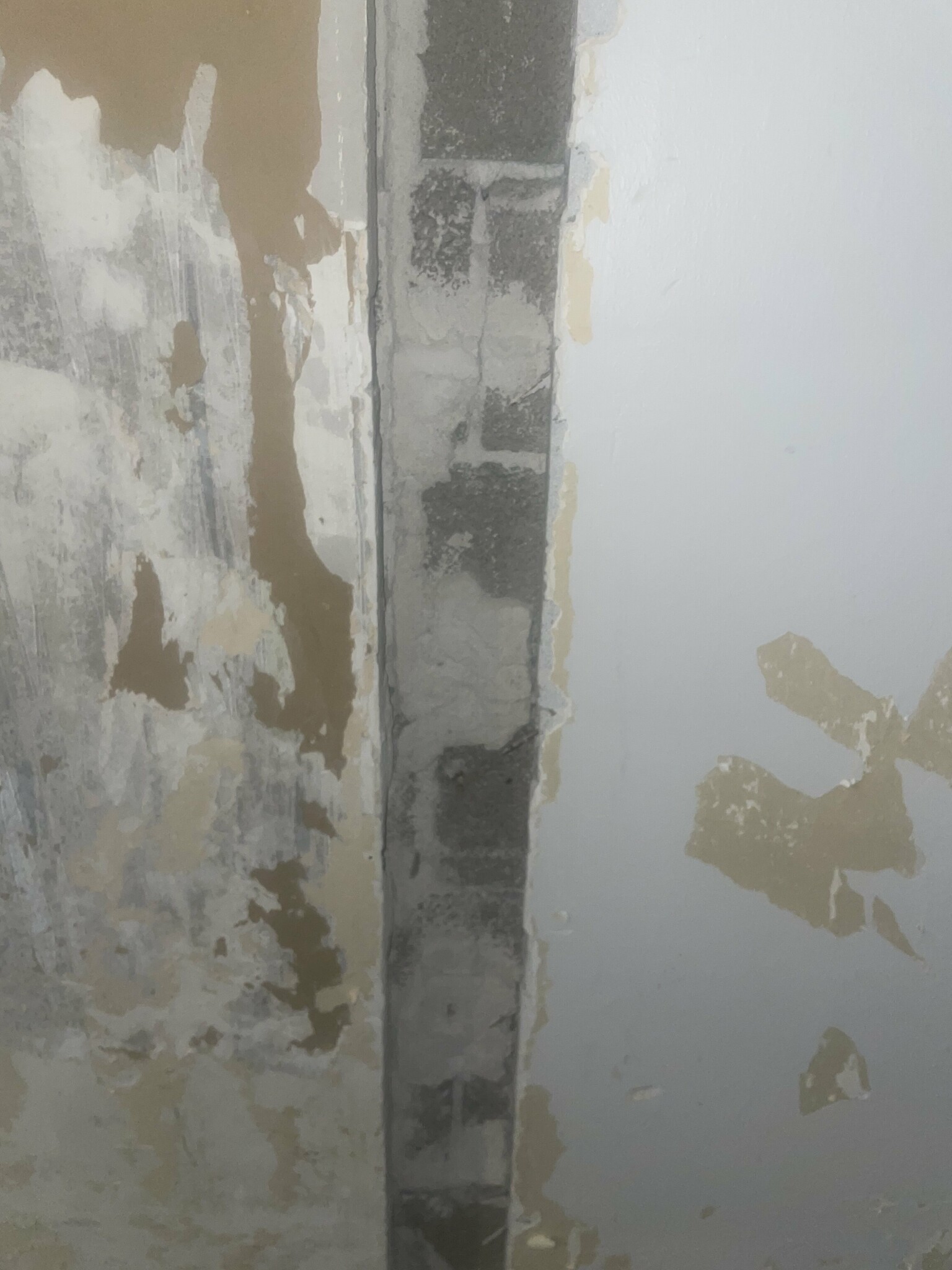

I realize that I expressed myself unclearly. The inner block of the exterior wall (I don't know what this is called) is bent. So not the actual foundation wall of the exterior wall. But yes, it's an exterior wall that now has a gap we want to brick up after demolishing the interior wall. We can't handle more big projects and need to be able to use the room as soon as possible.L Lajmen said:

Buy a bag of regular plaster C, apply it and scrape it off with a board. Adjust the surface with the trowel so that the surface resembles the rest of the wall, for example, it might be smoothed (achieved by pressing the hardening plaster with a large trowel when it has slightly set). Make sure that the edges against the damage do not stick up before you start plastering, if so, chip away what protrudes with a chisel.
EDIT: Now see in picture three that it is quite a deep cavity. Initially thought it was just a few cm. How deep exactly? Needs to be filled with something. Can 90 mm leca fit in?
EDIT: Now see in picture three that it is quite a deep cavity. Initially thought it was just a few cm. How deep exactly? Needs to be filled with something. Can 90 mm leca fit in?
Great tips above but....
When you mention a masoned basement wall, it makes me immediately think that the wall might have been load-bearing. Do you have a floor plan? Can we get an overview image of the room? Has someone with experience in load-bearing structures approved the demolition?
When you mention a masoned basement wall, it makes me immediately think that the wall might have been load-bearing. Do you have a floor plan? Can we get an overview image of the room? Has someone with experience in load-bearing structures approved the demolition?
No, the small section we demolished was not load-bearing. The fact that those inner blocks against the outer wall are curved is because the house is old and sits on poor ground. It was curved before we demolished the wall edge where there is now a hole.FreQa said:
Yes, the gap is at most 1.5-2 cm. Thanks for the tips! Appreciate it! Maybe I should plaster to a stop there first.. I don't have any leca but I do have regular mortar C.Claes Sörmland said:
Buy a bag of regular plaster mortar C, apply it and scrape/tear off with a board. Adjust the surface with the trowel so that the surface resembles the rest of the wall, for instance, it may be smoothed (achieved by pressing the setting plaster with a large trowel when it has somewhat solidified). Make sure that the edges against the damage are not sticking up before you start plastering; if so, chip away what is sticking up with a chisel.
EDIT: Now I see in the third picture that it's quite a deep cavity. I initially thought it was just a few cm. How deep exactly? Needs to be filled with something. Will 90 mm leca fit in?
Looks like there are lightweight concrete blocks built up towards the room. If you want to fill everything with mortar, my vote would probably go to gypsum plaster rather than something more cement-based, and if it's too deep to handle all at once, you can either do multiple layers or use thinner lightweight concrete blocks that can be sawed into strips with a handsaw. As long as both sides of the wall where the previous wall was are uniform, it should be possible to get it done well.
Thanks for the tip on gypsum plaster. That was my first plan. Why do you think gypsum plaster would work better than C mortar? Due to simplicity or strength?M myrstack said:Looks like there are light concrete blocks built up towards the room. If you want to fill everything with mortar, my vote would probably go to gypsum plaster rather than something more cement-based. If it's too deep to handle in one application, you might have to do multiple layers or use spacer blocks with thinner light concrete blocks, which you can saw down to strips with a handsaw. As long as both sides of the wall where the wall was previously are uniform, it should be possible to get it right.
For me, gypsum plaster is easier to work with, and for indoor use above ground, you don't need anything cement-based. Additionally, gypsum plaster from certain manufacturers often allows application in thicknesses that can completely fill gaps, whereas many cement-based products might require several coats.W Walkamile said:
Click here to reply
Similar threads
-
Hur murar jag igen ett källarfönster?
Fönster & Dörrar -
How do you brick this?
Building Materials and Construction Technology -
Någon som känner igen detta ogräs?
Trädgård allmänt -
Vad kan detta vara och hur får man egentligen bort det?
Badrum -
How do I brick up this basement window?
Building Materials and Construction Technology