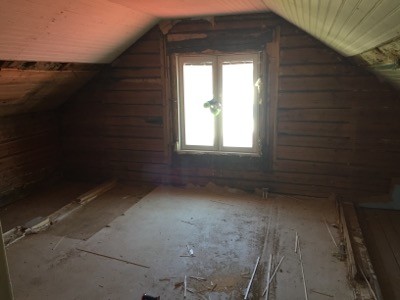
Just started tearing down in the attic to build my two little girls their own rooms.
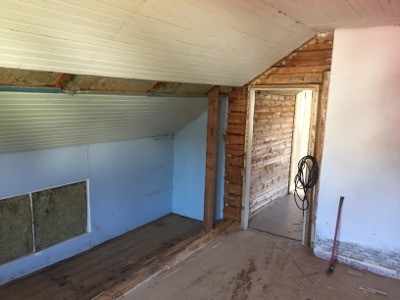
One of the rooms has two knee walls on each side. I've begun tearing into these and have some questions.
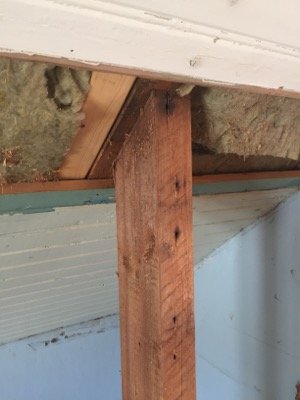
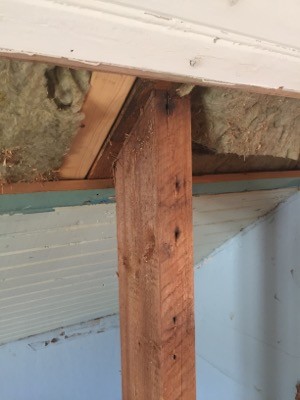
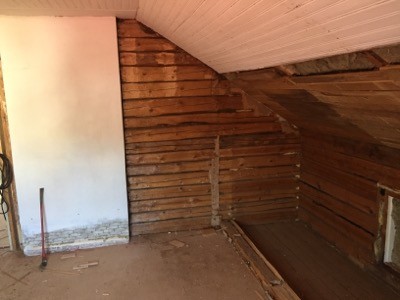
The first is whether there might be any load-bearing function in the construction. I've already removed all the studs in the wall except for one. I wouldn't say there was any significant weight on those that were nailed to the side of the rafters. The last stud, however, was embedded under the rafter. Attaching picture.
For your information, the house's roof was rebuilt a few years ago as some rafters had rotted due to a water leak. I wasn't home when it happened but can see that new studs were nailed next to/on the old ones.
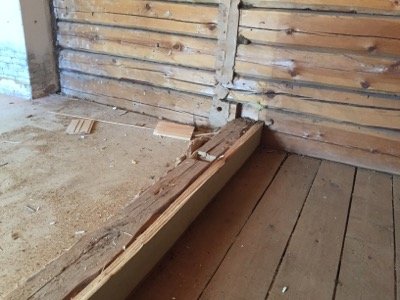
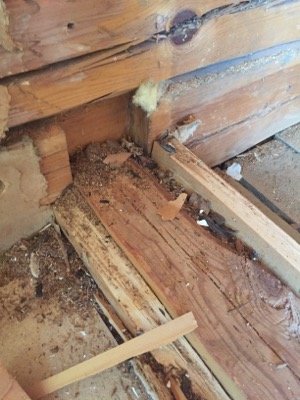
The second question is about the board the studs were resting on. It seems to be embedded in the timber walls. What function could this have?
I would preferably like to get rid of it to just screw the floor chipboard onto the old floor. But it surely has some function with the ceiling on the ground floor.
You need to provide a clearer presentation in order to understand the context. Please indicate the direction in which the different pictures are taken.
Checked the roof trusses. The old ones were 120mm high and the current ones are 2x120. So the roof should be quite a bit sturdier than before. They are placed at just over cc 60.
Then I have also found that the beam on the floor is only attached to the walls and not fastened to the floor or the ceiling of the ground floor. So it only serves some function to the old roof trusses.
So the wall to the kattvindarna has consisted of horizontal timber. (Preferably, do not use the word "regel" for wood that lies this way, as it leads to incorrect associations) Since these logs have lain perpendicular to the floor joists, it cannot be ruled out that they have had a certain load-bearing effect. Then one must consider whether the trusses have sufficient dimensions for the roof to hold anyway. To assess this, the following needs to be known: The house's width, i.e., the distance between the outer walls, the roof's pitch, where in the country the house is located (to assess snow load), the width measurement of the trusses, and the execution of the outer roof.
No, the walls to the kattvind were made of the support beam on the floor. (What you can see sticking up in the pictures.) On that stood studs 45x90 nailed to the side of the old trusses. On the studs, some kind of panel was nailed. Maybe 22x120.
The old trusses were 45x120.
When we replaced the roof a few years ago, the roofers called and told that some of the trusses were bad (kex) because the roof had leaked.
Since I wasn't home at the time, the directive to the company was to fix what was needed.
From what I can assess, they placed two 45x120 (vertically) next to the old truss. Then some masonite/board followed by an air gap of 45mm, finally 45x70 on cc 400. Covered with a metal roof.
The width of the room is about 5M, and the roof pitch is 36 degrees. I live in Norrland, so it's probably the highest snow load, but since the pitch is so steep and the roof so smooth, it doesn't collect much snow.
Spontaneously, it feels like the roof should be much sturdier now than when it was 120mm trusses.
From what I can read online, the part of the old truss I have torn down may have a function in preventing the outer wall from being pushed out at high loads.
Considering framing up a new wall with 45x120 against the log wall and screwing the vertical studs into the new rafters as well as attaching it to the log walls on the side. To stabilize the wall on which the rafters lean against the short sides.
From what I understand, your double 45x120 joists in the trusses should suffice "despite" being in Norrland. Most places in Norrland have a snow load of 3.5 kN/sqm (calculated in the horizontal plane). A roof slope of 36 degrees means you need to account for 80% snow load.
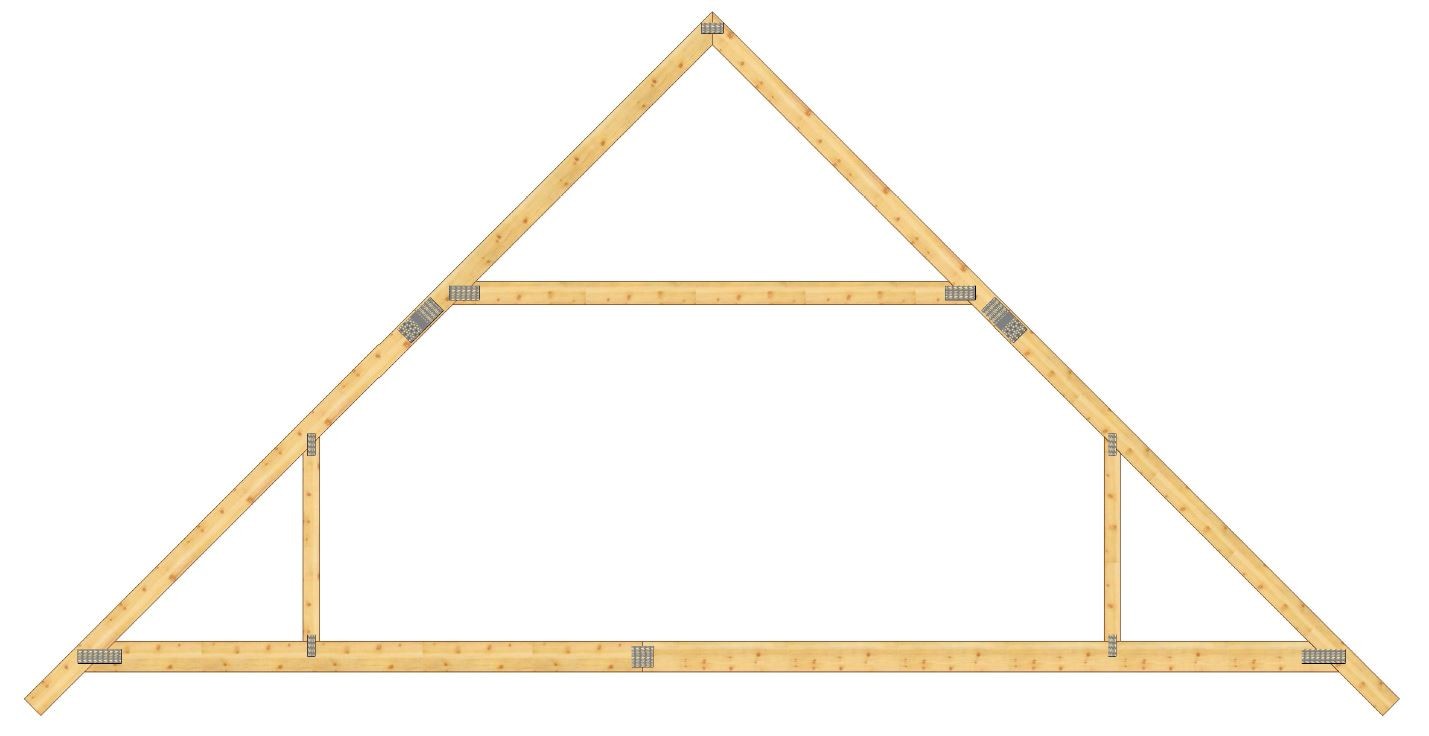
There should be no risk of the walls being pushed out since there are collar ties to prevent that.
There are many other reasons (furnishing and heating) why it's good to have kattvindar.
I have built a hundred square meters next to my 1900 house and everything is so much easier when building new than "guessing" how things work in my old house.
Something I don't quite understand is what hanbjälkarna are.
Tie beams are the horizontal beams in a roof truss that serve to prevent the exterior walls from being pushed out. They can advantageously be replaced by steel tension rods.