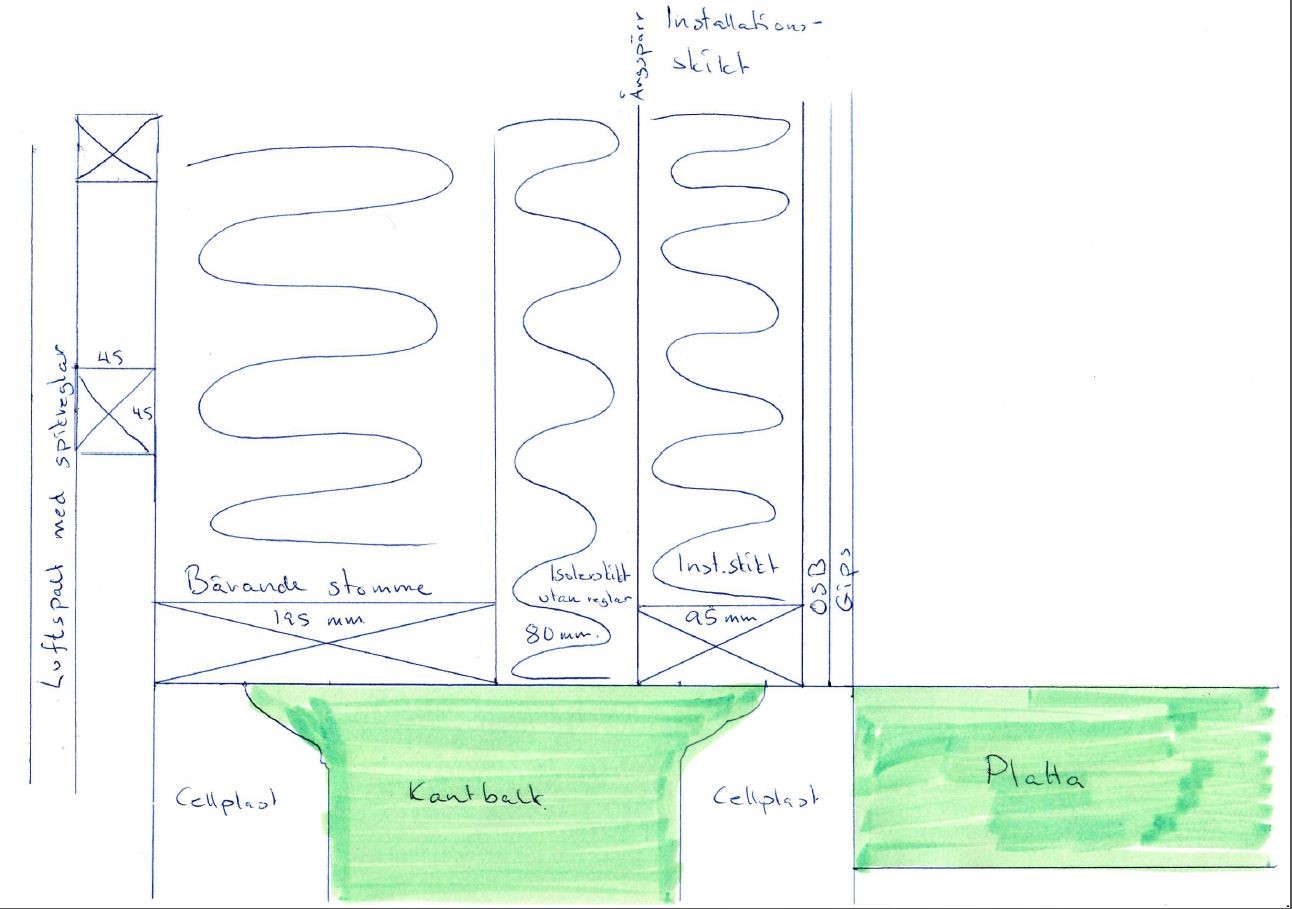
We are building a passive house and will have +400 mm insulation in the wall. The original design of a 500 mm wall inside the edge of the slab had to be revised at the last minute (the slab was made smaller due to the building committee) with the idea of letting the house hang out a little outside instead.
OSB and drywall excluded, I have 375 mm, which is too little. Therefore, I want to extend the wall outward by about 45 mm before the air gap and facade in the form of 8 mm thin fiber cement.
As I see it, there are two options.
1. A west coast board 50 mm that can go down a few cm over the edge of the slab.
2. A cross battening with 45 mm.
The west coast board is expensive and doesn't feel entirely right for me, which we've discussed in another thread. However, it creates no thermal bridge and covers nicely at the bottom, which is otherwise a known spot for cold to get in.
The cross battening is cheap, a wind barrier like Windy outside goes quickly, and feels better as weather protection during the construction period. Another plus is having more to screw/nail into when you later want to put things up on the facade (awnings etc.).
Option 2 means I blow loose-fill insulation all the way out to the wind barrier. How would you solve it at the bottom of the cross battening?
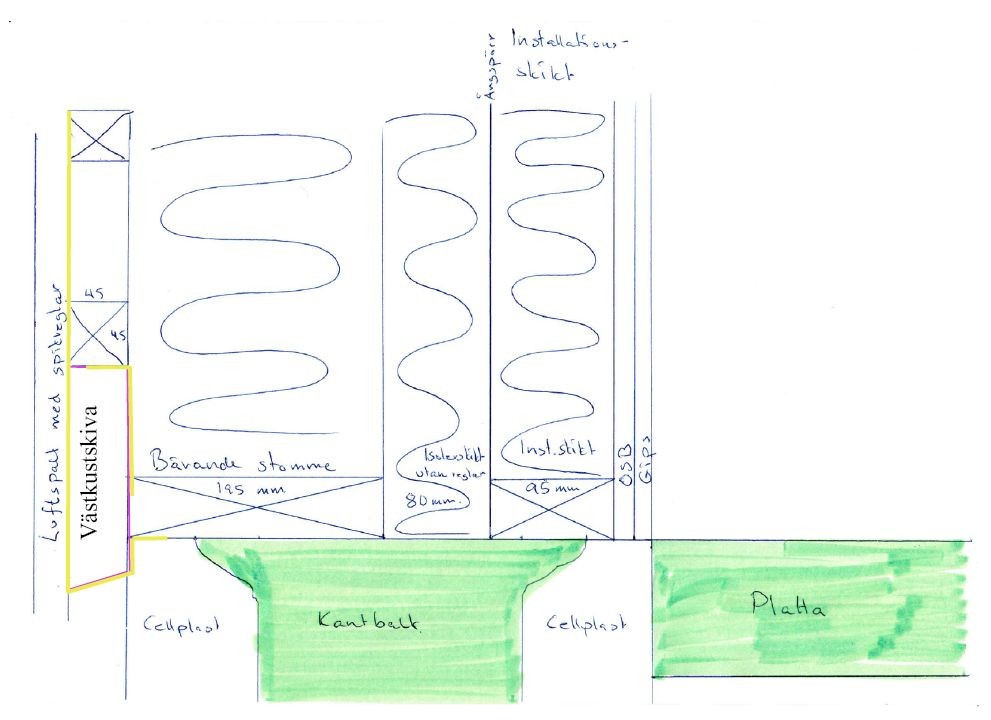
An idea that I have but am hesitant about is to let the last lying 45-rule on the outside be approximately as in the picture (a bit up) and then finish the last part with a västkustskivebit that goes down to the foundation. The Windy plastic could then go down over it and possibly turn in towards the edge.
I'm raising this thread. I know you have opinions and that you are usually not afraid to express them either, as it is evident in so many other threads...
Hello! I would probably go with cross-bracing on the outside. But I would consider a wind barrier. You mention windy, check if "isola top3" is better, I think that's the name. It’s a bit more expensive but is said to be better due to its Gore-Tex-like property.
Then there is an issue with the wind barrier: when it blows, it might move in the air gap, thus "pumping" air through the insulation, which you don’t want in a passive house. I would probably place it inside the cross-bracing you mention.
However, it won’t then provide the weather protection you want, but you’ll have to assess the importance of that for your project.
How should the vapor barrier be attached? There doesn't seem to be much to fasten it to if I understand the picture correctly.
I don't know if you're talking about the inner completely sealed one or the diffusion-open wind protection on the outside.
The outer one is installed in the horizontal 45x45 framework, and on top of that, vertical nail paneling 28x70 or similar is placed, at a fairly close distance (probably 30 cc to withstand the pressure from the eco-fiber that will be blown in).
The inner sealed plastic is placed against the interior wall studs, and inside, lots of noggings (sparse panel) at 30 cm centers are used to hold the insulation in that direction.
It will be Isola's top3 even though I don't think the differences between various wind-coverings are that decisive.
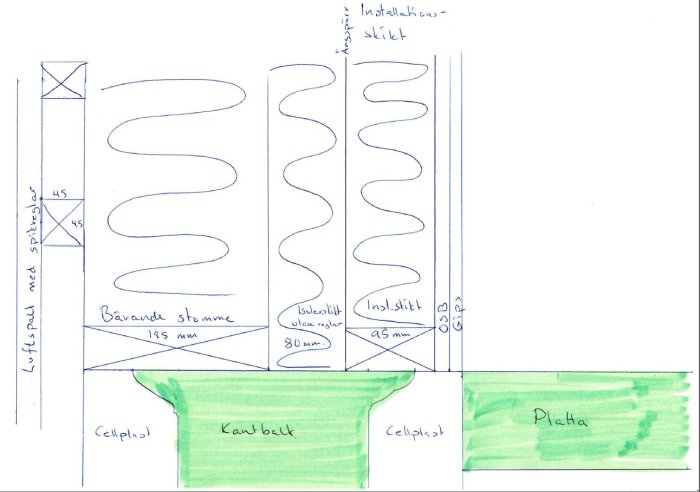
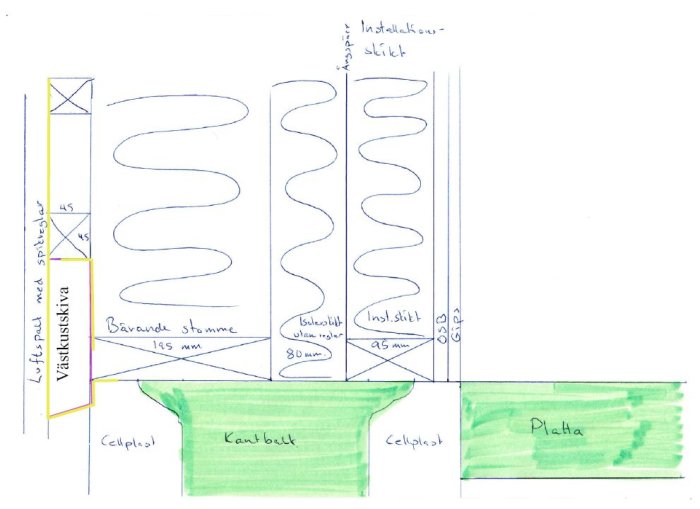
The construction will be like this:
The lowest cross brace 45x45 is set a few decimeters up from the bottom edge. Below it, a narrow strip of west coast board is placed that goes down over the concrete edge and takes care of the thermal bridge. Cut at an angle at the bottom.
The wind plastic goes down and around it.
Since I will be blowing eco-fiber, I am placing an extra small piece of Windy/top3 on the inside of the west coast board.
The facade panels of minerit go down a few cm or two below the west coast board. Voila! The perfect wall!
Spontaneously, it doesn't look very stable to place the load-bearing 195mm framework halfway outside the edge beam. A detached edge beam, as you have, becomes much more sensitive to tipping if you are not going to reinforce it together with the slab?
The edge beam and slab are reinforced together cc 80 cm with sinus iron (a type of stainless steel intended specifically for this).
Whether it is sufficient or not, I do not know, but two independent designers I have spoken to at least say that the forces from above nicely distribute diagonally downwards into the edge beam. I have also considered going up to a 220 frame, but it is VERY overdimensioned, actually I only need 170 mm.
Spontaneously, it doesn't look very stable to place the load-bearing
195mm frame halfway outside the edge beam.
A detached edge beam, like the one you have, becomes much more sensitive to tipping,
if you are not going to reinforce it together with the slab?
+1 on that!
Is it supergrunds, u-mingrund?
What does their own designer say, he (at least the one who was their designer a few years ago) was quite particular about the load needing to be centered on the edge beam.
But personally, I think the air gap should align with the minerit board on the outside of the edge elements. That is, move the sill in by the thickness of the west coast board, in your sketch.
It is Grundmäklarnas own U-elements that I have used, but the construction is probably the same regardless of the supplier. 10 cm cellplast - 20 cm kantbalk - 10 cm inner cellplast - slab
Well, I'm not going to claim that I'm sufficiently informed.
But logically, it should be significantly better to centrally place the load on the edge beam as much as possible.
However, maybe it's not so bad to have some degree of non-centering either, here I do have a complete knowledge gap...