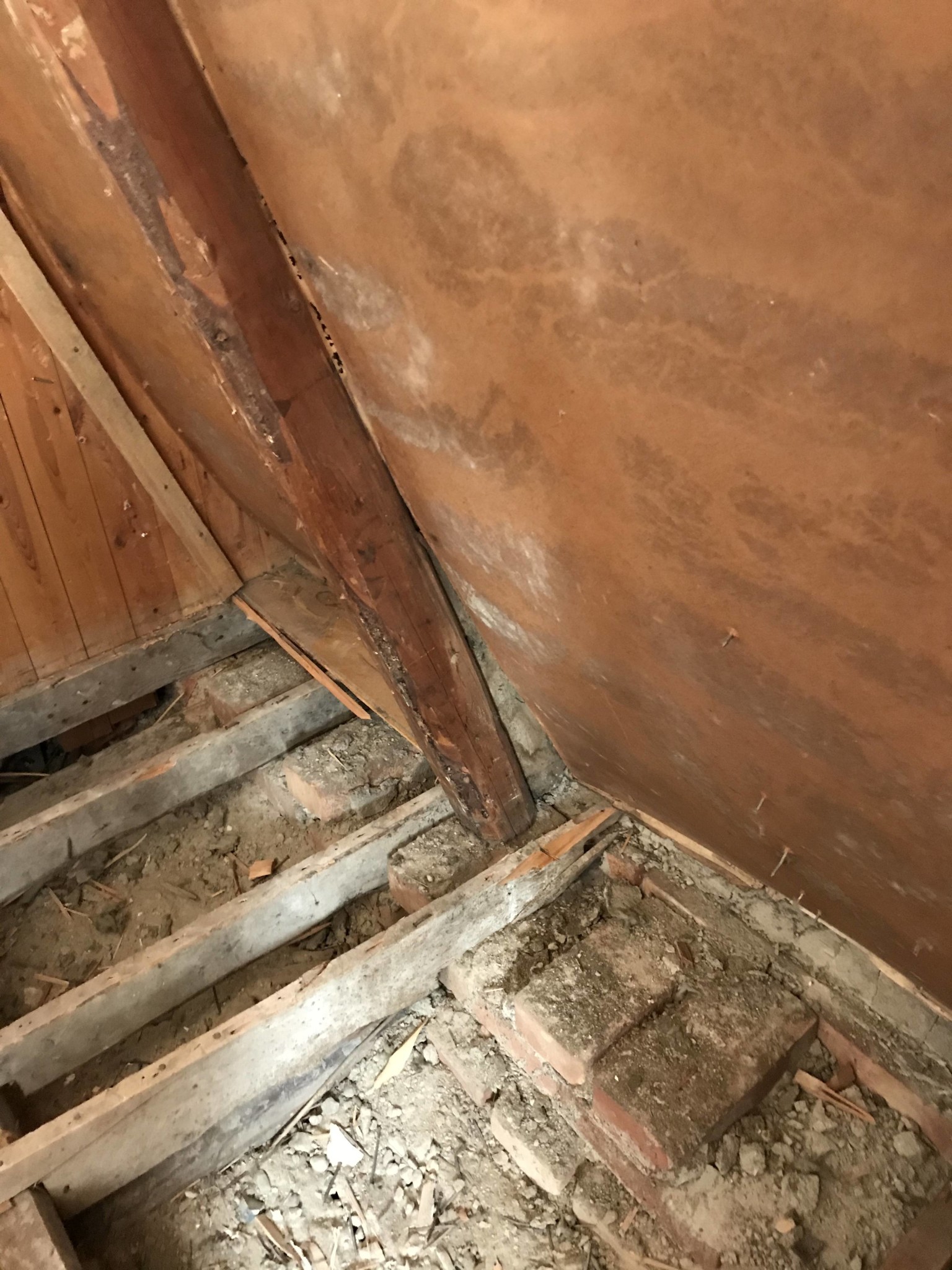
Hi, I live in a 1930s house with a mansard roof.
On the upper floor, it seems there were originally closets in the attic spaces, but previous owners have created niches in several places.
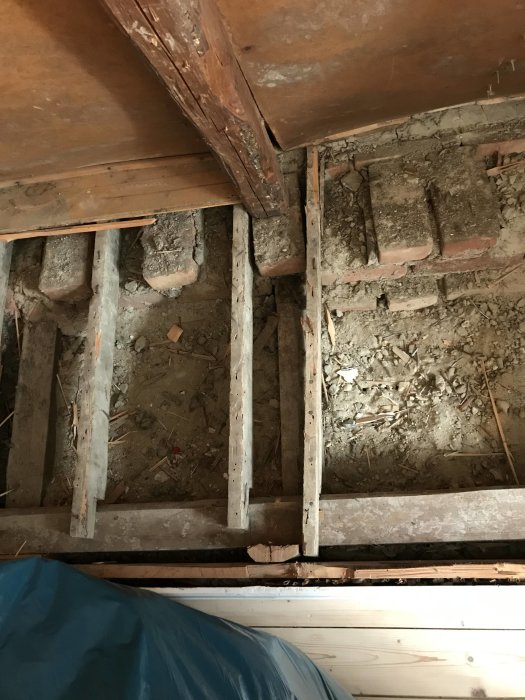
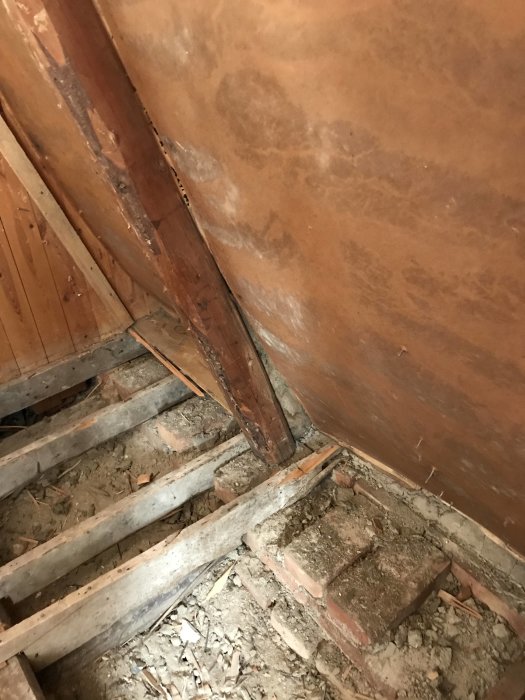
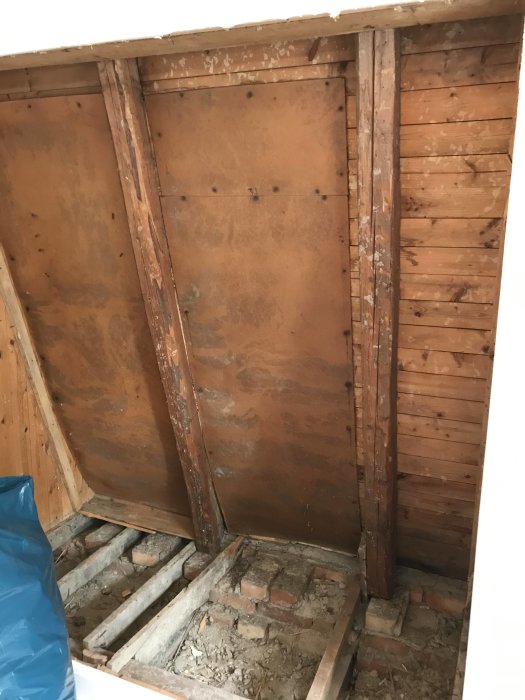
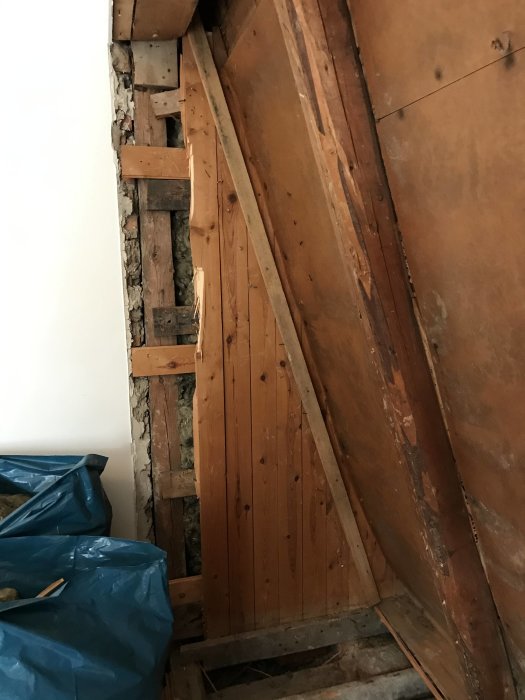
In the process of freshening up one of these niches, I have removed fiberboard, insulation, etc., and managed to uncover the original construction.
Previous owners have cut two of the vertical beams and removed support for the rafters that rest directly on the outer wall.
My plan was to lay 95mm wood wool on the bottom, sides, and between the rafters. Remove the roof boards and the thin braces on the sides and replace them with 7mm plywood clad with Rot gypsum all around. Should I reinforce anything more, or am I worrying unnecessarily? The reason we're removing the boards is to make room for a full-size bed.
Thanks - Magnus
The previous owner has therefore cut off the support legs? It shouldn't look like that. The support legs are needed both for the roof loads and for stability. In some parts of Skåne, it may only show up every ten years, but that is bad enough. Either you put the support legs back or you replace them partially with beams.
Previous owners have shortened the support legs? It shouldn't look like that. The support legs are needed for both the roof loads and for stability. In some parts of Skåne, it might only become apparent every ten years, but that's bad enough. Either you put back the support legs, or you replace them bit by bit with beams.
Thanks Justus, I live in Skåne 'luckily'. If one considers a horizontal beam between the remaining support legs (cc ~2m) What dimension should one aim for?
It is difficult to answer that straight away. You need to know some dimensions and slopes. The best thing is if you have a sectional drawing. With a 2 m span, it won't involve very large dimensions.
It's difficult to answer that right off the bat. You need to know some measurements and angles. The best thing is if you have a sectional drawing. With a 2 m span, it's not a question of very large dimensions.
Unfortunately, there are only sketch-like drawings. I believe the angle is around 25-30 degrees, beams approximately 100x100 with a center-to-center of 650-700mm. The distance from the brick wall to the beam that the supporting legs stand on is about center-to-center 800.
The width of the house, the width of the upper roof truss triangle, and the slopes of the roof sections. If the upper part slopes 25-30°, then maybe the lower part slopes 70°?
The width of the house, the width of the upper roof truss triangle, and the slopes of the roof parts. If the upper part slopes at 25-30°, then perhaps the lower part slopes at 70°?
Hi, yes, that was a bit unclear. I'll get back with better measurements once the children are asleep.
House width measurements, the width of the upper roof truss triangle, and the slopes of the roof sections. If the upper part slopes 25-30°, then perhaps the lower part slopes 70°?
Hello again. The house width is about 8m. The upper triangle should therefore be about 6m.
The angle at the bottom is 70 degrees and at the top 30 degrees.
No crossbeams in the upper construction except at the short side, see image.
Hi, checked further. There is a beam above the opening now. Horizontal 45x145. Only attached on one side and then fixed to the roof trusses. So more for stability than compressive load.
How long is the house from gable to gable? The masonry gable walls help to stabilize, otherwise, it's strange that there are no collar ties (the horizontal beams that complete the top triangle).
How long is the house, from gable to gable? The brick gable walls help to stabilize, otherwise, it's odd that there aren't any collar beams (the horizontal beams that complete the top triangle).
It's about nine meters in length. I hadn't thought about it before I took the picture. Maybe a previous owner took them down =/
The house is quite tall too, nine-ten meters, so it has probably withstood a lot during its nearly 90 years.
For a 2 m long beam between two supports, 45x195 C 24 timber should suffice. I believe three factors have contributed to the roof holding up despite the absence/removal of collar ties and supports: 1) It is located in Skåne where roof constructions are rarely subjected to possible challenges, 2) The substantial roof pitch, and 3) The brick gable walls. In the long run, it is not good to lack collar ties. These can be fairly easily replaced with steel rods. Start by placing rods on every other truss. Supports must be present on every truss. Individual supports can be replaced with transfer beams. These are not expensive or complicated measures, but it seems to be a house worth the care.
For a 2 m long beam between two support legs, 45x195 C 24 wood should suffice. I believe three circumstances have contributed to the roof surviving despite the non-existent/removed collar beams and support legs: 1) It's located in Skåne where roof structures are rarely subjected to the challenging conditions possible, 2) The significant roof pitch, and 3) The brick gable walls. In the long run, it's not good to have no collar beams. These can be fairly easily replaced with steel ties. Start by placing ties on every other rafter. Support legs must be present on each rafter. Single support legs can be replaced with lintel beams. These are not expensive or complicated measures, but it seems like a house worth the care.
Thanks for the information and tips, Justus! The house is in 'good' original condition and we are very happy with it.
I will make sure to review the collar beam situation when time allows.
How high up on the rafters can they be placed without losing their effectiveness?
Have a nice evening
Click here to reply
Vi vill skicka notiser för ämnen du bevakar och händelser som berör dig.